
October 8, 2026
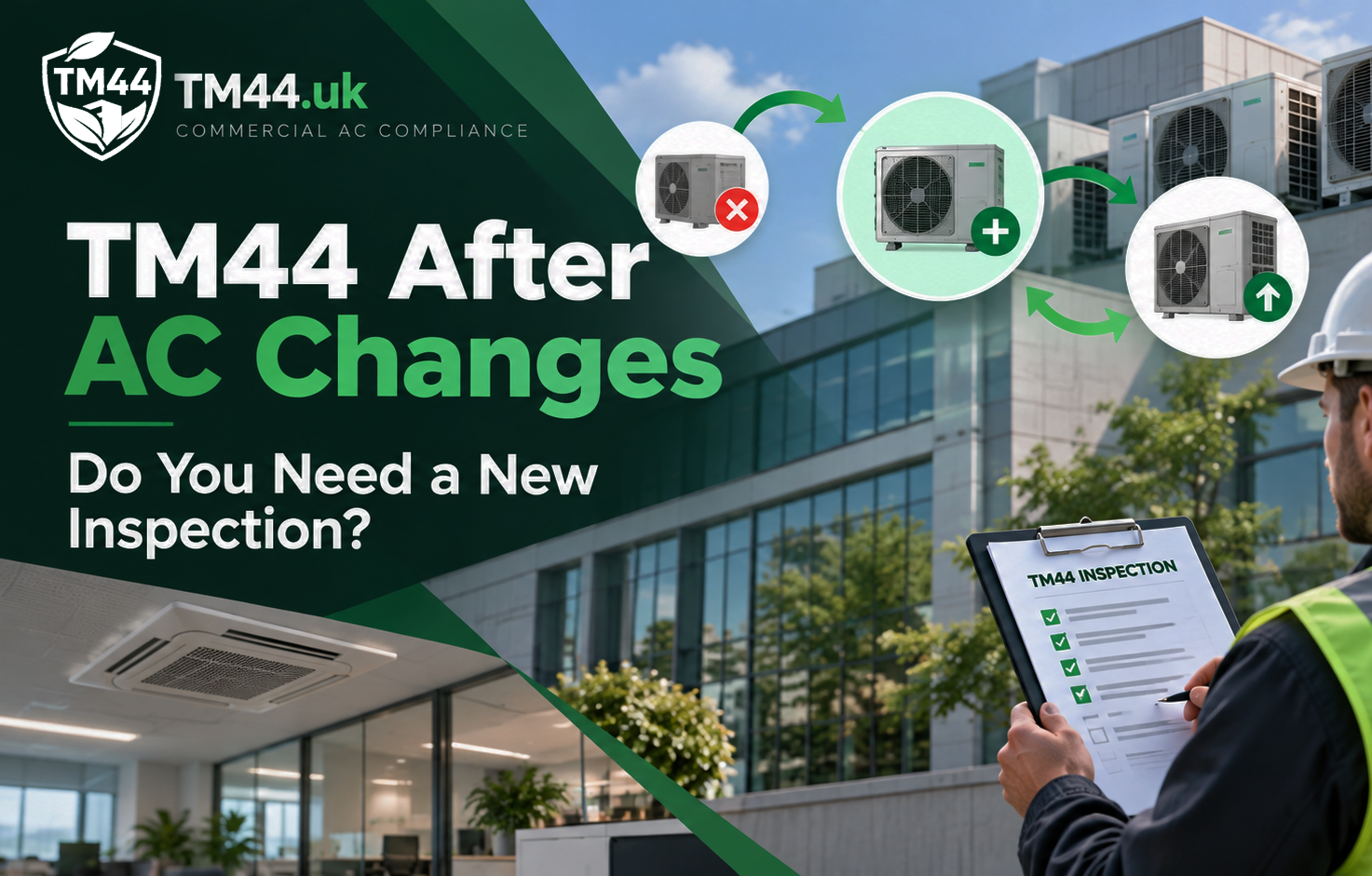
TM44 After Replacing, Extending or Removing Air Conditioning: Do You Need a New Inspection?
October 13, 2026

Written by
TM44TeamAlfa
Commercial air-conditioning systems rarely stay unchanged for five years.
A business may replace an ageing condenser. A tenant may add several split systems. A landlord may refurbish a floor and install a new VRF system. A server room may receive dedicated cooling. Old equipment may be removed, or an entire system may be replaced with newer, more efficient plant.
That creates an important compliance question:
If your air-conditioning installation changes after a TM44 inspection, does the existing report still cover the building — or should you arrange another inspection?
The answer is more nuanced than simply saying that every alteration requires a new TM44 report.
For buildings in England and Wales, air-conditioning systems with an effective rated output of more than 12kW must be inspected by an energy assessor at intervals not exceeding five years. Multiple units controlled by the same relevant person can be treated as components of one air-conditioning system when determining whether the 12kW threshold is exceeded. Legislation.gov.uk
However, air-conditioning installations can change considerably during that five-year period.
If the equipment described in your existing TM44 report no longer represents what is actually installed, simply looking at the expiry date may not give you the complete compliance picture.
This guide explains what property owners, Facilities Managers, landlords, tenants and managing agents should consider after replacing, extending or removing commercial air-conditioning equipment.
The short answer
Replacing or modifying air-conditioning equipment does not automatically mean that every existing TM44 report immediately becomes invalid or that the five-year inspection period automatically restarts.
However, significant changes can mean that the existing report no longer accurately describes the air-conditioning installation currently operating in the building.
That is particularly important where:
- additional systems have been installed;
- the building has moved from below to above the 12kW threshold;
- a large VRF or VRV installation has been replaced;
- cooling has been extended into additional floors or areas;
- tenant-installed systems have been added;
- chillers, AHUs or associated systems have changed;
- major plant has been removed;
- control arrangements have changed; or
- the system configuration is materially different from the one previously assessed.
In those circumstances, it is sensible to have the current installation reviewed by an accredited TM44 assessor rather than assuming that an older report still represents the building correctly.
If you are unsure whether your current system exceeds the statutory threshold, see our guide to the TM44 12kW threshold.
Why air-conditioning changes matter for TM44
A TM44 inspection is not simply a certificate attached permanently to a postal address.
The assessment relates to the air-conditioning system operating within the building.
Under the Energy Performance of Buildings regulations in England and Wales, systems with an effective rated output above 12kW require regular inspection. The inspection considers accessible parts of the system and must include an assessment of efficiency, system sizing in relation to the building’s cooling requirements and appropriate energy-performance advice. Legislation.gov.uk
The resulting report therefore reflects the installation assessed at that point in time.
If that installation later changes significantly, an obvious practical issue arises:
Does the lodged report still accurately describe the system that now exists?
A report showing six outdoor units when the property now contains twelve is clearly less representative than it was when originally produced.
Similarly, a report referring to an old fixed-speed system may offer limited insight into a completely new VRF installation commissioned three years later.
This does not mean that every small maintenance replacement triggers an immediate statutory inspection.
It does mean that system changes should form part of your TM44 compliance management rather than being ignored until somebody notices the discrepancy several years later.
What does the five-year rule actually require?
In England and Wales, relevant air-conditioning systems must be inspected at regular intervals not exceeding five years.
The legal duty applies to the person who has control of the operation of the qualifying air-conditioning system. Legislation.gov.uk
Government guidance also makes clear that systems consisting of multiple individual units can fall within scope even where each individual unit is below 12kW, if their combined effective rated output exceeds the threshold and they are under the relevant control arrangement. GOV.UK
That distinction matters greatly after refurbishment or extension work.
A business might begin with:
- two 5kW systems = 10kW total.
It may therefore initially sit below the threshold.
Later it installs another:
- 5kW system.
The combined effective rated output may now be approximately:
15kW.
That apparently modest extension can change the building’s TM44 position altogether.
The important question is therefore not just:
“Is our old report still within five years?”
It can also be:
“Is the system we have today the same system and capacity that the previous compliance decision was based on?”
Scenario 1: You replace one indoor or outdoor unit
Not every equipment replacement represents a major system change.
For example, an outdoor condenser may fail and be replaced with an equivalent or near-equivalent unit serving the same area.
Likewise, an indoor cassette or wall-mounted unit might be replaced because of failure while the remainder of the system remains unchanged.
In a straightforward like-for-like replacement, the practical TM44 implications may be limited.
However, you should still retain accurate documentation showing:
- equipment removed;
- new equipment model;
- cooling capacity;
- installation date;
- commissioning information;
- associated outdoor or indoor unit;
- maintenance records; and
- updated F-Gas information where applicable.
This helps the next assessor understand what changed since the previous TM44 inspection.
The less documentation available, the more work may be required during the next inspection to reconstruct the asset information.
For more on what an assessor may need, see our guide to air-conditioning asset registers and TM44 inspections.
Scenario 2: You replace an entire VRF or VRV system
This is much more significant.
Suppose a commercial office originally had:
- three old VRF outdoor modules;
- 25 indoor fan-coil units;
- conventional local controls.
During a refurbishment, the system is completely replaced with:
- new high-efficiency heat-recovery VRF equipment;
- different outdoor units;
- 32 indoor units;
- new branch controllers;
- centralised controls;
- altered zoning.
The building may still have an existing TM44 report with several years remaining before its nominal five-year date.
But technically, the installation described in that report may now be substantially different.
The equipment efficiency may be different.
The controls may be different.
The rated cooling capacity may be different.
The zoning may be different.
The system configuration may be different.
The old recommendation set may also relate to plant that no longer exists.
That is precisely the type of situation where obtaining an assessor’s advice makes sense rather than relying only on the date shown on an old report.
Scenario 3: You add new air-conditioning units
Adding equipment is one of the most important TM44 triggers to monitor.
The legal threshold is based on effective rated output, not simply the number of units.
A property could therefore have many small systems or only a few large systems and still exceed 12kW.
Government guidance specifically confirms that several individual systems below 12kW can collectively require an inspection where the combined cooling capacity exceeds the threshold under the relevant control arrangement. GOV.UK
Consider this example.
A small office originally has:
- Unit A: 3.5kW
- Unit B: 3.5kW
- Unit C: 3.5kW
Total:
10.5kW
The company then converts a meeting room and installs:
- Unit D: 5kW
New total:
15.5kW
The addition of one seemingly modest system may push the installation above the TM44 threshold.
This is why simply asking whether an individual AC unit exceeds 12kW is often the wrong question.
Read our detailed explanation of air conditioning over 12kW and TM44 requirements.
Scenario 4: A tenant installs its own air conditioning
This is one of the easiest compliance gaps to create in multi-let buildings.
The landlord may already have:
- central cooling;
- a current TM44 report;
- an established maintenance contractor;
- an asset register.
A tenant then fits additional systems serving:
- meeting rooms;
- a server room;
- a retail area;
- offices;
- kitchens;
- trading floors.
The landlord may assume the existing building-wide report covers everything.
The tenant may assume the landlord is responsible for TM44.
Neither assumption should be made automatically.
Government guidance recognises that control matters. It gives examples in which a landlord controls a central system while a tenant separately controls additional equipment installed for its own premises. GOV.UK
Responsibility therefore needs to be established based on who controls the operation of the relevant equipment.
This is particularly important during:
- lease commencement;
- tenant fit-out;
- lease assignment;
- dilapidations;
- property acquisition; and
- facilities-management handover.
We cover this issue separately in our guide to tenant-installed air conditioning and TM44 compliance risk.
For broader responsibility questions, see TM44 legal responsibility for landlords, tenants and managing agents.
Scenario 5: You remove air-conditioning equipment
Removing plant can also affect the TM44 picture.
Suppose an older office originally had:
- 65kW of installed comfort cooling.
Following refurbishment:
- half the floor is converted to naturally ventilated use;
- multiple split systems are removed;
- only 10kW of controlled cooling remains.
The current installation may now be materially different from what appears in the historic report.
Whether the remaining equipment falls outside the regulatory threshold depends on the actual system arrangement, effective rated output and control.
This should be established from evidence rather than assumed.
Good records should identify:
- what equipment was decommissioned;
- whether it was physically removed;
- remaining installed capacity;
- areas still served;
- controls;
- associated systems; and
- date of the change.
An abandoned outdoor unit sitting on a roof is not the same thing as an operating system. Conversely, equipment that staff describe as “unused” may still be connected and capable of operation.
We explain that distinction further in Unused Air Conditioning and TM44 Compliance.
Scenario 6: You refurbish a building
Refurbishment is a common source of outdated TM44 information.
A typical commercial refurbishment can involve:
- removing existing split systems;
- installing VRF or VRV;
- adding mechanical ventilation;
- relocating indoor units;
- changing cooling loads;
- installing new BMS controls;
- converting storage areas into offices;
- creating meeting rooms;
- adding IT rooms;
- changing occupancy density;
- adding kitchen cooling; or
- changing tenant areas.
Even where the building address and ownership remain unchanged, the mechanical-services arrangement may be completely different.
This is why TM44 should form part of refurbishment close-out documentation.
Your handover package should ideally contain:
- updated AC asset schedule;
- equipment model numbers;
- cooling capacities;
- commissioning documentation;
- schematics where available;
- controls information;
- O&M manuals;
- F-Gas records;
- maintenance information; and
- details of equipment removed.
For a more detailed treatment of this issue, see TM44 Risk After Commercial Refurbishment.
Scenario 7: You add dedicated server-room cooling
Server rooms are particularly easy to overlook.
A building may originally have a compliant comfort-cooling installation.
Later, additional cooling is installed for:
- server rooms;
- communication rooms;
- IT closets;
- network infrastructure;
- trading systems;
- critical equipment areas.
Those systems may be controlled differently and can operate continuously.
Whether and how they affect the TM44 scope depends on the particular installation and applicable control arrangement.
The important operational lesson is simple:
Do not assume that equipment added outside the original office AC system is irrelevant to TM44.
Record it.
Identify it.
Include it in the information provided to the assessor.
Our dedicated guide covers TM44 inspections for data centres and server rooms.
Scenario 8: You install or replace an AHU
Commercial cooling systems are not always simple split systems.
Larger buildings may contain combinations of:
- chillers;
- VRF systems;
- air-handling units;
- fan-coil units;
- heat-recovery systems;
- rooftop packaged units;
- central controls;
- mechanical ventilation.
The statutory definition of an air-conditioning system is wider than simply “the box outside”.
Government guidance describes an air-conditioning system as the combination of components required to provide air treatment where temperature is controlled or can be lowered, including systems combining this treatment with ventilation, humidity or air-cleanliness control. GOV.UK
Consequently, a substantial change to associated plant can matter when determining the appropriate assessment scope.
For a complex building, the assessor may require:
- mechanical-services schedules;
- plant schematics;
- control strategy;
- BMS information;
- AHU schedules;
- chiller information;
- commissioning data.
This is one reason TM44 pricing varies materially between apparently similar buildings.
A small office containing four split systems is fundamentally different from a corporate headquarters containing VRF, AHUs, central controls and multiple plant rooms.
Does replacing AC automatically restart the five-year TM44 period?
This is where care is required.
The legislation requires qualifying systems to be inspected at regular intervals not exceeding five years. Legislation.gov.uk
There is not a simple general provision saying:
“Every time any component is replaced, the previous TM44 date is cancelled and a new five-year cycle automatically starts.”
Therefore, businesses should avoid inventing a rule that does not exist.
The more useful approach is to distinguish between three situations.
1. Minor maintenance or like-for-like component replacement
Example:
A failed indoor cassette is replaced with an equivalent model while the overall installation remains substantially unchanged.
This would generally be treated very differently from replacing the entire air-conditioning installation.
2. Significant modification
Example:
A floor is refurbished and several additional systems are installed.
The building may still be inside its previous five-year inspection period, but the current system may no longer correspond closely with the report.
3. Complete or substantial replacement
Example:
The old central installation is removed and a new VRF system with new controls and different capacity is installed.
At that point, relying exclusively on the historical report without reviewing the changed installation becomes increasingly difficult to justify from a practical compliance-management perspective.
When changes are substantial, contact an accredited assessor and provide the existing report alongside the new plant information.
Does a new air-conditioning installation get five years before its first inspection?
For systems first put into service on or after 1 January 2008, the regulations state that the first inspection must take place within five years of the date the system was first put into service. Legislation.gov.uk
However, applying this correctly becomes more complex when new equipment is integrated into an existing building that already contains qualifying systems.
For example:
Existing system:
70kW
Existing TM44 inspection:
2024
Additional system installed:
2026 – 20kW
The compliance question should not necessarily be reduced to:
“The new 20kW equipment is new, so we can ignore it until 2031.”
The relationship between the new plant, the existing system, control responsibility and the current report needs to be understood.
This is especially true where the new plant becomes part of a larger system already subject to inspection.
For standalone new-system questions, see New Air Conditioning Installation and TM44 Inspection.
What if the existing TM44 report lists equipment that no longer exists?
This happens frequently.
A Facilities Manager obtains an old report showing:
- Outdoor Unit 1
- Outdoor Unit 2
- Outdoor Unit 3
- Outdoor Unit 4
When the current roof is inspected, only two of those systems remain.
Alternatively, six new condensers may have appeared since the report was produced.
That does not necessarily mean the original assessor made an error.
The installation may simply have changed after the assessment.
This distinction matters.
A report that was accurate when produced can become outdated because of subsequent building works.
That is different from a report containing incorrect information at the time it was produced.
If you believe your report was incorrect when issued, see our guide to TM44 report errors and corrections.
What records should you keep after changing the AC installation?
This is one of the easiest ways to improve future TM44 inspections.
Government guidance recommends retaining relevant inspection and maintenance information with the building logbook or O&M documentation. It specifically notes the usefulness of maintaining air-conditioning inspection information and other regular inspection records. GOV.UK
After replacing, extending or removing AC equipment, retain:
- updated asset register;
- manufacturer;
- model;
- serial number;
- outdoor/indoor unit relationship;
- cooling capacity;
- refrigerant type;
- commissioning date;
- decommissioning records;
- F-Gas records;
- service reports;
- control information;
- O&M manuals;
- schematics where available;
- BMS information;
- photographs of plant/data plates;
- contractor handover information;
- previous TM44 report.
This documentation can save significant time during the next inspection.
It also reduces uncertainty when obtaining quotations.
Without an asset schedule, an assessor may have to establish the installation almost entirely on site.
That can increase inspection time and cost.
See our guide explaining what we need from you for a TM44 quote.
Why maintenance records are not a substitute for TM44
Another common misconception is:
“We service our AC twice a year, so TM44 is covered.”
It is not.
TM44 air-conditioning inspections and routine maintenance serve different purposes.
Government guidance explicitly distinguishes air-conditioning energy assessments from more frequent maintenance and cleaning programmes. It also notes that F-Gas inspection requirements fall outside the scope of the Energy Performance of Buildings inspection guidance. GOV.UK
Your contractor may provide:
- servicing;
- filter cleaning;
- refrigerant checks;
- leak testing;
- repairs;
- F-Gas records;
- performance checks.
Those records are useful evidence for the TM44 assessor.
But they do not themselves replace the statutory air-conditioning inspection where one is required.
Read our comparison of PPM contracts and TM44 compliance.
You can also see our guide to TM44 vs F-Gas inspections.
Practical example: office refurbishment
Consider a four-storey office building.
At its 2024 TM44 inspection, it contained:
- 4 outdoor VRF systems;
- 30 indoor units;
- approximately 85kW total cooling;
- local controllers;
- one central controller.
The report is theoretically not due for its next regular inspection until 2029.
In 2026 the second and third floors are refurbished.
The works include:
- removing 12 indoor units;
- installing two new VRF outdoor units;
- adding 18 new indoor units;
- installing new central controls;
- adding a 7kW server-room system.
The new installation is materially different from that assessed in 2024.
The sensible action is not to blindly wait until 2029.
Instead:
- Update the AC asset register.
- Obtain the new equipment capacities.
- Retain commissioning and maintenance documentation.
- Compare the new plant with the existing TM44 report.
- Ask an accredited assessor whether the changed installation should be reassessed.
That creates a defensible compliance trail.
Practical example: restaurant refurbishment
Restaurants are another strong example.
A restaurant may already contain:
- customer-area cooling;
- kitchen cooling;
- office AC;
- heat-recovery ventilation.
A refurbishment then adds:
- additional dining capacity;
- new kitchen equipment;
- another split system;
- new ventilation plant.
Even where the new AC unit is only 5kW or 7kW, it should not automatically be considered in isolation.
Its relationship with the other controlled air-conditioning equipment matters.
Restaurants and commercial kitchens can also contain mechanical plant that is more complex than a standard office.
For sector-specific guidance, see TM44 for restaurants, pubs and commercial kitchens.
Practical example: tenant fit-out
A landlord has a central system already covered by a TM44 report.
A new tenant leases one floor and installs:
- 4 × 5kW split systems;
- 1 × 8kW server-room system.
Total tenant-installed cooling:
28kW
Those systems should not disappear from the compliance process simply because the landlord already holds a TM44 report for another installation.
Control responsibility and system scope need to be established.
This is exactly why AC information should be checked during:
- lease assignment;
- tenant fit-out approval;
- handover;
- dilapidations;
- acquisition due diligence.
See our guide to TM44 and lease assignments / tenant fit-outs.
Practical example: removing old cooling
A warehouse originally contained:
- 8 split systems;
- total capacity 42kW.
Following operational changes, six systems are removed.
The two remaining systems total approximately 10kW.
At first glance, the site may now appear below the regulatory threshold.
But this conclusion should be based on confirmed equipment information and control arrangements rather than a rough visual count.
The safest process is:
- update the plant register;
- verify actual rated output;
- document decommissioned equipment;
- review whether any other cooling systems remain;
- obtain professional advice if threshold status is uncertain.
Government guidance specifically states that where it is unclear whether the threshold is reached, installed capacity should be established through appropriate inspection, calculation and enquiries. GOV.UK
What if you cannot find the previous TM44 report?
Do not assume that no certificate exists.
You can search the official register or use our TM44 checking resources.
Start with our TM44 register checker by postcode or visit our TM44 Checker.
If an existing report is found, compare:
- address;
- certificate/report number;
- inspection date;
- listed equipment;
- cooling capacity;
- assessor details;
- current installation.
If the plant has changed significantly since that inspection, provide both the old report and the current asset information when requesting advice.
Can an assessor inspect every AC unit?
Not necessarily in the simplistic sense some building owners expect.
The scope and methodology of TM44 assessment depend on the system configuration, accessible equipment and applicable assessment methodology.
Large commercial buildings may contain dozens or even hundreds of components.
Access can also affect what can reasonably be examined.
Equipment may be located:
- on roofs;
- behind ceiling voids;
- in secure plant rooms;
- above stairwells;
- inside tenant areas;
- within restricted technical spaces.
Where information is available in advance, the inspection can be planned more effectively.
See our detailed guide: Does a TM44 Assessor Inspect Every AC Unit?.
What happens if additional plant is discovered on the inspection day?
This is another reason accurate pre-inspection information matters.
A quotation may be based on:
- 6 outdoor units;
- 30 indoor units;
- no chillers;
- no AHUs.
The assessor arrives and discovers:
- 3 additional VRF systems;
- an unreported chiller;
- multiple AHUs;
- roof-mounted heat-recovery equipment.
That can materially change:
- inspection time;
- technical scope;
- access requirements;
- reporting workload;
- price.
A professional quotation should therefore clearly define the equipment on which the fee is based.
If substantial additional plant is discovered, the assessor or inspection provider should clarify the revised scope rather than silently carrying out unlimited extra assessment work.
This is especially important on large:
- hotels;
- office buildings;
- schools;
- healthcare sites;
- retail premises;
- manufacturing facilities;
- multi-site portfolios.
How to decide whether your changed system needs attention now
Use this practical checklist.
You should consider contacting a TM44 assessor before the next scheduled renewal where:
1. The total cooling capacity has increased materially.
2. New systems may have pushed the building above 12kW.
3. A major VRF/VRV system has been replaced.
4. Several additional split systems have been installed.
5. New tenant equipment has been added.
6. The existing TM44 report’s asset list no longer resembles the current plant.
7. Significant AHUs, chillers or associated systems have changed.
8. The building has undergone a major refurbishment.
9. Control responsibility has changed.
10. You cannot confidently establish which current equipment is covered by the existing report.
That does not automatically mean a complete new inspection will always be required.
It means the change is significant enough that obtaining qualified advice is preferable to making an assumption.
A simple decision framework
Has the air-conditioning installation changed?
No
Continue managing the existing inspection cycle and keep maintenance information current.
Yes
Proceed to the next question.
Was the change minor and genuinely like-for-like?
Yes
Record the replacement properly and retain the evidence for the next inspection.
No / unsure
Proceed to the next question.
Has cooling capacity, system layout or control materially changed?
Yes
Have the existing report and current plant information reviewed.
Have new systems been added?
Calculate or confirm the current total effective rated output and consider the control arrangement.
Could the installation now exceed 12kW?
If yes or uncertain, seek assessment advice.
Does the existing report describe equipment that is no longer installed?
Update your records and have the current compliance position reviewed where the differences are substantial.
Who is responsible after equipment changes?
For England and Wales, the legal duty sits with the relevant person who has control of the operation of the qualifying air-conditioning system. Legislation.gov.uk
Depending on the property, this may be:
- building owner;
- occupier;
- tenant;
- operator;
- another party exercising operational control.
In multi-let buildings, responsibility can be divided between landlord-controlled central systems and tenant-controlled additional equipment.
Do not rely only on who pays the service charge.
Establish who actually controls the relevant system.
Our TM44 Responsibility Guide explains this in more detail.
What happens when responsibility for the system changes?
There is another important rule.
Where a new relevant person takes control of an air-conditioning system and is not given the latest inspection report, the regulations can require them to ensure an inspection is carried out within three months. Government enforcement guidance specifically highlights this obligation. GOV.UK
This can become relevant following:
- property acquisition;
- lease transfer;
- change of occupier;
- business acquisition;
- facilities-management handover.
That is why TM44 should be included in commercial property due diligence rather than treated as an isolated maintenance issue.
See our guides to:
TM44 for newly acquired commercial buildings
and
TM44 for commercial property investors and due diligence.
What should Facilities Managers do after an AC replacement project?
A good close-out process is straightforward.
Before the contractor leaves the project, obtain:
Updated asset schedule
Every current indoor and outdoor AC item should be identifiable.
Rated cooling capacities
Do not rely on approximate unit descriptions.
Equipment relationship
Know which indoor units connect to which outdoor systems where relevant.
Commissioning information
Retain commissioning records and system settings.
Controls information
Record central controllers, BMS interfaces and operating strategies.
O&M manuals
Keep manufacturer’s and installer’s documentation.
F-Gas records
Retain current refrigerant information and maintenance records where applicable.
Decommissioning information
Record what equipment has been permanently removed.
Updated drawings
Retain schematics where produced.
Existing TM44 report
Compare the old asset information with the new installation.
Once those records are assembled, determining the appropriate TM44 action becomes considerably easier.
Why this matters beyond avoiding a penalty
The government’s public guidance states that qualifying air-conditioning systems must be inspected every five years and identifies a £300 penalty for failure to secure the required inspection. GOV.UK
But compliance management should not be reduced to the penalty amount.
An outdated or poorly documented AC portfolio can create wider problems during:
- property sale;
- refinancing;
- lease negotiations;
- corporate compliance audits;
- ESG reviews;
- acquisition due diligence;
- landlord/tenant disputes;
- facilities-management transfer;
- maintenance retendering.
A current asset register and a clear TM44 compliance trail therefore have operational value beyond the inspection itself.
TM44 is not an efficiency “pass or fail”
Another misconception is that replacing air conditioning becomes necessary because the TM44 system has “failed”.
TM44 does not operate like an electrical inspection where the outcome is simply satisfactory or unsatisfactory.
The assessment considers energy efficiency, system sizing and opportunities for improvement.
Government guidance explains that recommendations can relate to faults, efficiency improvements, replacement and alternative solutions. Legislation.gov.uk
Recommendations themselves do not automatically mean a building is non-compliant.
For more detail, read:
and
TM44 Report Recommendations Explained.
Do not replace equipment just because a TM44 report recommends improvement
A TM44 recommendation may identify opportunities such as:
- improved controls;
- revised operating times;
- system maintenance;
- recommissioning;
- better zoning;
- upgrading older equipment.
That does not mean every recommendation requires immediate plant replacement.
The commercial decision should consider:
- equipment condition;
- energy consumption;
- maintenance cost;
- operational requirement;
- remaining service life;
- comfort problems;
- planned refurbishment;
- capital budget.
Our guide to repairing, recommissioning or replacing commercial air conditioning explains this distinction.
Frequently asked questions
Do I need a new TM44 inspection every time an AC unit is replaced?
Not automatically. A minor like-for-like component replacement is very different from materially altering the complete air-conditioning installation. Keep accurate records and seek assessor advice where system capacity, layout or configuration has changed substantially.
Does replacing one condenser cancel my existing TM44 report?
There is no general rule stating that replacing a single condenser automatically cancels an existing report. However, the replacement should be documented so future asset information remains accurate.
What happens if I add new air-conditioning units?
Check the combined effective rated output and control arrangement. Adding units may push an installation above the 12kW threshold or materially change a system already covered by TM44.
Can several small AC units require TM44?
Yes. Government guidance confirms that individual units below 12kW can collectively fall within scope where their combined effective rated output is above 12kW under the relevant control arrangement. GOV.UK
Does replacing an entire VRF system require a review?
It is sensible to review the TM44 position after a substantial system replacement because the existing report may describe plant, capacities and controls that no longer exist.
Does the five-year period automatically restart after replacement?
Not every equipment change automatically creates a new statutory five-year period. The appropriate position depends on the nature of the installation and change. For substantial replacement or reconfiguration, obtain advice from an accredited assessor.
What if I remove enough AC equipment to fall below 12kW?
Confirm the actual remaining capacity and control arrangement. Do not rely solely on a visual estimate or assumptions about equipment being unused.
Do F-Gas service records replace TM44?
No. Maintenance and F-Gas records are useful supporting evidence but are distinct from the statutory air-conditioning energy inspection requirements. GOV.UK
Should I update my asset register after replacing AC?
Yes. An accurate asset register makes compliance management, maintenance and future TM44 inspections much easier.
What should I send a TM44 assessor after refurbishment?
Ideally provide the existing TM44 report, updated asset register, cooling capacities, commissioning records, O&M information, F-Gas/service records, controls information and any relevant mechanical schematics.
Changed your air-conditioning system since your last TM44 inspection?
If your commercial air-conditioning equipment has been replaced, extended, removed or substantially reconfigured, you do not need to guess whether your previous report still adequately represents the installation.
Send us:
- the existing TM44 report, if available;
- current AC asset register;
- maintenance or F-Gas records;
- details of new or removed equipment;
- photographs or equipment schedules where available.
Our team can review the information, confirm the likely inspection scope and provide a quotation where a TM44 assessment is required.
You can request a TM44 quotation or use our TM44 checker to investigate an existing record.
TM44.uk provides commercial air-conditioning inspections across the UK through accredited assessors, supporting individual commercial properties and multi-site portfolios.
Key takeaway
A TM44 report should not be viewed as a document that can simply be filed away for five years regardless of what happens to the building.
Minor like-for-like maintenance and complete system replacement are not the same thing.
When cooling capacity, equipment configuration, system controls or responsibility changes materially, review the TM44 position rather than assuming the old report still tells the complete story.
The most effective compliance process is simple:
Keep the asset register current. Document plant changes. Retain the previous report. Check the 12kW threshold. Ask an accredited assessor where the installation has materially changed.
That creates a stronger compliance record and makes the next inspection faster, clearer and easier to scope.
TM44 Checker v9 Pro
Check TM44 compliance status in seconds
Search the official GOV data routes and public register fallback. If a record is missing or unclear, request a manual compliance review from TM44.uk.
Official data routesGOV fallbackCommercial buildings only
Case Studies & Success Stories Energy Efficiency & Cost Savings Guides & How-To Articles Industry News & Updates TM44 Compliance & Regulations
Related Posts
October 7, 2026
