July 22, 2026
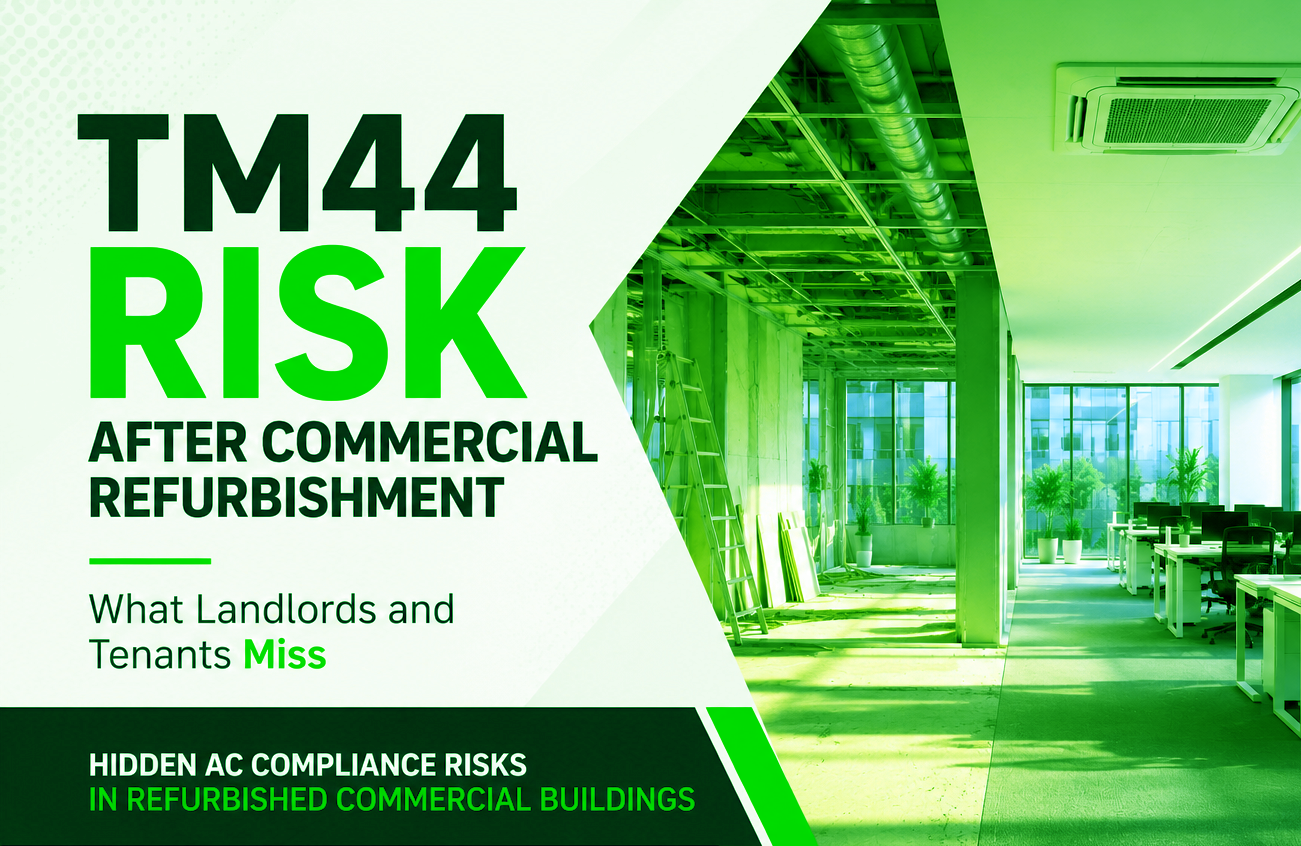
TM44 Risk After Commercial Refurbishment: What Landlords and Tenants Miss
June 2, 2026

Written by
TM44TeamAlfa
Commercial refurbishment can make a building look modern, efficient and ready for occupation. New ceilings, new lighting, new workstations, new meeting rooms and upgraded finishes can completely transform the space. But behind the visual improvement, one compliance issue is often missed: the air conditioning system.
For many commercial buildings in the UK, air conditioning is not just a comfort feature. If the combined cooling output is over 12kW, the system may require a TM44 air conditioning inspection. This is a legal energy efficiency inspection designed to assess how the system is performing, whether it is being controlled properly, and where energy may be wasted.
The problem is that refurbishment works often change the building’s cooling layout without anyone checking whether the TM44 position still makes sense.
A landlord may refurbish an office before marketing it. A tenant may complete a Cat B fit-out before moving in. A managing agent may split one large floor into smaller units. A contractor may alter the ducting, add new cassette units, disconnect old equipment, or move controls into new zones. Everyone focuses on design, cost, programme and handover, but nobody asks a simple question:
Has the air conditioning compliance position changed?
That is where hidden TM44 risk begins.
Why Commercial Refurbishment Creates TM44 Risk
Refurbishment is one of the most common points where air conditioning compliance becomes unclear. The building may already have an old TM44 certificate, but that does not automatically mean the current layout is still properly covered.
Commercial fit-outs can affect air conditioning systems in several ways:
• Existing systems may be extended to serve new rooms
• Old indoor units may be retained but no longer match the new layout
• Additional cooling may be installed for meeting rooms or server cupboards
• Controls may be changed or replaced
• Tenants may add their own supplementary AC units
• Old plant may remain physically present but no longer operational
• Asset lists may become outdated after works
• Responsibility may shift between landlord and tenant
• One building may be divided into several separately occupied spaces
This matters because TM44 compliance is based on the actual air conditioning system in the building, not just what was installed years ago or what appears on an old maintenance schedule.
If the system has changed, the compliance picture may also have changed.
For businesses unsure whether their building falls into scope, TM44.uk provides guidance through its main air conditioning inspection service page at https://tm44.uk/tm44-air-conditioning-inspections/ and its requirement guide at https://tm44.uk/tm44-inspection-requirements-uk/.
The 12kW Rule After Refurbishment
A key point many landlords and tenants misunderstand is the 12kW threshold.
TM44 does not only apply to one large air conditioning unit. Multiple smaller systems can count together if they serve the building and their combined effective rated output exceeds the threshold. This is where refurbished properties often become risky.
For example, a small office may originally have two wall-mounted split systems. After refurbishment, extra cassette units may be added to serve meeting rooms, reception areas or server spaces. Each unit may seem small on its own, but together they may push the building over the TM44 threshold.
This is especially common in:
• Refurbished offices
• Serviced office spaces
• Coworking units
• Retail-to-office conversions
• Medical and dental fit-outs
• Restaurant and hospitality refurbishments
• Commercial units split into multiple tenancies
• Mixed-use commercial buildings
• Showrooms and customer-facing premises
• Light industrial offices with staff welfare areas
If you are not sure whether your building is over the threshold, the safest step is to check the asset list, outdoor condenser details, indoor unit model numbers and cooling capacity. TM44.uk also has a dedicated checker page at https://tm44.uk/tm44-kw-checker/ to help businesses understand whether the system may fall within scope.
Why Old TM44 Reports Can Become Misleading
A TM44 report is not simply a decorative document for the compliance file. It is based on the condition, configuration and operation of the air conditioning system at the time of inspection.
After refurbishment, an old report may no longer reflect the current building.
This can happen where:
• The previous inspection covered a different floor layout
• The report refers to units that have now been removed
• New AC equipment has been added since the inspection
• System controls have changed after the fit-out
• Plant rooms, ceiling voids or rooftop access points have changed
• Tenant areas have been divided differently
• The system is now serving different occupancy levels
• Cooling demand has increased due to new equipment or people density
In practical terms, this creates a gap between the certificate and the building as it actually operates today.
That gap may not be noticed immediately. It usually appears later when someone asks for compliance evidence. This could be during a lease transaction, sale, refinancing, insurance review, facilities audit, managing agent handover, or enforcement enquiry.
At that stage, the problem becomes urgent.
A building owner may assume they are compliant because a TM44 document exists. But if the building has been materially changed, the report may not give the level of comfort they think it does.
Landlord vs Tenant: Who Should Check TM44 After Fit-Out?
One of the biggest problems after refurbishment is unclear responsibility.
In many commercial properties, the landlord owns or controls the base building services, while the tenant controls the internal fit-out. Air conditioning can sit awkwardly between the two.
For example:
• The landlord may provide central cooling or condenser infrastructure
• The tenant may install indoor units as part of their fit-out
• The landlord may retain responsibility for external plant
• The tenant may maintain internal units
• The managing agent may hold service records but not capacity data
• The M&E contractor may have commissioning documents but not compliance records
This creates confusion. The landlord may say the tenant added the units. The tenant may say the AC was part of the building. The managing agent may only have partial information. Meanwhile, the legal requirement still needs to be addressed if the system qualifies.
This is why a TM44 review should be included in the post-refurbishment compliance checklist.
TM44.uk’s responsibility guide at https://tm44.uk/news-blog/tm44-responsibility-guide/ is a useful internal page to link from this section because it explains how responsibility can fall between building owners, occupiers, landlords and managing agents.
The Hidden Problem With Cat A and Cat B Fit-Outs
Commercial refurbishment often happens in stages.
A landlord may complete a Cat A refurbishment to provide a clean, lettable shell with basic services. Then a tenant completes a Cat B fit-out with desks, partitions, meeting rooms, reception areas, IT rooms and final finishes.
The TM44 risk is that both sides may assume the other side has checked the air conditioning.
During Cat A works, the focus may be on making the property marketable. During Cat B works, the focus may be on making it operational for the tenant. But TM44 can be missed because it is not always treated as part of the fit-out design process.
This creates several risks:
• The installed cooling may exceed 12kW without being flagged
• The tenant’s layout may increase cooling load beyond the original design
• New meeting rooms may suffer poor temperature control
• Server rooms may be cooled by separate systems not included in old records
• Controls may be badly zoned, causing energy waste
• A landlord may hand over a “finished” unit without current AC compliance evidence
• A tenant may inherit a compliance issue they did not create
For high-quality commercial property management, TM44 should not be left until someone asks for a certificate. It should be checked before handover, not after occupation.
Case Study Example 1: Refurbished Office With an Outdated Asset List
A landlord refurbishes a 465 m² office floor in a London commercial building. The space is upgraded with new lighting, suspended ceilings, glass meeting rooms and fresh flooring. The landlord has an old TM44 certificate from four years ago and assumes everything is fine.
During the refurbishment, two additional ceiling cassette systems are added to serve new meeting rooms and a breakout space. The old TM44 report only listed the original systems.
When a new tenant requests compliance documents before signing the lease, the managing agent provides the old report. The tenant’s facilities consultant notices that the report does not match the current ceiling plan. Several indoor units visible during the viewing are not listed.
The result:
• The landlord has to arrange a fresh review of the AC system
• The tenant’s lease process is delayed
• The managing agent has to chase updated equipment data
• The M&E contractor has to confirm model numbers and cooling outputs
• The landlord loses credibility because the compliance file looked incomplete
This is a classic refurbishment risk. The building looked ready, but the compliance evidence did not match the final installation.
A simple TM44 check after refurbishment could have avoided the problem.
Case Study Example 2: Tenant Fit-Out Adds Cooling Above the Threshold
A tenant takes a small commercial unit for a design studio. At the start, the landlord’s information shows two small split systems. The tenant’s contractor later installs additional comfort cooling for a meeting room, podcast room and small server cupboard.
Each item looks minor in isolation. Nobody treats the project as a TM44 issue.
Six months later, the tenant’s internal health and safety consultant reviews building compliance. The combined cooling output appears to be over 12kW. The tenant asks the landlord whether there is a valid TM44 report. The landlord says the tenant added the extra units and should deal with it. The tenant says the property was leased as air-conditioned space.
Now the issue becomes contractual, operational and potentially legal.
This is common in tenant-led fit-outs. The AC system changes gradually, and the compliance trigger is missed because nobody calculates the combined cooling capacity.
TM44.uk can help avoid this by reviewing the AC information before or shortly after occupation. Businesses can request a quote through https://tm44.uk/get-quote/ and provide the unit list, property address and any available maintenance or commissioning documents.
Case Study Example 3: Office Conversion Creates Poor Zoning and Energy Waste
A commercial landlord converts a traditional office layout into a flexible coworking space. The space now includes private rooms, hot desk areas, phone booths, meeting rooms and a reception lounge.
The original air conditioning system was designed for open-plan use. After the fit-out, the same system is expected to serve smaller enclosed rooms with very different occupancy patterns.
Soon after opening, complaints begin:
• Some rooms are too cold
• Meeting rooms overheat when fully occupied
• Staff adjust controls constantly
• Units run for long hours even when rooms are empty
• Energy bills rise
• Maintenance visits increase
The problem is not only comfort. It is also efficiency.
A TM44 inspection can identify whether the system is being operated sensibly, whether controls are suitable, whether time schedules are being used properly, and whether recommendations should be considered. The inspection does not replace detailed HVAC design, but it can highlight waste, control issues and system mismatch after refurbishment.
This is why TM44 should be seen as more than a certificate. It can help expose avoidable energy waste after a commercial fit-out.
For businesses focused on energy improvement after inspection, TM44.uk also provides post-inspection energy efficiency support at https://tm44.uk/energy-efficiency-upgrade-report-post-tm44/.
What Should Be Checked After a Commercial Refurbishment?
After refurbishment, landlords, tenants and managing agents should check more than whether the AC “works”. Operational cooling is not the same as compliance clarity.
A strong post-refurbishment TM44 checklist should include:
• Full list of indoor and outdoor AC units
• Cooling capacity for each system
• Confirmation of which units are active, isolated or decommissioned
• Updated floor plans showing areas served
• Maintenance records and F-Gas information where available
• Control strategy, timers and zoning information
• Details of any newly installed or relocated systems
• Confirmation of who controls and maintains the equipment
• Previous TM44 report, if one exists
• Whether the combined system output exceeds 12kW
• Whether the existing TM44 certificate still reflects the current system
• Whether a new inspection should be booked
If you do not have a complete asset list, that does not mean you should ignore the issue. It simply means the first step is to gather enough information to quote and plan the inspection. TM44.uk explains this process clearly on https://tm44.uk/news-blog/what-we-need-from-you-for-a-tm44-quote/.
Why Managing Agents Should Care
Managing agents are often the people caught in the middle.
They may not have designed the refurbishment, installed the AC system or signed the lease, but they are often asked to provide compliance documents when a tenant, landlord, solicitor or buyer requests them.
For managing agents, the risk is not only the fine. It is the operational pressure caused by incomplete compliance records.
A missing or outdated TM44 report can create:
• Tenant complaints
• Delays during lease assignment
• Problems during property sale
• Extra admin during compliance audits
• Confusion over landlord and tenant responsibilities
• Emergency requests for inspection evidence
• Disputes over who should pay for the inspection
• Poor confidence from asset owners
This is why TM44 should be added to the managing agent’s refurbishment and handover checklist. It is much easier to confirm compliance while contractors, drawings and commissioning information are still available than to investigate the system months later.
TM44.uk provides support for managing agents and property portfolios through its portfolio management service at https://tm44.uk/tm44-portfolio-management/.
Why Commercial Property Owners Should Care
For commercial property owners, a refurbishment is usually intended to increase rental value, reduce vacancy time and improve marketability. A weak compliance file can undermine that.
A tenant may love the space but still ask:
• Is there a valid TM44 certificate?
• Who is responsible for AC compliance?
• Is the system over 12kW?
• When was the last inspection?
• Has the report been lodged correctly?
• Does the certificate match the current layout?
• Are there recommendations that could affect running costs?
If the landlord cannot answer those questions, the property can look poorly managed.
This is especially important for higher-value commercial spaces, multi-let offices, refurbished floors, mixed-use buildings and properties being prepared for sale or lease.
TM44 compliance should be treated as part of commercial asset protection. It helps demonstrate that the building has not only been improved cosmetically, but also checked from an operational and energy compliance perspective.
TM44 and Commercial Property Transactions
TM44 issues often appear at exactly the wrong time: when a deal is already moving.
This may include:
• Sale due diligence
• Lease renewal
• New tenant occupation
• Refinance
• Insurance review
• Asset management audit
• Managing agent changeover
• Compliance review by a facilities team
• Local authority request
At this stage, nobody wants delays. But if the AC information is incomplete, the inspection may take longer to quote, book and complete.
A proactive approach is stronger. Before marketing or handing over a refurbished property, check whether the TM44 position is clear. If the system is over 12kW and no valid inspection is in place, arrange the inspection early.
TM44.uk has a dedicated article on TM44 before selling or leasing commercial property at https://tm44.uk/news-blog/tm44-inspection-before-selling-or-leasing-commercial-property/. This is a natural internal link for readers preparing a building for transaction.
TM44 Is Not the Same as AC Maintenance
One dangerous assumption is that regular AC servicing means TM44 is already covered.
It does not.
AC maintenance and F-Gas checks are important, but they are not the same as a TM44 air conditioning energy inspection. Maintenance usually focuses on keeping equipment working safely and reliably. TM44 focuses on energy performance, system control, sizing, operation and recommendations.
A building may have:
• Regular maintenance visits
• Clean filters
• F-Gas records
• Engineer call-out history
• Working indoor units
• A functioning thermostat
But still not have a valid TM44 inspection report.
This is why refurbished buildings need a clear distinction between maintenance records and compliance evidence. Both matter, but one does not automatically replace the other.
TM44.uk covers F-Gas-related compliance support at https://tm44.uk/f-gas-leak-testing-compliance-checks/, but where the building falls under TM44 requirements, an accredited TM44 inspection may still be needed.
Why Refurbished Buildings Can Waste More Energy Than Expected
A refurbished office may look efficient, but energy performance depends on how systems operate in real life.
After refurbishment, cooling systems can become inefficient because:
• Old AC equipment is reused in a new layout
• Controls are not matched to new rooms
• Occupancy levels increase
• Meeting rooms have higher heat gains
• IT equipment adds extra cooling demand
• Tenants run systems outside normal hours
• Heating and cooling operate against each other
• Timers are not set correctly
• Units are oversized or undersized for the new layout
• Staff override controls because comfort is poor
This can increase electricity bills and reduce comfort. It can also damage the perception of the refurbishment because tenants do not judge a building only by how it looks. They judge it by how it feels and how expensive it is to operate.
A good TM44 inspection can highlight obvious efficiency problems and provide recommendations that help owners and occupiers make better decisions.
When Should You Book a TM44 Inspection After Refurbishment?
The best time to check TM44 is after the AC system configuration is known, but before the compliance file is finalised.
In practical terms, this may be:
• Before lease handover
• Before tenant occupation
• Shortly after AC commissioning
• Before marketing a refurbished commercial unit
• Before selling a commercial property
• When updating the building compliance file
• After adding new AC equipment
• After splitting a floor into multiple units
• After converting retail, office or leisure space
• When an old TM44 report no longer matches the current system
If the system is already occupied and you are unsure, do not wait for a solicitor, tenant or enforcement enquiry to raise the issue. Check it now.
TM44.uk can review the available information and advise what is needed to provide a quote. The enquiry route is simple through https://tm44.uk/get-quote/.
What Information Do We Need to Quote?
For a fast and accurate quote, send as much of the following as possible:
• Full property address
• Type of building or space
• Approximate floor area
• Number of indoor AC units
• Number of outdoor condenser units
• Make and model numbers, if available
• Any asset list or F-Gas register
• Whether units are split systems, VRF, VRV, cassette, ducted or chiller-based
• Whether the site is occupied, vacant or under refurbishment
• Access details and parking information
• Preferred inspection dates
• Any deadline linked to lease, sale, handover or audit
Do not worry if you do not have everything. Many clients contact us with incomplete information, especially after refurbishment. We can still advise the next practical step.
How TM44.uk Helps Refurbished Commercial Buildings
TM44.uk supports landlords, tenants, managing agents, facilities managers, contractors and commercial property owners across the UK.
Our service is built for real-world commercial situations where the information is not always perfect. We regularly deal with buildings where AC records are incomplete, asset lists are missing, old reports are unclear, or responsibility is split between multiple parties.
We can help with:
• TM44 air conditioning inspections
• TM44 certificates and government lodgement
• AC system compliance checks
• 12kW threshold reviews
• Multi-site and portfolio TM44 planning
• Emergency TM44 inspections where a deadline exists
• Support for landlords and managing agents
• Guidance where asset lists are incomplete
• Post-inspection energy efficiency recommendations
• Coordination with site contacts and facilities teams
Our aim is not just to issue a report. It is to help you understand what needs to happen, what information is required, and how to move the compliance issue forward without unnecessary delay.
For urgent projects, see our emergency inspection page at https://tm44.uk/emergency-tm44-24-48-hour-service/. For standard bookings, start with https://tm44.uk/get-quote/.
Practical Post-Refurbishment TM44 Checklist
Before signing off a refurbished commercial building, ask these questions:
• Has any air conditioning equipment been added, removed or relocated?
• Has the layout changed since the last TM44 inspection?
• Is the combined cooling capacity over 12kW?
• Is there a valid TM44 report for the current system?
• Does the report match the current floor layout and equipment list?
• Are there tenant-installed systems that need to be included?
• Are any systems decommissioned but still listed?
• Who is responsible for arranging inspection: landlord, tenant or managing agent?
• Are maintenance records being confused with TM44 compliance?
• Is the report needed for lease, sale, insurance, audit or handover?
If several of these questions cannot be answered, the building needs a compliance review.
Final Word: A Refurbished Building Is Not Automatically a Compliant Building
A commercial refurbishment can increase value, improve appearance and attract better tenants. But a polished office, shop, clinic or commercial unit can still have a hidden compliance gap if the air conditioning system has not been checked properly.
TM44 risk often appears where buildings have changed but records have not caught up.
That is why landlords, tenants and managing agents should treat TM44 as part of the refurbishment process, not an afterthought. If AC systems have been altered, extended, reused or inherited, the compliance position should be checked before it becomes urgent.
TM44.uk can help you confirm whether your refurbished commercial building needs a TM44 inspection, what information is required, and how quickly the inspection can be arranged.
To get started, visit https://tm44.uk/get-quote/ and send us the property details, AC information and any available asset list. If your refurbishment, lease handover or commercial property transaction is time-sensitive, our team can advise the fastest route to move the compliance process forward.
TM44 Refurbishment FAQs
TM44 Risk After Commercial Refurbishment
Key answers for landlords, tenants, managing agents and commercial property owners dealing with office fit-outs, commercial refurbishments, conversions and lease handovers.
Does a refurbished commercial building need a new TM44 inspection?
A refurbished commercial building may need a new TM44 inspection if the air conditioning system has changed, the layout has been altered, new cooling equipment has been added, or the existing TM44 report no longer reflects the current system. If the combined cooling output is over 12kW, the compliance position should be checked after refurbishment.
Can an old TM44 certificate still be valid after an office fit-out?
It may still be valid by date, but it may not properly reflect the current building if the office fit-out changed the air conditioning layout, added new indoor units, altered controls, created new zones or changed how the space is occupied. A certificate should match the actual system in use, not only the previous layout.
Who is responsible for TM44 after a tenant fit-out?
Responsibility depends on the lease, who controls the air conditioning system, and who is responsible for the building services. Landlords, tenants and managing agents should clarify this early, especially where the landlord provides base building cooling and the tenant adds or modifies internal AC units.
Does TM44 apply if each air conditioning unit is under 12kW?
Yes, it can. TM44 is based on the combined effective rated output of the air conditioning system in the building. Several smaller split systems, cassette units or VRF indoor units may still bring the total cooling capacity above 12kW, even if each individual unit is below the threshold.
Why do office refurbishments create hidden TM44 compliance gaps?
Office refurbishments often change partitions, meeting rooms, occupancy levels, ceiling layouts, controls and AC zoning. If the air conditioning records are not updated, the previous asset list and TM44 report may no longer match the building. This can create a hidden compliance gap during a lease, sale, audit or tenant handover.
Is AC servicing the same as a TM44 inspection?
No. AC servicing keeps equipment maintained and operational, while a TM44 inspection is a formal air conditioning energy assessment carried out by an accredited assessor. A building can have regular AC servicing and F-Gas records but still be missing a valid TM44 inspection report.
Should TM44 be checked before a commercial lease handover?
Yes. Checking TM44 before lease handover is strongly recommended where the building has air conditioning over the threshold or where the system has changed during refurbishment. It helps avoid delays, tenant disputes and missing compliance evidence after occupation.
What information is needed for a TM44 quote after refurbishment?
Useful information includes the property address, number of indoor and outdoor AC units, make and model numbers, any asset list, F-Gas register, floor plans, access details and whether the building is occupied, vacant or still under refurbishment. If some details are missing, TM44.uk can still advise the next step.
Can TM44 help identify energy waste after a fit-out?
Yes. A TM44 inspection can highlight poor controls, inefficient operation, unsuitable zoning, unnecessary running hours and systems that may no longer match the refurbished layout. This can help landlords and tenants reduce energy waste and improve building performance.
How can TM44.uk help with refurbished commercial buildings?
TM44.uk helps landlords, tenants, managing agents and commercial property owners check whether a refurbished building requires a TM44 inspection, review available AC information, arrange an accredited inspection, support certificate lodgement and provide practical guidance where records are incomplete.
Case Studies & Success Stories Energy Efficiency & Cost Savings Guides & How-To Articles Industry News & Updates TM44 Compliance & Regulations
Related Posts
July 16, 2026