September 8, 2026
Air Conditioning Asset Registers: Why TM44 Inspections Get Delayed
July 12, 2026

Written by
TM44TeamAlfa
Most TM44 inspections do not become complicated because of the inspection itself. The problem usually starts much earlier, when the building owner, facilities manager or managing agent is asked a simple question:
What air conditioning equipment is installed at the property?
The answer is often less straightforward than expected.
A maintenance contractor may hold one version of the equipment list. The landlord may have an older schedule produced when the building was refurbished. A tenant may have installed additional split systems without updating the central records. Outdoor units may have been replaced while the original model numbers remain on the spreadsheet. Some systems may have been isolated for years but are still shown as operational.
This is where a missing or inaccurate air conditioning asset register begins to create problems.
Without reliable information, it becomes harder to calculate the likely system capacity, understand the complexity of the building, prepare an accurate quotation and allow enough time for the site inspection. The assessor may arrive expecting a small installation and discover a much larger collection of split systems, VRF equipment, server-room cooling and tenant-installed units.
The result can be a longer survey, delayed reporting, additional access arrangements or, in some cases, a return visit.
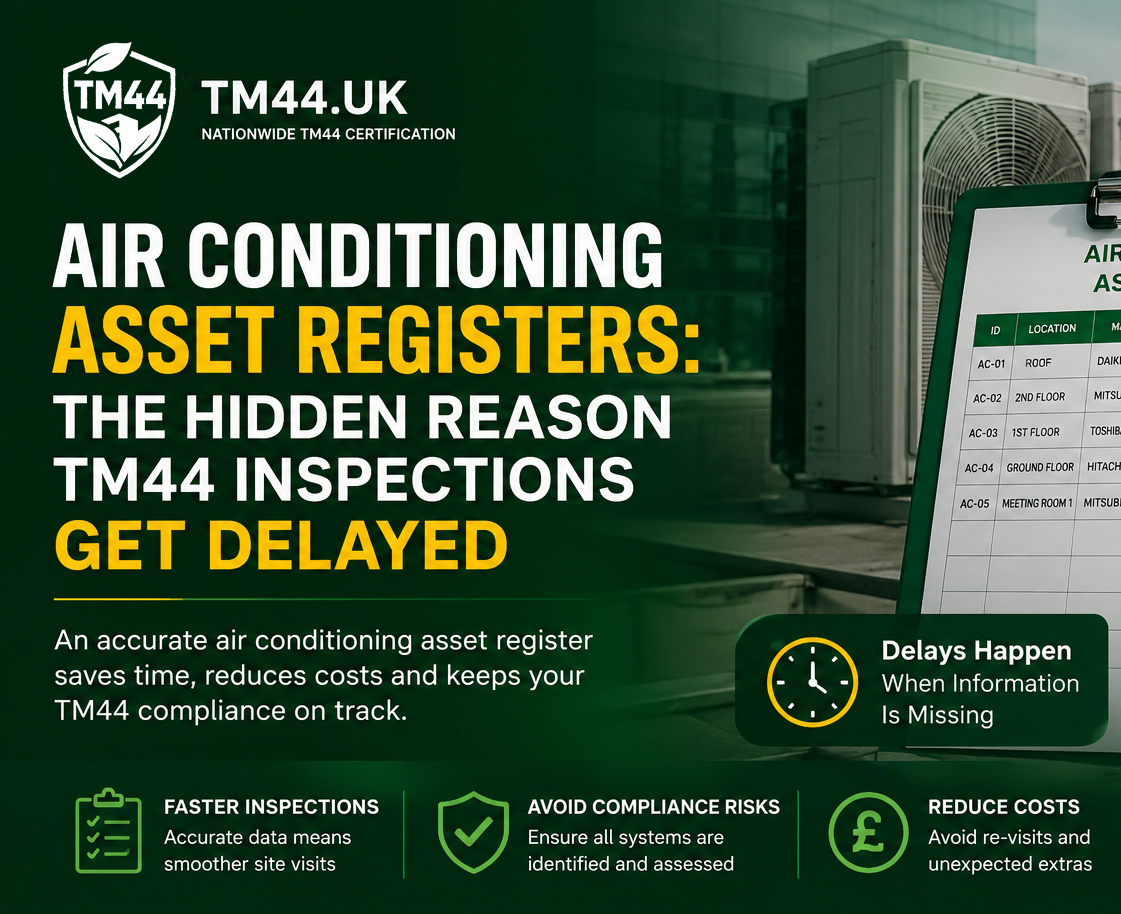
An asset register is not simply a spreadsheet kept for the maintenance contractor. It is one of the most valuable building-management documents available to a facilities team. When properly maintained, it supports servicing, budgeting, F-Gas records, equipment replacement and statutory compliance. It also makes the entire TM44 air conditioning inspection process clearer and more efficient.
What is an air conditioning asset register?
An air conditioning asset register is a structured record of the cooling equipment installed within a building or property portfolio.
In a small office, this may be a basic spreadsheet showing several wall-mounted systems and their outdoor units. In a large commercial building, it may form part of a wider mechanical and electrical asset database covering chillers, air handling units, fan coil units, VRF systems, central controllers and building management system connections.
The purpose is simple: every relevant item should be identifiable.
A useful register normally records the equipment location, asset reference, manufacturer, model number, cooling capacity, approximate installation date and operational status. It should also show how connected equipment relates to the wider system. For example, five indoor cassette units may all be served by one outdoor VRF unit. Recording them as six completely separate systems would give a misleading picture of the installation.
The best registers are not necessarily the most sophisticated. A clear and accurate spreadsheet is more useful than an expensive facilities-management platform containing outdated data.
Accuracy is what matters.
Why asset information matters before a TM44 inspection
A TM44 quotation is based on the size and complexity of the air conditioning system.
An assessor needs to understand whether the property contains four small split systems, a large VRF installation, multiple chillers or a mixture of systems spread across several buildings. The number of visible indoor units alone does not always provide the answer.
Consider two offices, each described as having “20 air conditioning units.”
The first office may contain 20 simple wall-mounted indoor units paired with 20 easily accessible outdoor condensers. The second may contain 20 indoor fan coil units connected to central plant, controlled through a building management system and distributed across restricted areas of a multi-occupied property.
The number is the same, but the inspection work is not.
A reliable TM44 asset register helps the assessor understand what is likely to be involved before the appointment is confirmed. This allows the provider to estimate the inspection duration, determine whether specialist access may be needed and prepare a quotation that reflects the actual site.
Without this information, the quotation may have to be provisional. The client may be asked for photographs, maintenance schedules, equipment model numbers or the previous TM44 report. Several days can then be lost while different contractors and departments search for the records.
This is one reason why some inspections seem to be delayed before they have even been booked.
The register may exist, but that does not mean it is correct
Many facilities managers confidently say that they have an air conditioning asset list. The difficulty begins when the document is compared with the physical building.
It is common to find equipment that was installed during a refurbishment but never added to the register. Server rooms often receive additional cooling as IT requirements grow. Tenants may add systems to meeting rooms, kitchens, treatment rooms or communications areas. Old units may be removed while the original entries remain in the database.
The register can therefore look complete while describing a building that no longer exists.
This is sometimes more problematic than having no asset list at all. When everybody knows the records are missing, the inspection can be planned with that uncertainty in mind. When an outdated schedule is presented as current, the assessor may reasonably use it to prepare the quotation and site programme.
If the actual installation is significantly larger, the original scope may no longer be realistic.
A good asset register should therefore be treated as a living document. It should be updated whenever equipment is installed, replaced, moved, isolated or permanently removed. The facilities team should not wait until the next inspection or property transaction to correct it.
The hidden impact of tenant-installed air conditioning
Tenant alterations are one of the most common causes of incomplete building records.
A landlord may hold excellent information about the original base-build cooling system but have limited visibility over what individual occupiers have installed since moving into the property.
A tenant might add a wall-mounted unit to a meeting room because the existing system is inadequate. Another may install dedicated cooling in a server room. A retail occupier may fit additional equipment during a shop refurbishment. These changes can happen gradually over several years, and the landlord’s central asset register may never be updated.
This matters because the overall TM44 position cannot always be assessed by looking only at the original landlord installation.
The combined effective rated output of the relevant systems may exceed the threshold even when each individual unit appears relatively small. Additional tenant systems may also create access issues if the assessor was not informed that several occupied areas needed to be inspected.
Our detailed guide to tenant-installed air conditioning and TM44 compliance risk explains why landlords, tenants and managing agents should establish clear responsibility for recording these changes.
In practical terms, lease procedures should require tenants to provide updated equipment information whenever they alter the air conditioning installation. This information should then be added to the master building register rather than remaining in a separate fit-out file.
Why the 12 kW threshold is often misunderstood
One of the most persistent misunderstandings surrounding TM44 compliance is the assumption that only individual units above 12 kW matter.
A commercial property may have several smaller systems whose combined effective rated output places the building within the inspection requirements. This is why a complete commercial air conditioning asset list is so important.
Imagine an office containing three 5 kW split systems, two 4 kW systems and a 7 kW cassette. None of the individual units exceeds 12 kW, but the combined installed cooling capacity is well above that figure.
If the building records mention only the most obvious equipment, the responsible person may incorrectly conclude that a TM44 inspection is not required.
The opposite problem can also occur. Indoor and outdoor units may be counted separately even though they form one connected system, producing an exaggerated estimate of the installed capacity.
Model numbers, technical data and system relationships therefore matter. Where capacity is uncertain, our TM44 kW checker can provide an initial indication, although complex installations may still require professional review.
For the broader legal position, see our guide to TM44 inspection requirements in the UK.
How incomplete records create delays on the day
The first difficulty caused by poor records is an uncertain quotation. The second appears during the inspection itself.
An assessor may arrive with a programme based on the information supplied. If additional equipment is discovered, time must be spent locating units, reading model plates, establishing which indoor units connect to which outdoor systems and confirming whether the plant is operational.
This can become particularly difficult in large or multi-occupied buildings.
The site contact may know that air conditioning exists but not where every external condenser is located. Roof access may require a permit or escort. Ceiling-mounted equipment may be hidden above tiles. Server rooms may be controlled by another department. Tenant areas may be locked or occupied by staff who were never informed about the inspection.
None of these issues is unusual. Together, however, they can consume a substantial part of the site visit.
The assessor may still be able to complete the inspection, but the reporting stage can then be delayed while missing model information, maintenance records or access details are obtained. If significant systems were inaccessible, a return visit may be necessary.
This is not administrative bureaucracy. A professional report must reflect the installation that actually exists.
Illustrative case study: the office with “eight units”
Consider a typical example.
A facilities manager requests a quotation for a three-storey office and advises that the building contains eight split air conditioning systems. A maintenance spreadsheet is provided, and the inspection is booked on that basis.
During the visit, the assessor discovers that the spreadsheet has not been updated since a refurbishment three years earlier.
Two ceiling cassettes were installed in new meeting rooms. A dedicated server-room unit was added following an IT upgrade. One original system was removed, but its replacement had a different capacity. A tenant on the first floor had also installed two wall-mounted units without informing the managing agent.
The building did not contain the eight systems originally described. It contained a mixture of old, new and tenant-controlled equipment that needed to be identified and reconciled.
The inspection could still proceed, but more time was required. Tenant access had to be arranged. Additional technical information was requested. The asset schedule had to be corrected before the final report could accurately describe the installation.
The delay was not caused by the assessor or by the TM44 methodology.
It was caused by the difference between the building records and the physical building.
This is why asset-register accuracy should be checked before the appointment, not after the survey has started.
A national portfolio can multiply a small data problem
For a single property, an inaccurate asset register may cause inconvenience. Across a national portfolio, the same weakness can create a major compliance-management problem.
Different maintenance contractors often use different naming systems. One may identify equipment by room number. Another may use the manufacturer and model. A third may refer only to external condenser locations. Head office then receives several asset lists that cannot easily be compared.
The property manager may know that 40 sites have air conditioning but still be unable to answer basic questions: which locations exceed the threshold, which reports are current, which buildings have been refurbished and which systems have been replaced since the previous inspection.
The solution is not simply to collect more spreadsheets. It is to standardise the information.
Every site should record equipment in the same way, using consistent asset references and a common set of data fields. The portfolio manager should be able to distinguish clearly between operational, faulty, isolated, decommissioned and removed equipment.
Once the information is normalised, inspections can be grouped geographically, quotations can be compared fairly and renewal dates can be managed centrally.
TM44.uk provides TM44 portfolio management for landlords, facilities-management companies and multi-site organisations that need a coordinated approach across the UK.
What a useful register should tell the reader
An asset register should make the building understandable to someone who has not visited it before.
A row containing “Mitsubishi unit, second floor” is usually not enough. A better entry would identify the asset reference, exact room or area, manufacturer, complete model number, cooling output, connected outdoor unit, installation year and current status.
The register should answer practical questions.
Can the equipment be located? Can its technical information be checked? Is it still operational? Is it part of a larger connected system? Was it installed before or after the last TM44 inspection? Has it been replaced under the same asset number?
Photographs can make the register substantially more useful. A general photograph confirms the equipment type and location, while a clear image of the model plate can support technical verification.
For large buildings, floor plans or roof plans showing equipment locations are also valuable. They reduce time spent searching and make it easier to identify areas that require special access.
The document does not need to become overly complex. Its purpose is to replace uncertainty with clear, usable information.
Can an inspection proceed without an asset register?
Yes. The absence of an asset register does not necessarily prevent a TM44 inspection.
Many properties, particularly older buildings and smaller businesses, do not have a reliable equipment inventory. An experienced assessor can often build or verify the necessary information during the site visit.
The important point is to disclose the situation before the quotation is agreed.
If the client says there is no current asset list, the provider can allow for a more detailed site review. The quotation can explain whether additional systems or restricted access may affect the final scope. The site contact can also prepare keys, roof access and maintenance assistance in advance.
Problems arise when a rough estimate is presented as confirmed information.
Guessing that there are “about ten units” may produce an attractive initial price, but it does not help if 25 units are later found across the property. Being transparent about incomplete records usually leads to a smoother process than providing inaccurate data.
Our article on arranging a TM44 inspection without an asset list explains how to proceed when little or no technical information is available.
How to improve the register without creating another major project
Facilities teams sometimes postpone updating asset data because the task appears too large. They imagine that every model number, serial number and installation date must be confirmed before any useful progress can be made.
A better approach is to improve the information in stages.
Start with what is already available: maintenance schedules, F-Gas records, commissioning documents, previous inspection reports, mechanical drawings and equipment invoices. These records provide a working starting point, but they should not be accepted without verification.
The next stage is a physical walk-through of the building.
Every operational area should be considered, including roof spaces, plant rooms, service yards, server rooms, tenant areas and outbuildings. Equipment labels should be photographed where accessible, and the relationship between indoor and outdoor units should be checked as far as reasonably possible.
Where exact installation dates are unknown, an approximate year may be sufficient. Where an item is believed to be decommissioned, that status should be confirmed rather than assumed. A unit that has been switched off is not necessarily the same as a system that has been permanently removed from service.
Finally, responsibility for maintaining the register must be assigned. Without a named owner, the data will begin to deteriorate again after the next replacement project.
The register should be updated as part of the handover process whenever equipment changes. A contractor should not simply install a new system and leave the facilities team with another set of paperwork. The central records should be amended while the information is still available.
The financial value of accurate asset data
An asset register does not make a complex building simple. It makes the complexity visible.
That distinction matters when obtaining quotations.
A provider can price a complicated installation accurately when the scope is understood. Uncertainty is more difficult. It creates the risk of an underpriced survey, an excessive contingency or additional fees when the actual equipment is discovered.
Accurate records can reduce avoidable time spent searching for plant, arranging repeat access, requesting technical data and returning to areas that were unavailable during the original visit.
They can also support better capital planning.
When the facilities team knows the age, model, capacity and condition of the equipment, it becomes easier to identify systems approaching the end of their service life. Replacement budgets can be planned before a major failure occurs. Energy-efficiency recommendations from the TM44 report can be connected to specific assets rather than remaining as general observations.
For building owners, this transforms the register from a compliance document into a practical management tool.
Asset registers support more than TM44 compliance
The same information used to prepare for a TM44 survey can support several other areas of property management.
Maintenance contractors need to know which equipment they are responsible for. F-Gas records depend on accurate identification of refrigerant-containing systems. Insurance providers may request evidence of plant maintenance. Purchasers and tenants may expect clear building information during a property transaction.
A well-maintained register also improves continuity when staff or contractors change.
Without central records, important knowledge often sits with one facilities manager or engineer. When that person leaves, the organisation loses years of practical understanding about the building. The next contractor must then reconstruct the installation from old invoices, labels and memory.
This is particularly risky for managing agents who may inherit buildings with limited handover information. Creating an accurate asset register early can prevent repeated confusion throughout the management period.
TM44 compliance is therefore one strong reason to improve the records, but it is not the only one.
How TM44.uk helps when the records are incomplete
TM44.uk works with commercial property owners, landlords, facilities managers, managing agents and national organisations across the UK.
Some clients approach us with detailed asset schedules, previous reports and complete maintenance records. Others have little more than the property address and a rough estimate of the installed equipment.
Both situations can be managed.
Where good information is available, we use it to understand the likely scope and prepare the inspection efficiently. Where the records are incomplete, we can review photographs, service documents and previous reports, then advise what further information would be useful before attendance.
Our nationwide network supports small offices, schools, retail premises, healthcare buildings, hotels, industrial sites and complex multi-building estates. We can also coordinate inspections across multiple regions for clients who need consistent reporting and one central point of contact.
The objective is not to make the client produce a perfect asset register before speaking to us. It is to identify uncertainty early so that the inspection is planned properly.
To obtain an accurate quotation, send us the property address, any available equipment information, the previous TM44 report if one exists and details of recent installations or refurbishments. Even photographs of the outdoor units and model labels can be useful.
You can request a TM44 inspection quotation or contact the TM44.uk team to discuss a building with incomplete records.
The real reason inspections become delayed
When a TM44 inspection takes longer than expected, the natural assumption is that the assessor or reporting process is slow.
In reality, the delay may have started years earlier.
It may have started when a replacement unit was installed but not recorded. When a tenant added cooling without notifying the landlord. When the previous maintenance contractor kept the asset list in its own system. When a refurbishment handover file was stored but never integrated into the facilities records.
By the time the TM44 inspection is booked, these small administrative gaps have become a larger operational problem.
The assessor is then expected to reconstruct the building’s air conditioning history during a limited site visit.
A reliable air conditioning asset register prevents this. It gives the assessor a credible starting point, helps the client receive a more accurate quotation and reduces the chance of unexpected equipment being discovered during the survey.
It also gives the building owner a much clearer understanding of the plant they are responsible for.
Final thoughts
An air conditioning asset register is not just a list of model numbers.
It is the link between the physical equipment, the people maintaining it and the organisation responsible for compliance.
When the register is accurate, the TM44 process becomes easier to plan. The assessor understands the installation before arriving. The site team knows which areas must be accessible. The quotation is based on real information rather than assumptions. The final report can be prepared with fewer delays.
When the records are missing or outdated, even a relatively straightforward building can become difficult to assess.
The practical message is simple: do not wait until the inspection date to find out what air conditioning equipment is installed.
Review the register early, check it against the building and tell the assessor where information remains uncertain.
TM44.uk provides accredited TM44 inspections, government lodgement support and nationwide portfolio coordination. Whether your building has a detailed asset database or no reliable equipment list at all, our team can help establish the next step and prepare the inspection correctly.
Request your TM44 quotation and send us whatever building information you currently hold. We will review the scope and advise what is needed to move the inspection forward.
TM44 Asset Register FAQs
Air Conditioning Asset Register FAQs
Clear answers for landlords, facilities managers, managing agents and building owners dealing with missing, outdated or incomplete air conditioning records before a TM44 inspection.
What is an air conditioning asset register?
An air conditioning asset register is a structured record of the cooling equipment installed within a building or property portfolio. It normally identifies each system by location, manufacturer, model number, cooling output, installation date and operational status. A reliable register helps the assessor understand the building before the TM44 inspection takes place.
Is an asset register legally required before a TM44 inspection?
An asset register is not normally treated as a separate legal certificate that must exist before the inspection. However, the absence of a register does not remove the need to comply. Buildings with qualifying air conditioning systems may still require an inspection under the TM44 inspection requirements . Missing records usually mean the assessor must spend more time identifying and verifying the equipment on site.
Can a TM44 inspection proceed without an asset register?
Yes. An accredited assessor can often identify and record the installed equipment during the site visit. The client should explain in advance that no reliable asset list exists so the survey can be scoped correctly. The quotation may need to be provisional, and additional time or access may be required if more equipment is found than expected.
Why can a missing asset register delay a TM44 inspection?
Without accurate equipment information, the assessor may not know how many systems are installed, where they are located or how they are connected. Time can then be lost finding outdoor units, checking model plates, accessing tenant areas and confirming cooling capacities. If important equipment cannot be inspected during the original visit, further information or a return visit may be needed before the TM44 report can be completed.
What information should an air conditioning asset register contain?
A useful register should identify the asset reference, exact location, equipment type, manufacturer, model number, rated cooling output and current operational status. It should also show which indoor units connect to which outdoor systems. Installation dates, maintenance details, refrigerant information, control arrangements and clear equipment photographs can make the register considerably more useful.
Can an outdated asset register cause problems?
Yes. An outdated register may exclude replacement units, refurbishment work, server-room cooling or systems installed by tenants. It may also continue to show equipment that has already been removed. If the quotation is based on inaccurate records, the inspection may take longer or require a revised scope when the actual installation is discovered.
Should tenant-installed air conditioning appear on the register?
Yes. Tenant-installed systems should be recorded where they form part of the building's installed air conditioning provision. Small units can affect the combined cooling capacity, and access to tenant areas may be required during the inspection. Our guide to tenant-installed air conditioning and TM44 compliance explains why these systems are frequently missed.
How does an asset register help with the 12 kW threshold?
The register helps establish the combined effective rated output of the relevant air conditioning systems. Several small units can collectively exceed 12 kW even when no single unit appears large. Accurate model numbers and system relationships reduce the risk of equipment being omitted or counted incorrectly. The TM44 kW checker can provide an initial indication where cooling capacities are known.
What happens if extra air conditioning units are found on site?
A small discrepancy can often be managed during the same visit. A larger difference may require additional inspection time, technical information, access to further areas or a revised quotation. The outcome depends on the number and complexity of the additional systems. Clients should disclose when the asset information is approximate so the provider can allow for that uncertainty from the beginning.
Can TM44.uk help when our air conditioning records are incomplete?
Yes. TM44.uk can review available maintenance schedules, photographs, model numbers and previous reports before attendance. Where no reliable register exists, we can advise what information would help and plan the inspection around the uncertainty. Send us the property address and whatever records you currently hold through our TM44 quotation form .
No accurate air conditioning asset register?
Request a TM44 Quote
Send us the property address, available maintenance information, equipment photographs and any previous TM44 report. We can review the likely scope and advise what is needed before the inspection.
Case Studies & Success Stories Energy Efficiency & Cost Savings Guides & How-To Articles Industry News & Updates TM44 Compliance & Regulations
Related Posts
August 28, 2026