September 8, 2026
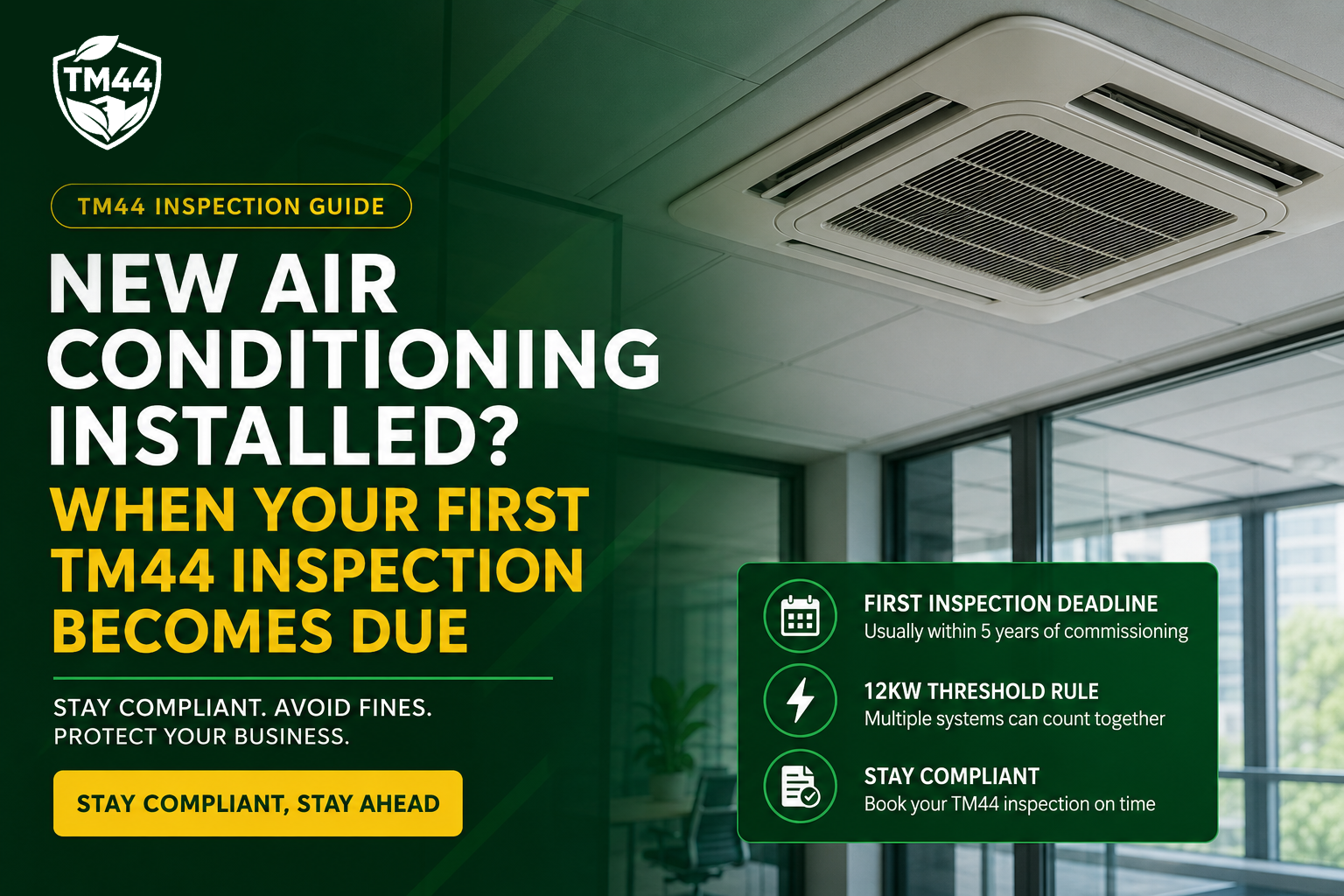
New Air Conditioning Installed? When Your First TM44 Inspection Becomes Due
July 5, 2026

Written by
TM44TeamAlfa
Installing new air conditioning is usually treated as a building upgrade, a comfort improvement, or part of a refurbishment project. The installer completes the work, the client receives commissioning paperwork, the system starts running, and everyone moves on.
But for commercial buildings, there is a compliance question that is often missed:
When does the first TM44 inspection become due?
The mistake many building owners make is assuming that a new air conditioning system does not need a TM44 inspection because it has only just been installed. That is not the right way to look at it. A new system may be efficient, well installed and properly commissioned, but if the total effective rated cooling output is more than 12kW, it enters the TM44 compliance regime.
The first inspection does not usually need to be done immediately on day one. However, the system must be inspected within the required timeframe, and the responsible person needs to know the correct date from the beginning.
For landlords, tenants, facilities managers, schools, dental practices, retail units, offices, restaurants and multi-site businesses, this is where compliance problems often begin. Nobody records the installation date clearly. The commissioning certificate is filed away. The new units are added to the maintenance contract, but not to a compliance tracker. Five years later, the building is being sold, leased, audited or reviewed by a managing agent, and nobody can prove whether a valid TM44 certificate is in place.
This guide explains when the first TM44 inspection becomes due after new air conditioning is installed, how the 12kW rule works, what documents you should keep, and how TM44.uk can help you avoid last-minute compliance problems.
The basic rule: new air conditioning is not automatically exempt
A TM44 inspection is required for qualifying non-domestic air conditioning systems with an effective rated output of more than 12kW.
That threshold can be reached by one large system or by several smaller systems under the same control. This is one of the most common areas of confusion.
A single 14kW split system may trigger the requirement.
Three 5kW units may also trigger the requirement if they are part of the same building or controlled system.
A VRF or VRV system serving several rooms will often exceed the threshold easily.
A refurbished office floor with multiple cassette units may become in scope even if no single indoor unit looks particularly large.
The important point is that TM44 is not only about large chillers, plant rooms or high-rise office towers. Many ordinary commercial properties cross the 12kW threshold without realising it.
You can use our TM44 kW checker if you are unsure whether your new air conditioning system is likely to fall within the requirement.
When does the first TM44 inspection become due?
For a new air conditioning system, the practical rule is simple:
The first TM44 inspection should be completed within five years of the system being installed or commissioned, provided the system meets the qualifying threshold.
After that, the inspection must be renewed at intervals not exceeding five years.
The safest date to use is the commissioning date, not the invoice date, not the first service date, and not the date someone later notices the system on an asset register.
For example:
• Air conditioning commissioned on 12 March 2026
• Combined cooling output: 42kW
• First TM44 inspection due by 12 March 2031
• Next inspection due no later than five years after the first inspection date
In practice, you should not wait until the final week before the five-year deadline. Building owners and facilities managers should start checking TM44 status at least three to six months before the due date, especially where access, tenant coordination, roof access, plant records or multiple sites are involved.
If the property is being sold, leased, refinanced, audited or reviewed for compliance, the inspection may need to be arranged sooner.
Why the installation date matters
The installation or commissioning date is the anchor point for the first inspection deadline.
If that date is not recorded properly, the compliance position becomes harder to prove. This is especially common in buildings where air conditioning has been added gradually over time.
For example, a small office may install two wall-mounted split systems in 2023. The total cooling output is below 12kW, so TM44 may not apply at that stage. In 2026, the same business adds another unit for a meeting room, bringing the combined output above 12kW. The relevant compliance question then becomes: when did the system first exceed the TM44 threshold?
This is why asset records are critical. A good compliance file should include:
• Installation date
• Commissioning certificate
• Outdoor unit model numbers
• Indoor unit schedule
• Cooling capacity in kW
• Location of each unit
• Maintenance records
• F-Gas records where relevant
• Lease or management documents showing who controls the system
If you do not have this information, our TM44 inspection evidence guidance can help you understand what should be gathered before the assessment.
The 12kW trap: multiple small units can still count
Many businesses wrongly assume TM44 only applies when one air conditioning unit is over 12kW. This is not correct.
The threshold is based on effective rated output. Several smaller systems may need to be counted together depending on how the building is arranged and who controls the system.
Example 1: small office
An office installs:
• Reception split system: 5kW
• Main office split system: 7kW
• Meeting room split system: 3.5kW
Total: 15.5kW
Even though no single unit is very large, the combined system may be over the threshold. The building owner or occupier should check whether a TM44 air conditioning inspection is required.
Example 2: dental practice
A dental practice installs AC in two surgeries and reception:
• Surgery 1: 3.5kW
• Surgery 2: 3.5kW
• Reception/waiting area: 5kW
Total: 12kW exactly or slightly above depending on manufacturer rating.
This is where exact model data matters. If the effective rated output is more than 12kW, the practice may need a TM44 inspection within the required cycle.
Example 3: restaurant and kitchen cooling
A restaurant installs comfort cooling in the dining area and additional cooling in office/admin space. The owner thinks only the dining area matters. However, if the systems are under the same control and used for the building, the combined output may bring the site into scope.
Restaurants, pubs and hospitality buildings should treat new AC installations as a compliance trigger, not just an operational upgrade.
New AC installed in a leased property: landlord or tenant responsibility?
Responsibility depends on who controls the technical operation of the air conditioning system.
This is not always the same person who adjusts the temperature controller. It usually means the person or organisation with control over the technical functioning, maintenance, replacement and management of the system.
In a simple owner-occupied building, the owner will usually be responsible.
In a full repairing and insuring lease, the tenant may be responsible if they control the air conditioning system.
In a multi-let building, the landlord may be responsible for central systems, while tenants may be responsible for tenant-installed systems.
In a shopping centre, serviced office, retail park or multi-tenant commercial building, responsibility can be split.
This is where disputes happen. A tenant installs its own AC. Five years later, the landlord asks for compliance documents. The tenant says the landlord should have managed it. The landlord says the tenant installed and controlled the equipment. The report was never arranged.
The practical solution is to record responsibility at the time of installation. If a tenant installs air conditioning, the lease licence, fit-out approval or management agreement should clearly state who is responsible for TM44 compliance, maintenance records, F-Gas records and future access.
For broader legal context, see our guide to TM44 legal requirements for commercial buildings.
Case study: new VRF installed during office refurbishment
A landlord refurbished a three-floor commercial office building and installed a new VRF system serving open-plan office areas, meeting rooms and reception.
The system was commissioned in May 2021. The total cooling output was approximately 95kW. The installer provided commissioning sheets and O&M manuals. The building was then let to a tenant on a long lease.
In 2026, the tenant prepared for an internal compliance audit. The facilities team had maintenance records, but no TM44 report. The system was now five years old, over 12kW, and clearly within scope.
The problem was not the quality of the installation. The problem was that nobody diarised the first TM44 inspection after commissioning.
The building then needed a fast inspection, asset review, site visit, report and lodgement to restore the compliance position.
The lesson is clear: when new commercial air conditioning is installed, the first TM44 deadline should be added to the compliance calendar immediately.
Case study: gradual AC installation in a growing clinic
A private clinic opened with one small split system in reception. Two years later, it added cooling to treatment rooms. A further year later, it added another system for a consultation room.
Individually, each installation looked minor. Nobody treated the works as a major compliance event. However, the combined cooling capacity eventually exceeded 12kW.
When the clinic later reviewed its building compliance documents, it had electrical certificates, servicing records and F-Gas paperwork, but no TM44 report.
This is common in dental practices, clinics, salons, small offices and independent schools. The building does not start with a large central system. Instead, air conditioning is added room by room until the threshold is crossed.
For this type of property, the correct question is not “Did we install one big AC system?” The correct question is “What is the total effective rated cooling output under our control?”
If you are unsure, start with our TM44 checker.
Does a new, efficient system still need TM44?
Yes, if it is within scope.
A new system may be efficient, correctly sized and properly commissioned, but TM44 is still a legal inspection requirement once the threshold and timing apply.
The inspection is not only about finding faults. It also reviews:
• Likely system efficiency
• Suitability of controls and control settings
• Maintenance adequacy
• System sizing compared with building cooling load
• Opportunities to reduce energy use
• Issues that may affect performance
• Practical recommendations for improvement
A new system may receive a cleaner report than an older system, but the inspection still creates a formal compliance record and government-lodged report reference.
For owners, this is useful because it creates an auditable compliance trail. For tenants and facilities managers, it helps prove the system has been reviewed by an accredited assessor.
TM44 is not the same as commissioning, F-Gas or maintenance
A common mistake is assuming that other documents replace the TM44 inspection.
They do not.
Commissioning confirms the system was installed, tested and set up.
Maintenance records show the system has been serviced.
F-Gas records relate to refrigerant compliance and leak checks where applicable.
An EPC assesses the energy performance of the building.
A TM44 inspection is specifically an air conditioning energy assessment for qualifying systems.
These records support each other, but one does not automatically replace the other.
For example, a building can have excellent maintenance records and still be missing a TM44 report. A building can have a valid EPC but still need a TM44 inspection. A new AC installation can be fully commissioned but still require its first TM44 inspection within the required timeframe.
If you need to understand the difference between the report and certificate, see our TM44 report guide and TM44 certificate page.
What should you do when new AC is installed?
The best time to prepare for TM44 compliance is at installation handover.
Do not wait five years and then try to reconstruct the asset history. Ask the installer or mechanical contractor for the correct information while the project is fresh.
At handover, you should collect:
• Full asset schedule
• Indoor and outdoor model numbers
• Cooling capacity for each unit
• Commissioning date
• O&M manuals
• Control strategy details
• Maintenance recommendations
• F-Gas information where relevant
• Location details and access notes
• Installer contact details
• Warranty information
Then add the first TM44 inspection deadline to your compliance system.
For example:
“New AC commissioned 18 September 2026. Combined cooling output 31kW. First TM44 inspection due before 18 September 2031. Review and book inspection by March 2031.”
This simple line can prevent a future transaction delay, audit issue or compliance scramble.
Should you book the first TM44 inspection immediately after installation?
Usually, no. TM44 is not a commissioning inspection.
For a brand-new system, the first TM44 inspection is normally due within the five-year compliance window, not necessarily immediately after installation.
However, there are situations where an earlier inspection may be sensible:
• The building is being sold
• The building is being leased
• A buyer or tenant solicitor has asked for a TM44 report
• The landlord wants a clean compliance file
• The system was installed but paperwork is poor
• The building already had older AC systems in scope
• A portfolio audit has identified missing reports
• Responsibility has changed and no valid report was provided
If you have installed new AC into a building that already had existing air conditioning, the position needs careful review. The older systems may already be overdue even if the newest units are not.
This is why a whole-building review is better than checking only the newest installation.
What happens if responsibility changes?
If control of the air conditioning system passes to a new person and no inspection report is handed over, the new controller may need to arrange an inspection within a short timeframe.
This matters in:
• New leases
• Business sales
• Property acquisitions
• Facilities management contract changes
• Tenant handovers
• Landlord takebacks
• Portfolio transfers
For example, if a tenant takes over a commercial unit with air conditioning and no TM44 report is provided, the tenant should not simply assume the previous occupier handled it. The system status needs to be checked.
This is one reason TM44 reports often become important during due diligence. A missing report may not stop a transaction on its own, but it can create delay, negotiation points, or post-completion compliance work.
Our TM44 register guide explains how lodged reports and compliance records fit into the wider process.
What if the system was installed more than five years ago and never inspected?
If your air conditioning system is over 12kW and was installed more than five years ago with no TM44 report, you should treat the inspection as overdue.
Do not wait for an enforcement notice. Do not rely on the age of the system as an excuse. Do not assume a maintenance contractor has arranged it unless you have the actual lodged report.
The practical next steps are:
• Confirm the system capacity
• Check whether any previous TM44 report exists
• Gather asset and maintenance records
• Identify who controls the system
• Arrange an inspection with an accredited assessor
• Keep the lodged report safely after completion
If the report is missing, expired or uncertain, TM44.uk can help review the position and arrange the inspection.
You can start through our get a quote page.
Why early planning saves money
Leaving TM44 until the last minute usually makes the job harder.
The assessor may need roof access. The building manager may need to coordinate with tenants. The maintenance contractor may need to provide asset details. Some systems may be difficult to identify if model plates are faded, access is restricted, or records are incomplete.
For single-site buildings, this may only cause minor delay. For larger portfolios, it can become a serious project management problem.
Early planning helps you:
• Avoid urgent booking premiums
• Reduce site access issues
• Give the assessor better information
• Avoid incomplete asset records
• Prevent transaction delays
• Combine visits where appropriate
• Build a clean compliance calendar
For multi-site businesses, TM44 should sit alongside EPCs, DECs, F-Gas, fire safety, electrical compliance and planned maintenance.
If you manage multiple properties, our TM44 portfolio management service can help structure the process.
How TM44.uk helps after new air conditioning is installed
TM44.uk helps building owners, landlords, occupiers, managing agents and facilities teams understand whether their new or existing air conditioning systems require inspection.
Our service can include:
• Reviewing whether the system appears to exceed 12kW
• Checking installation dates and likely first inspection deadlines
• Arranging inspection by an accredited TM44 assessor
• Supporting single-site and multi-site bookings
• Helping gather the right pre-inspection information
• Providing clear pricing before attendance
• Supplying the completed TM44 report after lodgement
• Helping clients plan renewal reminders
We cover London and locations across the UK through our assessor network. You can view our areas we cover or go directly to contact TM44.uk for help with a new installation, overdue inspection or portfolio review.
Practical checklist: first TM44 inspection after new AC installation
Use this checklist when new commercial air conditioning is installed:
• Confirm the total cooling output in kW
• Check whether the combined output is more than 12kW
• Record the commissioning date
• Keep all AC asset documents
• Save the O&M manuals
• Keep F-Gas and maintenance records
• Identify who controls the system
• Add the first TM44 due date to your compliance calendar
• Review the position at least six months before the deadline
• Book the inspection before the five-year point
• Keep the lodged report safely after completion
This simple process prevents most TM44 problems before they happen.
Final answer: when is your first TM44 inspection due?
If you have installed new commercial air conditioning and the effective rated output is more than 12kW, your first TM44 inspection normally becomes due within five years of installation or commissioning.
The system does not need to be old, faulty or inefficient to fall within the rules. The trigger is the qualifying cooling capacity and the compliance timetable.
The safest approach is to record the installation date, confirm the total kW, identify who controls the system, and diarise the first TM44 inspection well before the five-year deadline.
If the system was installed years ago and nobody arranged the inspection, treat it as a live compliance issue and get it checked.
TM44.uk can help you confirm whether your building is in scope, arrange the inspection, and provide a clear route to compliance.
Start with our TM44 checker or request a quote through TM44.uk.
New AC TM44 FAQs
New Air Conditioning and First TM44 Inspection FAQs
Practical answers for landlords, tenants, facilities managers and business owners who have recently installed commercial air conditioning and need to understand when the first TM44 inspection becomes due.
01Does new air conditioning need a TM44 inspection?
Yes, if the system is in a non-domestic building and the effective rated cooling output is more than 12kW. A new system is not automatically exempt because it has recently been installed. If you are unsure, start with the TM44 kW checker.
02When is the first TM44 inspection due after new AC is installed?
The first TM44 inspection is normally due within five years of the system being installed or commissioned, provided the system exceeds the 12kW threshold. The safest approach is to record the commissioning date and add the first inspection deadline to your compliance calendar immediately.
03Is the deadline based on the installation date or first service date?
The safest date to use is the commissioning or installation completion date. The first service date may be later and should not be used as the compliance start point unless the position has been properly reviewed. Keep commissioning records, asset schedules and maintenance documents together.
04Do several small AC units count towards the 12kW threshold?
Yes. Several smaller split systems can bring a building into scope if their combined effective rated cooling output is more than 12kW and they are under the relevant control. This is common in offices, clinics, schools, restaurants and retail units. You can also use the TM44 checker for an initial review.
05Does a commissioning certificate replace a TM44 report?
No. A commissioning certificate confirms that the air conditioning system was installed, tested and set up. A TM44 report is a separate air conditioning energy assessment completed by an accredited assessor and lodged where required.
06Who is responsible for TM44 after new AC is installed?
Responsibility usually sits with the person or organisation that controls the technical operation of the air conditioning system. This may be the landlord, tenant, occupier, managing agent or facilities manager depending on the lease, fit-out approval and maintenance arrangements.
07What documents should be kept after a new AC installation?
Keep the commissioning certificate, asset schedule, indoor and outdoor unit model numbers, cooling capacity in kW, O&M manuals, F-Gas records where relevant, maintenance records and access information. These documents make the future TM44 air conditioning inspection faster and cleaner.
08What if the system was installed more than five years ago?
If the system is over 12kW and no valid TM44 report exists, the inspection may already be overdue. You should confirm the system capacity, check whether a lodged report exists and arrange an inspection if required. For urgent help, request a TM44 quote.
09Can new AC create a TM44 issue during a sale or lease?
Yes. Buyers, tenants, solicitors, managing agents and auditors may ask for air conditioning compliance evidence. If a building has new or recently upgraded AC but no clear TM44 position, it can create avoidable delays. A valid TM44 certificate helps prove the compliance status.
10Can TM44.uk check when our first inspection is due?
Yes. TM44.uk can review the installation date, cooling capacity, model numbers, asset documents and property setup to confirm whether the system is likely to be in scope and when the first inspection should be planned. Contact TM44.uk for a review.
Installed new air conditioning and unsure when TM44 is due?
Send the installation date, property address, AC model numbers and any commissioning records. TM44.uk can check the 12kW position and advise whether an inspection should be booked.
TM44 Checker v9 Pro
Check TM44 compliance status in seconds
Search the official GOV data routes and public register fallback. If a record is missing or unclear, request a manual compliance review from TM44.uk.
Official data routesGOV fallbackCommercial buildings only
Case Studies & Success Stories Energy Efficiency & Cost Savings Guides & How-To Articles Industry News & Updates TM44 Compliance & Regulations
Related Posts
August 28, 2026