September 8, 2026
What We Need From You When You Contact Us About a TM44 Inspection
March 20, 2026

Written by
TM44TeamAlfa
When a business contacts us for a TM44 quote, one of the most common things we hear is:
“What exactly do you need from us?”
It is a fair question.
Most people responsible for a commercial property already have enough on their plate. They are dealing with day-to-day operations, maintenance issues, contractors, compliance deadlines, access arrangements, and internal approvals. So when TM44 comes up, the last thing they want is a vague process, unnecessary back and forth, or a quote that changes later because key details were missing at the start.
That is exactly why we ask for certain information before we quote.
We are not trying to make the process harder. We are trying to make it faster, more accurate, and far smoother for you.
At TM44.uk, we work with building owners, facilities managers, managing agents, operations teams, and businesses across the UK who need clear advice and reliable support. Whether you are arranging a first inspection, renewing an expired report, managing a single site, or dealing with a portfolio of properties, the same principle applies: the better the information at the beginning, the easier the whole TM44 process becomes.
If you want a quick, professional quote without wasting time, this guide explains exactly what we usually need from you, why we ask for it, and how it helps us deliver a better service from day one.
If you are ready to move forward now, you can start through our TM44 quote page or explore our wider TM44 air conditioning inspection services.
Why We Ask Questions Before Giving a TM44 Quote
A TM44 inspection is not a generic service with one flat price that fits every building.
Two sites can both say they have air conditioning, but the inspection requirements can be completely different.
One property might be a small office with a few accessible split systems and easy access. Another might be a multi-floor commercial building with roof condensers, controlled access, site induction requirements, a building management system, multiple system types, and restricted operational hours. On paper both properties “need TM44”, but the time, planning, and resources involved are not the same.
That is why we ask for upfront details.
When we receive the right information at the start, we can:
-
provide a more accurate quote
-
understand site complexity before attendance
-
reduce delays and follow-up questions
-
allocate the right assessor and time slot
-
prepare for access, safety, and operational requirements
-
help the inspection run smoothly on the day
That saves time for you and avoids unnecessary friction later.
If you are new to the subject, you may also find our guide on what a TM44 inspection is useful before reading further.
The Goal Is Simple: Make the Inspection Efficient, Accurate, and Stress-Free
A lot of people assume the quote stage is just about getting a price.
In reality, it is the start of the whole delivery process.
A good TM44 provider should not just throw out a number and hope for the best. They should gather enough information to understand your site properly, spot any issues early, and guide you through what is needed so the inspection can actually be delivered without confusion.
That is how we approach it.
We want the quote stage to do three jobs at once:
First, it should help us give you a price that reflects the building and systems involved.
Second, it should help us understand how the site works in practice, including who to speak to, how access will be handled, and whether there are any operational restrictions.
Third, it should help us prepare so the inspection itself is smooth, professional, and efficient.
That is why the information we ask for is not random. Every item has a purpose.
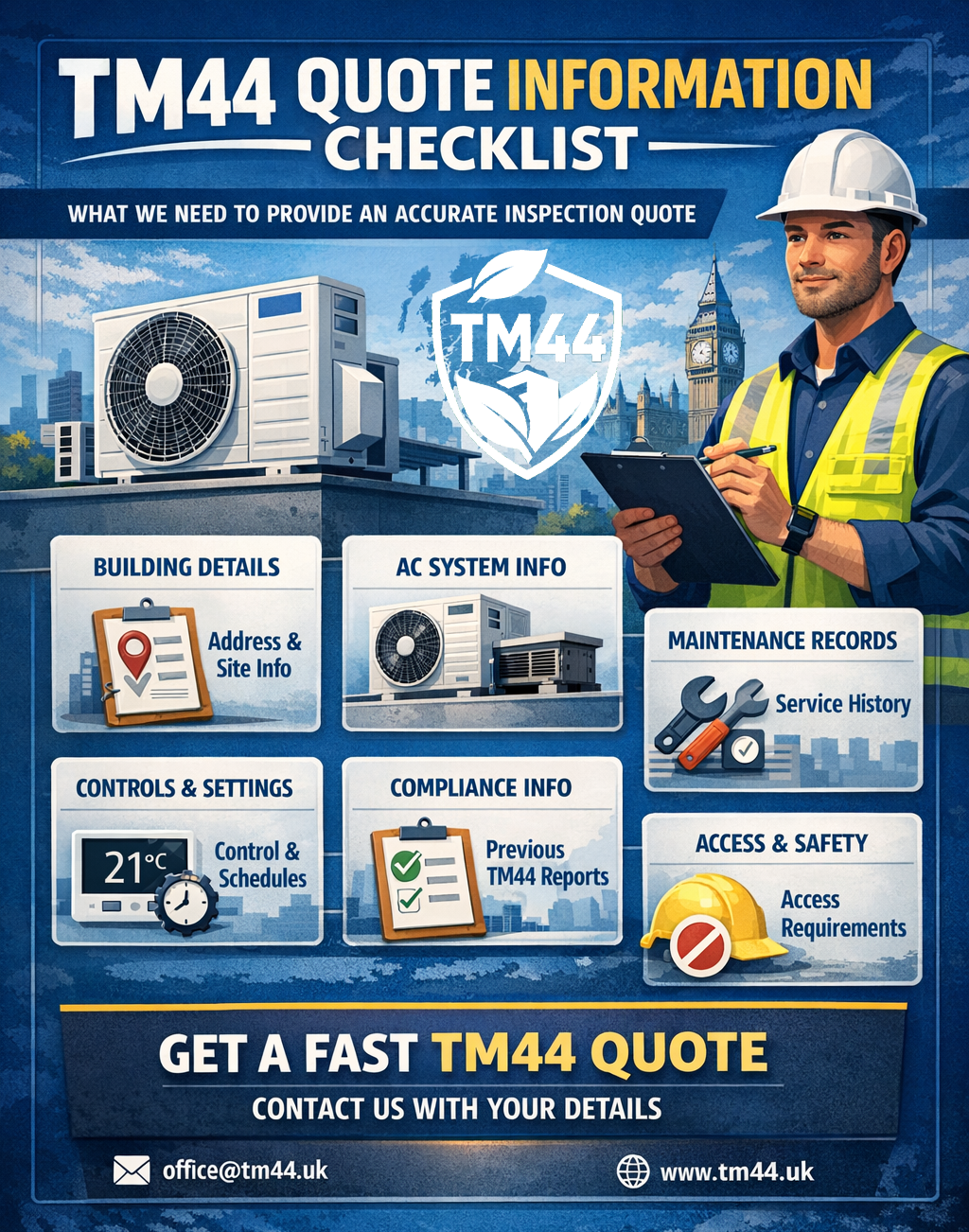
1. Building and Site Details
The first thing we usually need is the core building information.
This includes:
-
full site address
-
building type
-
number of floors
-
standard operating hours
-
access requirements
-
main site contact name and telephone number
This may sound basic, but it matters more than many people realise.
The full address lets us identify location, travel requirements, and whether the site is likely to need special planning. Building type helps us understand the likely layout, use of the premises, and the type of systems installed. A hotel, office, school, retail unit, clinic, warehouse, and leisure facility all tend to present different inspection realities.
The number of floors matters because it affects the physical scale of the site and often the spread of the air conditioning systems. Standard operating hours matter because some inspections are easier during quiet periods, while others need to be arranged around business activity. Access requirements matter because many sites have security procedures, booking slots, inductions, permits, keys, escorts, loading restrictions, reception sign-ins, or restricted plant areas.
And the main contact details are vital because if there is no clear person responsible on the day, delays happen fast.
This section alone often tells us whether a job is straightforward or whether it needs more planning.
If you manage multiple premises, you may also want to look at our TM44 portfolio management service because the way information is gathered becomes even more important at portfolio level.
2. Air Conditioning System Information
This is the most important part of the quote process.
To provide a proper TM44 quote, we need to understand the systems involved as clearly as possible.
The information we usually ask for includes:
-
total number of air conditioning systems installed
-
types of systems, such as split, multi-split, VRF, VRV, or packaged units
-
locations of indoor and outdoor units
-
manufacturer details, model numbers, and year of installation if available
-
cooling capacities in kW
-
asset lists, drawings, or schematics if you have them
Why do we ask for this?
Because TM44 is not based only on the fact that a building has cooling. The systems themselves matter. Their type, size, layout, accessibility, and complexity all affect how the inspection should be planned and quoted.
A single-site office with a small number of simple systems is very different from a building with multiple floors, mixed system types, rooftop condensers, plant room equipment, and distributed indoor units across the site.
Even partial information helps a lot. We do not expect every client to have a perfect asset register ready to go. But if you can send what you do have, it gives us a much better starting point.
For example, the following can be incredibly useful:
-
site photos of indoor and outdoor units
-
maintenance logs
-
equipment schedules
-
a simple list of units and locations
-
roof plans
-
O&M manuals
-
service engineer notes
-
building layout drawings
The more clearly we understand the system setup, the more accurately we can scope the work and reduce surprises later.
If you are not sure whether your building falls within the inspection requirement, our TM44 checker and TM44 inspection requirements guide can help point you in the right direction.
3. Maintenance and Service Records
The next area we often ask about is maintenance history.
This usually includes:
-
recent F-Gas service records
-
maintenance contract details
-
current service provider and frequency
-
known issues, faults, or breakdowns
-
recent repairs
-
outstanding problems not yet resolved
Some clients wonder why this matters when they are only asking for a quote.
It matters because TM44 is not only about confirming that systems exist. A proper inspection is influenced by the condition of the system, how it has been maintained, and whether known issues could affect efficiency or performance.
Maintenance records help us understand the site better before attendance. They also help highlight whether there are known access issues, recurring faults, or operational concerns that may be relevant during the inspection.
For example, if you already know one rooftop condenser is currently isolated, or a particular system has a control fault, or part of the building has limited access due to ongoing works, that is useful for us to know early.
It also helps avoid awkward situations on the day where the site team says, “That unit has been down for months” or “Those controls do not work properly” after the visit has already started.
If your site also needs related support around refrigerant obligations, our F-Gas leak testing and compliance checks page may also be relevant.
4. Controls and Operation
A surprisingly important part of the quote and planning stage is understanding how the systems are operated.
The details we usually ask for include:
-
current temperature setpoints
-
whether the systems use local controls, BMS, or centralised controls
-
on and off scheduling information
-
any known control strategy details
This matters because controls play a huge role in how systems are used in the real world.
A building can have technically suitable equipment but still run inefficiently because the controls are poorly set up, schedules are wrong, zones are not aligned with occupancy, or the system is being operated in a way that wastes energy.
From a quoting point of view, controls information helps us understand system complexity and how the site is managed. From an inspection point of view, it helps frame what the assessor may need to review during the visit.
Many businesses underestimate this area, but it is often where useful recommendations come from.
If you are interested in what the final inspection output can include, take a look at our pages on the TM44 report and TM44 report recommendations explained.
5. Compliance Information
We also usually ask whether a previous TM44 report already exists and who the responsible person is for the building.
That might sound like a small thing, but it is actually very useful.
If a previous report exists, it gives context. It may show what systems were previously assessed, what recommendations were made, and whether anything major has changed since then. It can also help us identify whether the site is going through a renewal cycle or whether the business is trying to correct a gap in compliance.
Confirming the responsible person matters because there should always be clarity around who is coordinating the inspection, who can approve attendance, and who needs the final documentation.
This becomes especially important on larger sites and for managing agents, landlords, operations teams, or FM companies handling multiple stakeholders.
If you need more detail around records and official documentation, you can explore our TM44 certificate and government lodgement page and TM44 lodgement process guide.
6. Access and Safety Information
This is the area that causes more problems than almost anything else if it is not discussed early.
We usually ask for:
-
roof access arrangements for condensers
-
any site-specific PPE requirements
-
safety procedures or permit requirements
-
parking availability
-
any other site restrictions that could affect attendance
Why is this so important?
Because even if everything else is in order, an inspection can still be delayed or disrupted if access has not been planned properly.
If rooftop condensers can only be reached with escort access, if a permit is needed, if there is a locked plant area, if induction is mandatory, if special PPE is required, or if parking is impossible without prior booking, those things need to be known in advance.
It is always better to plan properly than to discover barriers on the day.
For urgent situations where time is tight, our emergency TM44 24 to 48 hour service may be the right fit, but even then, good access information still makes the process faster and cleaner.
What If You Do Not Have All This Information?
Here is the good news.
Most clients do not have every single detail ready.
That is normal.
You do not need to panic if you do not have a perfect technical file for the building. We can still help.
In many cases, the minimum that gets the process moving is:
-
the site address
-
the rough number of systems
-
the type of building
-
a main contact
-
any basic documents or photos you do have
From there, we can often ask the right follow-up questions and help you fill in the gaps.
So the message here is not “do not contact us unless you have everything.”
The message is: send what you have, and we will guide you through the rest.
That is part of the value of working with a specialist service rather than a generic box-ticking provider.
If you want a more guided route, our TM44 consultant page and TM44 specialist UK page explain how we support clients who need expert help rather than just paperwork.
Why This Information Helps You Too
This is not just about helping us.
It helps you as well.
When you gather the right details upfront, you are more likely to get:
-
a realistic quote
-
fewer revisions later
-
a smoother booking process
-
less risk of delays
-
better communication between your site team and the assessor
-
a cleaner handover from quote to inspection to report
It also reduces the chance of frustration on both sides.
Nobody likes avoidable back and forth. Nobody likes turning up to a site and finding out access is impossible. Nobody likes receiving a quote that later needs changing because the original system information was incomplete.
Good upfront information solves that.
How to Send Us the Information
The easiest way is to send it in one organised email or upload it through our Get Quote page.
A simple structure works best.
You can send:
Building details
Address, building type, floors, hours, contact
System details
Number of systems, types, locations, capacities if known
Records
Service reports, F-Gas logs, maintenance information
Controls and compliance
Previous TM44 report, system control info, responsible person
Access and safety
Roof access, PPE, parking, permits, inductions
Even if it is incomplete, that structure helps us review your enquiry faster.
What Happens After You Send the Information
Once we receive your details, we review the site information and assess what is needed to quote properly.
If the information is clear, we can usually move quickly. If something is missing, we only ask for what is genuinely needed.
From there, the next stage may involve:
-
confirming scope
-
clarifying site logistics
-
agreeing attendance
-
carrying out the inspection
-
preparing the report
-
handling the relevant lodgement process where applicable
If you want to understand the full customer journey, our related guides on how to book a TM44 inspection, how long a TM44 inspection takes, and steps for the TM44 process are all worth reading.
Why Clients Choose TM44.uk
A lot of providers can talk about TM44.
What matters is whether they can make the process clear, practical, and reliable for real businesses.
At TM44.uk, we focus on making the service straightforward.
That means:
-
clear communication
-
accurate scoping
-
professional handling of site requirements
-
support for single-site and multi-site clients
-
nationwide service coverage
-
specialist understanding of compliance and reporting
We also know that every enquiry does not come from an engineer. Sometimes it comes from a facilities manager. Sometimes it comes from a landlord. Sometimes it comes from an office administrator, an operations lead, or a property manager who just needs someone to explain things properly and get the job done.
That is why our approach is practical and human.
We do not expect you to know everything before contacting us. We just need enough information to guide the process properly and give you a quote you can trust.
You can also explore our contact page if you want to speak with us directly, or browse our TM44 compliance guide for businesses for broader support.
The Better the Start, the Better the Whole TM44 Process
If there is one thing to take away from this guide, it is this:
The information we ask for at quote stage is not there to slow things down. It is there to make your TM44 inspection easier, faster, and better managed.
When we understand your building, your systems, your access setup, and your existing records, we can quote more accurately, prepare more effectively, and help the whole inspection process run with less stress.
So if you are contacting us for a TM44 quote, send us what you have. Even if it is not perfect, it gives us a solid starting point.
And if you are not sure where to begin, that is fine too. That is what we are here for.
Need a TM44 Quote?
If you need a fast, professional TM44 quote anywhere in the UK, head over to our Get Quote page and send us your site details.
You can also explore:
Send us the information you have, and we will help you take it from there.
Energy Efficiency & Cost Savings Guides & How-To Articles Industry News & Updates TM44 Compliance & Regulations
Related Posts
August 28, 2026