September 8, 2026
Repair, Recommission or Replace? How to Act on an Inefficient Air-Conditioning System After a TM44 Inspection
July 16, 2026

Written by
TM44TeamAlfa
A TM44 inspection can reveal an uncomfortable truth: the air-conditioning system may still be running, but it may no longer be running well.
That distinction matters.
A commercial air-conditioning system can continue cooling a building while consuming more electricity than necessary, operating for too many hours, struggling with poor controls, creating uneven temperatures and placing increasing pressure on ageing components. From the outside, the system appears operational. Inside the plant room, ceiling voids, rooftop units or control panels, however, the picture may be very different.
Once inefficiency has been identified, building owners and facilities managers normally face three possible routes:
Repair the system. Recommission it. Or replace it.
The wrong decision can be expensive. Replacing equipment prematurely can waste capital and create unnecessary disruption. Continuing to repair a system that is approaching the end of its useful life can drain maintenance budgets without solving the underlying problem. Ignoring control faults can leave even new equipment performing badly.
The purpose of a professional TM44 air-conditioning inspection is not simply to produce another compliance document. It should help the person responsible for the building understand how the cooling system is performing, where energy is being wasted and what type of intervention is commercially sensible.
The best decision is rarely based on equipment age alone. It requires a broader assessment of condition, controls, operating patterns, reliability, occupancy, maintenance history, refrigerant strategy and future plans for the property.
An inefficient system does not automatically need replacing
When an air-conditioning system performs poorly, replacement is often the first conclusion.
That conclusion may be wrong.
High electricity consumption can be caused by defective or ageing equipment, but it can also result from relatively ordinary operational problems. A modern VRF system running unnecessarily for fifteen hours every day can waste more energy than an older system operating efficiently for eight. A chiller with poor sequencing can consume heavily even if the main plant remains mechanically sound. A group of split systems can appear inadequate because temperature sensors are badly positioned or because occupants constantly override the controls.
Common causes of inefficiency include:
Incorrect operating schedules
Heating and cooling running simultaneously
Dirty filters, coils or heat exchangers
Damaged refrigerant pipe insulation
Faulty sensors or thermostats
Poor zoning
Disabled control functions
BMS overrides that were never removed
Systems operating during unoccupied periods
Incorrect setpoints
Equipment that is oversized for the actual cooling demand
Equipment that is undersized and constantly operating at maximum output
Poor maintenance
Changes to the building that were never reflected in the HVAC strategy
This is why diagnosis must come before investment.
A useful TM44 report should provide more than confirmation that an inspection took place. It should help identify whether the problem is primarily mechanical, operational, strategic or a combination of all three.
The three routes after a TM44 inspection
The distinction between repair, recommissioning and replacement is important because each route addresses a different type of problem.
Repair
Repair is appropriate where a specific fault or failed component is reducing performance.
The underlying system may still be suitable for the building. Its controls may be broadly correct, its capacity may still match the cooling demand and the equipment may have several useful years remaining. A damaged part, neglected component or isolated fault is simply preventing it from operating as intended.
Recommission
Recommissioning is appropriate where the equipment can function effectively but the system is no longer configured, controlled or balanced correctly.
This often happens gradually. The building changes, staff alter controls, tenants move, operating hours expand, sensors drift and maintenance contractors apply temporary overrides. Over time, the original control strategy becomes disconnected from the way the building is actually used.
Recommissioning is the process of bringing the system back into proper operational alignment.
Replace
Replacement becomes appropriate where the equipment is unreliable, inefficient by design, difficult to maintain, poorly matched to current building needs or approaching the point where further investment is difficult to justify.
Replacement may involve one component, one air-conditioning zone, one condenser, a complete VRF system, a chiller or the wider cooling infrastructure.
The correct decision is therefore not always one of three absolute choices. A building may require all three.
One floor might need control recommissioning. Several indoor units may need repair. One ageing condenser may need replacement. A central plant may require staged renewal over several financial years.
Route one: when repair is the right answer
Repair is usually the most proportionate response when the system remains fundamentally viable.
Typical examples include failed fan motors, damaged actuators, blocked coils, faulty temperature sensors, condensate problems, damaged insulation, refrigerant leaks, defective valves, worn bearings or control components that no longer respond correctly.
The key question is not simply, “Can this be repaired?”
Most equipment can be repaired if enough money is spent.
The better question is:
Will the repair restore dependable and efficient performance for a commercially reasonable period?
A repair is more likely to make sense when:
The system is not near the end of its expected service life.
Spare parts remain readily available.
The fault is isolated rather than systemic.
Breakdown frequency has been low.
The equipment still suits the building’s current cooling demand.
The refrigerant strategy does not create an immediate long-term risk.
The repair cost is modest compared with the value and remaining life of the system.
The controls and wider installation are generally sound.
Imagine a seven-year-old VRF system serving a medium-sized office. One condenser has developed a fan motor fault, several indoor units have dirty coils and a damaged pipe-insulation section is causing avoidable energy loss. The system has otherwise been reliable, spare parts are available and the building layout has not materially changed.
Replacing the entire system would be disproportionate. Targeted repairs, cleaning and control checks would probably restore performance at a fraction of the capital cost.
Repair becomes less attractive when the “isolated fault” is actually one of a growing number of failures. Repeated compressor problems, recurring refrigerant loss, obsolete controls and regular emergency callouts usually indicate that the building is no longer dealing with a single defect. It is dealing with declining asset condition.
Repair should address causes, not only symptoms
One of the most common commercial mistakes is authorising repairs without investigating why the fault occurred.
A compressor replacement may restore cooling, but if poor airflow, incorrect refrigerant charge, excessive operating hours or bad control logic caused the original failure, the replacement component may be exposed to the same conditions.
Likewise, replacing a failed fan motor without addressing blocked coils or excessive static pressure may solve the immediate breakdown while leaving the underlying stress in place.
Before approving significant repair expenditure, the responsible person should understand:
What failed?
Why did it fail?
Is the same issue present elsewhere?
Will the proposed repair restore normal efficiency?
Is the equipment being operated correctly?
Does the failure indicate wider deterioration?
Is there a realistic remaining life after repair?
A proper commercial air-conditioning service should support the mechanical condition of the system. A TM44 assessment has a different but complementary purpose: it considers energy performance, controls, sizing, operation and opportunities for improvement.
Maintenance and TM44 compliance are related, but they are not interchangeable.
Route two: when recommissioning offers the best return
Recommissioning is often the most overlooked option.
It can also deliver some of the fastest improvements.
Commercial cooling systems rarely remain exactly as they were when first commissioned. Buildings evolve. Office occupancy changes. Meeting rooms become server rooms. Retail units are subdivided. Opening hours extend. New equipment increases internal heat gains. Tenants install additional split systems. Control settings are changed to resolve complaints, then never returned to their intended values.
The hardware may still be capable. The operating strategy is what has deteriorated.
Recommissioning involves reviewing how the system currently operates and resetting it to match the building’s real requirements.
This may include:
Correcting time schedules
Reviewing temperature setpoints
Restoring automatic control functions
Removing unnecessary overrides
Calibrating sensors
Rebalancing air and water systems
Correcting zoning
Improving equipment sequencing
Adjusting deadbands between heating and cooling
Reviewing night, weekend and holiday operation
Matching plant operation to occupancy
Confirming that standby equipment is not operating unnecessarily
Checking that local controls and the BMS are not conflicting
A building may have efficient equipment but an inefficient operating pattern. Recommissioning targets that gap.
Simultaneous heating and cooling: a hidden source of waste
One of the clearest examples is simultaneous heating and cooling.
In a poorly controlled building, one zone may be cooling while another part of the same system is heating. In more serious cases, the same area may effectively receive both.
This can occur because of:
Conflicting thermostats
Narrow or incorrect control deadbands
Local heaters operating against the cooling system
Incorrect sensor readings
Occupant overrides
Poorly coordinated central and local controls
Different systems serving overlapping spaces
The result is not just higher electricity use. It also increases equipment operating hours, accelerates wear and makes comfort complaints harder to resolve.
The building manager may hear that one room is too warm and another is too cold. The immediate response is often to alter more settings. That can make the conflict worse.
Recommissioning starts by understanding the control logic as a complete system rather than treating each complaint independently.
Operating hours matter more than many owners realise
An air-conditioning system may be scheduled to start at 5:00 am even though the building is not occupied until 8:30 am. It may continue running until 10:00 pm when most employees leave before 6:00 pm. Weekend schedules may remain active in largely empty buildings. Local units may operate continuously because nobody is responsible for switching them off.
A system running three unnecessary hours per day may accumulate hundreds of avoidable operating hours each year.
That increases:
Electricity consumption
Component wear
Maintenance requirements
Refrigerant-system stress
The probability of breakdown
The apparent age of the equipment
The correct operating schedule must still protect comfort and allow the building to reach suitable conditions before occupation. The answer is not simply to reduce hours aggressively. The objective is to eliminate operation that serves no practical purpose.
Modern controls may allow optimum start and stop strategies, weather compensation, occupancy-based operation and more intelligent sequencing. Older systems may still achieve worthwhile improvements through careful timer and setpoint correction.
Why recommissioning should often happen before replacement
Replacing plant without reviewing the control strategy can transfer old problems into a new system.
A new chiller connected to poor sequencing may operate inefficiently. New VRF equipment may still run overnight if the schedule is wrong. New split systems may fight existing heating if responsibilities are unclear. A high-efficiency unit cannot deliver its expected savings if the building demands cooling unnecessarily.
Before significant replacement, the owner should establish a reliable operational baseline.
This does not mean spending heavily on a system that is clearly beyond recovery. It means understanding the current demand and control problems so the replacement is designed correctly.
Otherwise, the new equipment may be:
Oversized
Undersized
Poorly zoned
Controlled using outdated assumptions
Expected to resolve comfort issues caused by the building fabric
Installed without addressing ventilation or internal heat gains
Operated according to the same inefficient schedule as the old system
A post-inspection energy-efficiency upgrade report can help translate inspection findings into a staged improvement plan rather than treating every recommendation as equally urgent.
Route three: when replacement becomes the rational decision
Eventually, continued repair and optimisation reach a limit.
Replacement becomes commercially sensible when the system’s condition, efficiency, reliability or suitability no longer justifies further investment.
The decision should be based on total cost and risk, not only the next repair invoice.
An ageing system may appear cheaper to retain because the capital expenditure has already been made. However, the true annual cost may include:
Repeated repairs
Emergency callouts
Lost working time
Temporary cooling hire
High electricity consumption
Unavailable or expensive spare parts
Refrigerant-related costs
Tenant complaints
Staff discomfort
Damage to sensitive equipment or stock
Greater risk of failure during hot weather
Management time spent dealing with recurring problems
A replacement project has a visible price. Ongoing inefficiency is less visible because it is spread across energy bills, service contracts, reactive repairs and operational disruption.
Strong indicators that replacement should be considered
No single factor automatically proves that replacement is necessary. The case becomes stronger when several indicators appear together.
The equipment has become unreliable
One significant breakdown does not necessarily justify replacement. A pattern of failures is more important.
If compressors, boards, motors, valves or refrigerant components are failing repeatedly, the system may have entered a period where reliability will continue declining.
Spare parts are becoming difficult to obtain
Obsolete control boards or manufacturer-discontinued components can leave a building exposed. Even a repairable fault may result in long downtime if parts are unavailable.
The system uses an ageing or strategically problematic refrigerant
Refrigerant availability, environmental regulation, leak history and future serviceability should form part of the decision. The presence of an older refrigerant does not always mean immediate replacement is required, but it can materially weaken the case for major reinvestment in the existing plant.
Separate F-Gas leak testing and compliance checks may also be required depending on the system and refrigerant charge. F-Gas duties should not be confused with TM44 requirements; they address different obligations.
The system no longer matches the building
A cooling system designed for an open-plan office may perform poorly after the space is divided into smaller rooms. Equipment selected for one occupancy pattern may be unsuitable after a change of use. A building with modern IT loads, extended hours or higher occupancy may require a different cooling strategy.
Conversely, equipment may be significantly oversized after occupancy has fallen or energy improvements have reduced the cooling load.
Energy performance remains poor after sensible improvements
If maintenance, repair and recommissioning have been completed but energy consumption remains excessive, the limitations may be inherent in the equipment or system design.
Repair expenditure is escalating
A useful decision is not whether the next repair costs less than replacement. It is whether the cumulative likely repair cost, energy cost and operational risk over the next several years justify retaining the asset.
The building is due for refurbishment
A planned fit-out, major refurbishment, lease event or change of use can create the right opportunity for replacement. Access may be easier, disruption can be coordinated and the new system can be designed around the future layout.
A practical decision framework
The repair, recommission or replace decision should be made using a structured review.
1. Confirm the system inventory
Before making investment decisions, establish what equipment is actually installed.
This can be more difficult than expected in large or altered buildings. Systems may have been added over many years. Labels may be missing. Tenants may have installed equipment without updating the building records. Some plant may be decommissioned physically but still listed on old documents.
The asset information should include, where available:
Manufacturer and model
System type
Cooling output
Approximate age
Refrigerant
Areas served
Condition
Maintenance status
Control method
Breakdown history
Known defects
The combined cooling output is also important when determining whether the building falls within the regulatory threshold. The TM44 kW checker can help with an initial assessment, although a professional review may still be necessary where records are incomplete.
2. Separate condition problems from control problems
A mechanically poor system and a badly controlled system require different responses.
A building may have both.
This separation prevents the owner from replacing mechanically sound plant because of poor scheduling, while also preventing repeated control adjustments to equipment that is physically deteriorating.
3. Review the maintenance and breakdown history
One year of invoices can be misleading. A three-to-five-year pattern is more useful.
Look for repeated faults, rising callout frequency, parts delays, refrigerant losses and recurring complaints.
4. Examine actual operating requirements
The cooling strategy should reflect the building as it operates today.
Consider:
Occupied hours
Occupancy levels
Internal heat gains
Critical rooms
Server and communications equipment
Tenant requirements
Comfort expectations
Areas that operate outside normal hours
Future changes to the property
5. Prioritise improvements by urgency and return
Not every recommendation requires immediate capital expenditure.
A sensible sequence may be:
Immediate: Correct unsafe conditions, major faults, refrigerant leaks, extreme control errors and critical reliability risks.
Short term: Repair defective components, clean neglected equipment, restore sensors, correct schedules and recommission controls.
Medium term: Upgrade controllers, improve zoning, replace selected inefficient units and resolve recurring system weaknesses.
Long term: Plan phased or complete plant replacement aligned with budgets, lease events and refurbishment programmes.
Different systems require different decisions
A small collection of split systems should not be assessed in the same way as a central chiller installation.
Split systems
Individual split systems can often be replaced selectively. This makes phased renewal practical.
However, a building with many separate splits may suffer from fragmented control, inconsistent maintenance and poor visibility over total cooling capacity. Replacement may be straightforward unit by unit, but the wider control strategy still needs attention.
Multi-split and VRF systems
VRF and VRV installations require a system-level view.
Indoor and outdoor units are interconnected. Control compatibility, refrigerant circuits, manufacturer support and system age all affect replacement decisions. Replacing one component may be practical, but partial renewal must be carefully assessed.
Recommissioning can be particularly valuable where mode conflicts, central-controller issues, scheduling errors or local overrides are present.
Chillers and central systems
Chillers, pumps, air-handling units and distribution systems create more complex decisions.
The chiller itself may not be the only source of inefficiency. Poor pump control, dirty heat exchangers, incorrect flow rates, ineffective sequencing, failed valves or badly operated AHUs can undermine the entire installation.
Replacement should therefore be based on whole-system performance, not simply the age of the main chiller.
Consider whole-life cost, not only purchase price
The cheapest quotation is not always the lowest-cost decision.
Whole-life cost considers the financial effect of the system over the period the building expects to use it.
This may include:
Capital cost
Installation
Electrical upgrades
Builders’ work
Access equipment
Controls
Commissioning
Maintenance
Energy consumption
Refrigerant management
Expected repairs
Downtime risk
Disposal
Remaining building or lease life
A landlord planning to sell within eighteen months may make a different decision from an owner-occupier expecting to retain the building for twenty years. A tenant with a short lease may not recover the benefit of major capital expenditure unless the landlord contributes. A hospital, data facility or laboratory may place far greater value on resilience than an ordinary office.
The technically best solution must also fit the commercial reality.
Do not confuse a TM44 inspection with a design specification
A TM44 inspection can identify inefficiencies and recommend areas for improvement. It does not normally replace detailed mechanical design, intrusive fault diagnosis or a full replacement specification.
Where major works are being considered, the next stage may require:
Detailed condition surveys
Cooling-load calculations
Mechanical design
Controls strategy development
Electrical-capacity checks
Budget quotations
Lifecycle analysis
Project planning
Specialist refrigerant advice
The TM44 report is a valuable starting point because it brings the system’s condition and energy performance into focus. It helps the responsible person ask better questions and avoid making decisions based entirely on breakdown pressure or sales quotations.
A realistic example: the system that appeared ready for replacement
Consider a multi-storey office with an ageing VRF installation.
Staff complain about uneven temperatures. Electricity costs have increased. Several indoor units run continuously, and the maintenance contractor has warned that the system is “getting old”. Management begins preparing for full replacement.
A closer review identifies a different picture.
Several zones are scheduled from early morning until late evening despite limited occupancy. Local controllers have been overridden. Some areas are heating while adjacent zones are cooling. Two sensors are reading incorrectly. Filters and coils require attention. One condenser has a genuine component fault, but the rest of the system remains operational.
In this situation, the correct strategy may be:
Repair the defective condenser component.
Service and clean the affected equipment.
Replace faulty sensors.
Recommission schedules and temperature controls.
Monitor performance through the next cooling season.
Develop a phased replacement plan for the oldest equipment.
This avoids premature full replacement while acknowledging that the system will eventually require renewal.
Now consider a different building.
The plant is over twenty years old. Breakdowns occur regularly. Key parts are difficult to obtain. Refrigerant losses have occurred. The system no longer matches the refurbished floor layout. Electricity consumption remains high despite maintenance and control adjustments.
In that case, further repair may simply delay an unavoidable project while increasing the chance of failure at the worst possible time.
The same headline problem—“inefficient air conditioning”—can therefore lead to very different decisions.
What building owners should do after receiving the report
Once the inspection is complete, the report should not be filed away and forgotten.
The responsible person should arrange a review with the relevant facilities, maintenance, energy and financial stakeholders.
The review should answer five questions:
Which findings require urgent action?
Which issues can be corrected through maintenance or repair?
Which problems are primarily related to controls and operation?
Which equipment should be included in a replacement plan?
How will performance be checked after improvements are made?
The purpose is to turn technical observations into an accountable programme.
Every action should have:
An owner
A target date
An estimated cost
A priority
A method of verification
After changes are completed, compare energy consumption, operating hours, comfort complaints and breakdown frequency against the previous position. Without verification, it is difficult to know whether the intervention achieved the expected result.
Compliance and efficiency should be managed together
TM44 is a legal inspection requirement for qualifying air-conditioning systems, but the commercial value extends beyond compliance.
A valid inspection can help reveal:
Excessive energy consumption
Weak controls
Inadequate maintenance
Incorrect operating practices
Poor system sizing
Opportunities for repair
Replacement priorities
Risks to future reliability
Businesses that treat the report only as a certificate miss much of its value.
A stronger approach is to incorporate the findings into maintenance planning, energy management, capital expenditure and property strategy.
Where a system is repaired, ensure the root cause has been addressed.
Where it is recommissioned, ensure settings are documented and protected from uncontrolled changes.
Where it is replaced, ensure the new system is correctly designed, commissioned and operated.
The best answer may be a staged strategy
Commercial buildings rarely need a simplistic all-or-nothing decision.
A staged strategy is often the most practical:
Stage one: Correct obvious faults and waste.
Stage two: Recommission schedules, sensors, controls and zoning.
Stage three: Monitor actual performance.
Stage four: Replace only the equipment that remains inefficient, unreliable or unsuitable.
Stage five: Plan wider renewal around the building’s financial and operational timetable.
This approach protects capital while reducing the risk of spending money on temporary fixes.
It also creates evidence for future investment decisions. If energy performance improves significantly after recommissioning, full replacement may be delayed. If problems remain, the owner can proceed with stronger justification and better information.
Final decision: repair, recommission or replace?
The correct answer depends on what is actually causing the inefficiency.
Choose repair when the equipment remains suitable and a defined fault is preventing normal performance.
Choose recommissioning when the system is mechanically capable but operating schedules, controls, sensors, sequencing or zoning no longer match the building.
Choose replacement when the asset has become unreliable, obsolete, inefficient by design, difficult to maintain or commercially unjustifiable to retain.
In many buildings, the right answer will be a combination.
The critical principle is to diagnose before committing capital.
A TM44 inspection should provide the foundation for that decision by examining more than whether the air conditioning produces cold air. It should consider how the system operates, whether it is appropriately controlled, how efficiently it serves the building and what improvements are realistically available.
TM44.uk provides accredited inspections for commercial buildings across the UK, from small offices with multiple split systems to complex multi-site portfolios, VRF installations and central cooling plant.
To obtain an assessment, send the property postcode, site details, approximate number of systems and any available air-conditioning asset information through the TM44 quotation form. The system can then be reviewed for compliance, efficiency and the most appropriate next step.
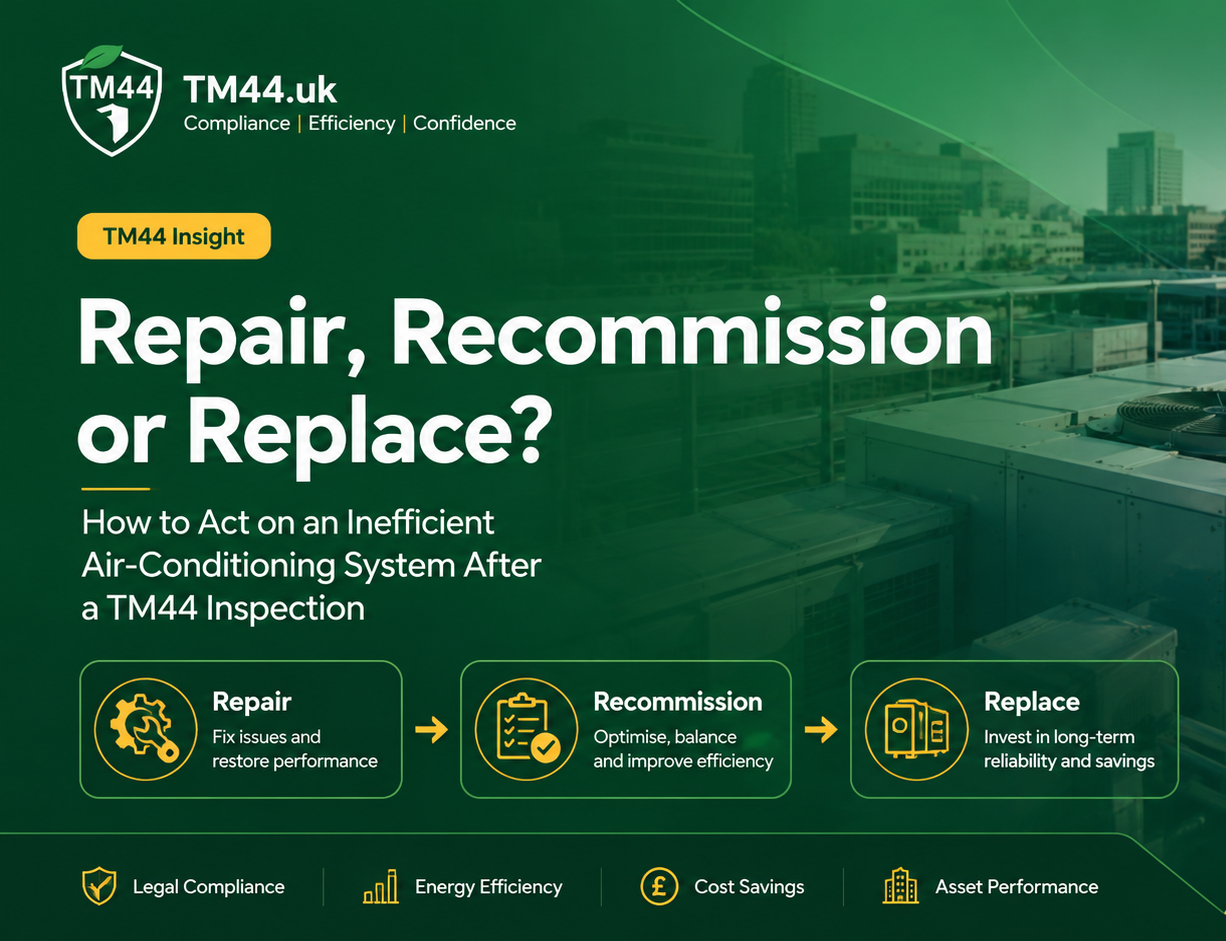
Repair, Recommission or Replace?
Clear answers for building owners, facilities managers, landlords and managing agents deciding what to do after a TM44 inspection identifies inefficient commercial air-conditioning equipment, weak controls or declining system performance.
Route One
Repair
Correct defined faults and restore otherwise suitable equipment.
Route Two
Recommission
Correct schedules, controls, sensors, zoning and system operation.
Route Three
Replace
Renew unreliable, obsolete or commercially inefficient equipment.
Does an inefficient air-conditioning system always need replacing?
No. Inefficiency does not automatically mean the equipment has reached the end of its useful life. Excessive energy use can result from incorrect operating hours, faulty sensors, poor maintenance, inappropriate setpoints, blocked coils or heating and cooling operating at the same time.
A professional TM44 air-conditioning inspection can help distinguish between a repairable fault, an operational problem and equipment that genuinely requires replacement.
When is repairing commercial air conditioning the best option?
Repair is usually appropriate when the system remains suitable for the building and a defined component fault is preventing normal performance. Examples include failed fan motors, defective sensors, damaged insulation, blocked coils, worn actuators or isolated control failures.
Repair becomes less attractive where faults are recurring, spare parts are difficult to source or the wider system is already approaching the end of its useful life.
What does recommissioning an air-conditioning system involve?
Recommissioning reviews how the existing equipment is configured and operated. It may involve correcting time schedules, recalibrating sensors, restoring automatic controls, removing overrides, adjusting temperature settings, improving zoning and coordinating heating and cooling.
The objective is to bring the system back into line with the building's current occupancy, operating hours and cooling demand.
Can recommissioning reduce energy costs without replacing equipment?
Yes. A mechanically sound system can still waste substantial energy when its controls, schedules or sensors are incorrect. Reducing unnecessary operating hours, correcting conflicting setpoints and preventing simultaneous heating and cooling can improve performance without major capital expenditure.
Savings will depend on the building, equipment and severity of the control problems. Performance should be monitored after the changes are completed.
What are the main signs that commercial air conditioning should be replaced?
Replacement should be considered where equipment has become unreliable, inefficient by design, difficult to maintain or unsuitable for the building's present use. Strong indicators include repeated breakdowns, unavailable spare parts, recurring refrigerant loss, excessive energy consumption and rising repair expenditure.
The decision should consider total operating cost and risk rather than comparing only the next repair invoice with the replacement price.
Should ageing equipment be replaced purely because of its age?
Age is important, but it should not be used alone. Some older systems remain reliable and suitable after proper servicing and recommissioning. Other systems decline earlier because of heavy operating hours, poor maintenance, environmental exposure or repeated component failures.
A better decision considers condition, efficiency, reliability, refrigerant type, parts availability, repair history and the building's future requirements.
How do controls affect the repair or replacement decision?
Poor controls can make serviceable equipment appear inefficient. Systems may start too early, run after occupants leave, target unsuitable temperatures or conflict with heating equipment.
Controls should therefore be reviewed before major replacement expenditure. Installing new equipment without correcting the control strategy can transfer existing inefficiencies into the replacement system.
What information should be reviewed before approving replacement?
The responsible person should review the air-conditioning asset register, maintenance records, breakdown history, operating hours, energy consumption, refrigerant information, spare-parts availability and actual building usage.
Where records are incomplete, the TM44 kW checker can support an initial assessment of combined cooling capacity, although a professional review may still be required.
Can a building use repair, recommissioning and replacement together?
Yes. This is often the most practical approach. A building may repair selected components, recommission central controls and replace only the oldest or least reliable equipment.
A phased strategy can reduce immediate capital expenditure while improving performance and creating a planned route for future renewal.
What should happen after TM44 recommendations are received?
The recommendations should be converted into a prioritised action plan. Urgent faults and major energy waste should be addressed first, followed by control improvements, planned repairs and longer-term replacement decisions.
An energy-efficiency upgrade report following TM44 can help organise findings into immediate, short-term and long-term actions. After improvements are completed, energy use, operating hours, comfort complaints and breakdown frequency should be reviewed to confirm the result.
Unsure whether your system needs repair, recommissioning or replacement?
Request a TM44 Quote
Send us the property address, approximate number of systems, available asset information and any previous TM44 report. Our team can review the likely inspection scope and provide a nationwide quotation.
Case Studies & Success Stories Energy Efficiency & Cost Savings Guides & How-To Articles Industry News & Updates TM44 Compliance & Regulations
Related Posts
August 28, 2026