September 18, 2026
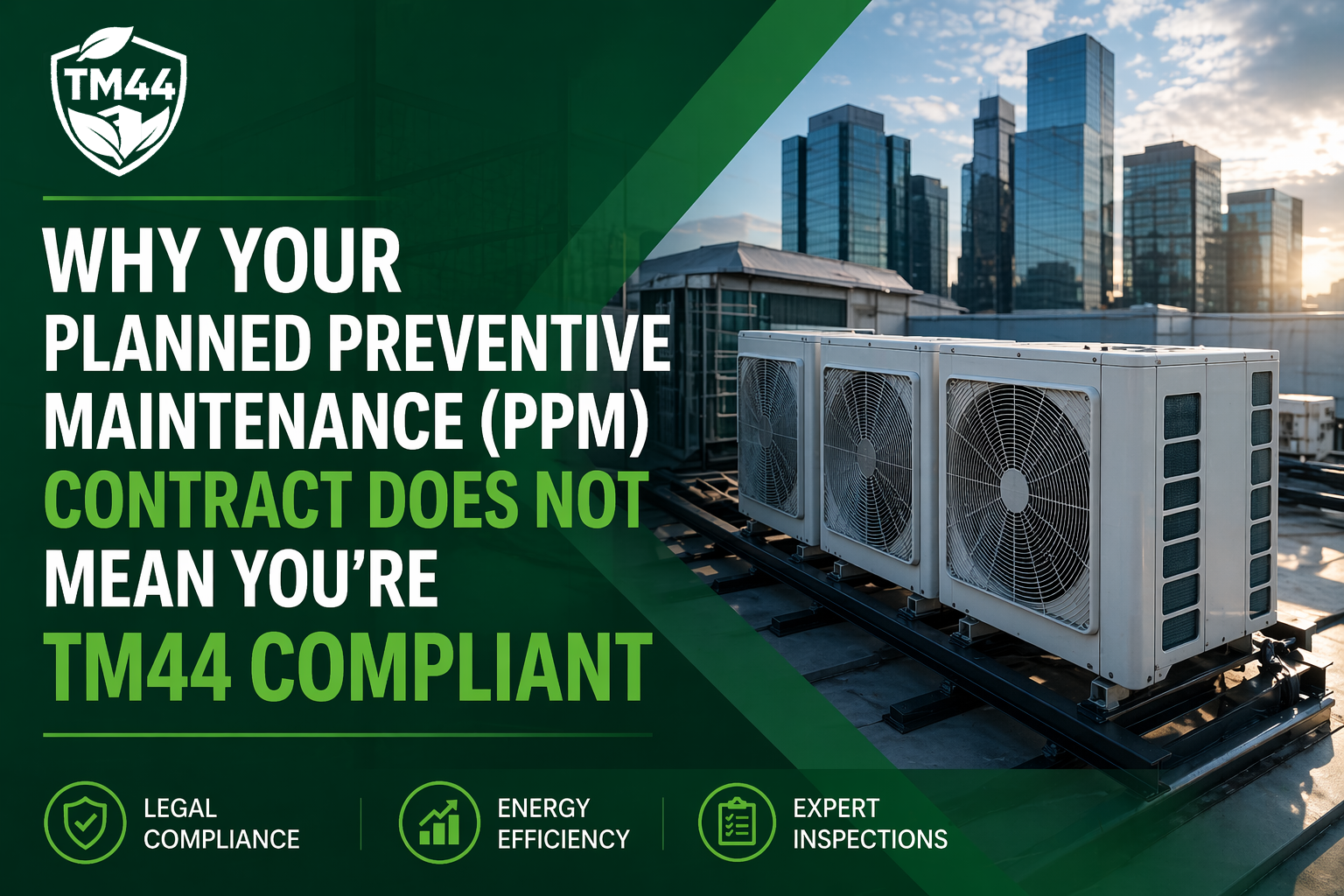
Why Your Planned Preventive Maintenance (PPM) Contract Does Not Mean You’re TM44 Compliant
April 22, 2026

Written by
TM44TeamAlfa
A lot of UK businesses assume that if their air conditioning is already covered by a Planned Preventive Maintenance contract, they must also be covered from a TM44 point of view.
That sounds logical.
But it is wrong.
And it is one of the easiest ways for a business, managing agent, landlord, FM team, or building operator to drift into a compliance gap without realising it.
A PPM contract can be valuable. It can help keep equipment running, reduce breakdowns, improve reliability, extend asset life, and support day-to-day operational performance. But none of that automatically means your building has a valid TM44 inspection, a properly lodged report, or an up-to-date compliance position.
That distinction matters.
Because when people say, “Our AC company already looks after everything,” what they often really mean is:
- the filters get cleaned
- the coils get checked
- the system gets serviced
- the contractor attends when something goes wrong
- and the maintenance file looks active
What they do not necessarily mean is:
- a TM44 inspection has been carried out by the correct type of assessor
- the building’s qualifying systems have been properly reviewed against TM44 requirements
- the inspection report exists and is current
- the report has been lodged correctly
- or the business could actually prove compliance if asked
That is where the problem starts.
If you are still unsure what the TM44 process actually involves, start with our main guide to TM44 air conditioning inspections, then come back here. This article goes deeper into one of the most common and expensive misunderstandings we see in the real world.
Why this confusion happens so often
On paper, maintenance and compliance feel like they should overlap.
A building owner pays an air conditioning company every quarter or every six months. Engineers attend site. Units are checked. Reports may be issued. The system is clearly not being ignored.
So naturally, somebody inside the business assumes the legal side must be covered too.
Sometimes that assumption sits with the facilities manager.
Sometimes it sits with the landlord.
Sometimes it sits with the tenant, managing agent, accounts team, or the director who signed the maintenance agreement years ago and has never looked at it since.
The result is always the same.
Everyone thinks somebody else has dealt with TM44.
Then later, when the building is being sold, leased, refinanced, audited, reviewed internally, or looked at as part of wider energy compliance, the question comes up:
“Do we actually have a valid TM44 report?”
And that is when people realise a PPM contract and TM44 compliance are not the same thing at all.
What a PPM contract actually does
A Planned Preventive Maintenance contract is mainly about ongoing system care.
Depending on the scope, it may include:
- routine visits
- filter cleaning or replacement
- visual checks
- basic operational testing
- condensate checks
- coil cleaning
- refrigerant-related observations
- minor adjustments
- fault finding
- reactive support
- call-out cover
- maintenance reports
That is all useful.
In fact, a strong maintenance regime can help a building perform better and can support some of the recommendations that might later appear inside a TM44 report.
But that still does not turn a maintenance contract into a TM44 inspection.
A PPM agreement is usually a service contract.
TM44 is a separate compliance requirement.
If you want a deeper overview of the legal side, see TM44 legal requirements for commercial buildings and TM44 regulations in the UK.
What TM44 is actually about
TM44 is not just about whether your engineer visited the site.
It is about whether your qualifying air conditioning systems have undergone the correct type of inspection required under the relevant rules for affected non-domestic buildings.
That inspection is a separate compliance process.
It looks at more than just whether the system is working today.
It is concerned with the broader energy-efficiency and inspection position of the installed cooling systems and whether the building has the required report and evidence trail.
If you need a simple breakdown, read our page on TM44 inspection requirements in the UK and our guide to the TM44 certificate.
The mistake businesses make
The most common mistake is this:
They assume routine servicing equals legal compliance.
That assumption is dangerous because it delays action.
A company can spend years paying for maintenance and still have no valid TM44 report.
Worse, they may only discover that when they are already under time pressure.
That usually happens during one of these moments:
1. A sale or lease is happening
A solicitor, buyer, surveyor, or property professional asks for the relevant documentation.
2. A compliance review is taking place
An internal FM or ESG review starts checking the building’s wider obligations.
3. A multi-site portfolio is being cleaned up
Head office realises records are inconsistent across branches.
4. An old report cannot be found
Somebody believes it was done years ago, but nobody can produce it.
5. The building has changed
Units were added, replaced, reconfigured, or expanded over time, but nobody reviewed what that meant from a TM44 angle.
6. The contractor relationship changes
A new provider takes over and says, “We maintain the system, but that does not mean your TM44 position is current.”
At that point the business often has a double problem.
First, they may not be compliant.
Second, they may not even know the real scope of their installed systems.
That is why our TM44 checker and TM44 register resources are so useful as starting points.
Why your maintenance contractor may not have handled TM44
This part matters.
Not every maintenance company is set up to deal with TM44.
Some are excellent at servicing and reactive works but do not offer formal TM44 inspections at all.
Some can arrange them, but only if specifically instructed.
Some assume the client knows it is separate.
Some mention it once in a proposal and never raise it again.
Some include vague wording that sounds broad enough to create false confidence, even though no actual TM44 inspection has been carried out.
And sometimes the opposite happens.
A contractor may genuinely believe they are helping by flagging the issue, but the message never reaches the person inside the client business who actually signs off compliance work.
So the site is maintained, but the TM44 inspection still never gets booked.
That does not necessarily mean anybody acted badly.
It usually means responsibilities were blurred.
Real-world example 1: The office building with a “fully managed” maintenance package
A medium-sized office building in London had a long-running maintenance contract with a mechanical services provider. The building manager was confident everything was covered because the contractor attended regularly, issued service sheets, and dealt with faults quickly.
On an operational level, things looked fine.
Then the ownership team started a broader compliance review. They asked for the current TM44 report.
Nobody had it.
The building manager believed the contractor had done it.
The contractor said the agreement only covered servicing and reactive maintenance.
The ownership team then had to rush the inspection process, review the installed systems properly, and correct the missing compliance record.
The building had not been neglected.
But the paperwork and compliance position were not where the client thought they were.
Real-world example 2: The retail site where everybody assumed head office had handled it
A regional retail operator had a maintenance company visiting sites under a national PPM programme. Individual store managers assumed head office dealt with compliance. Head office assumed the maintenance provider would flag anything critical. The maintenance provider assumed TM44 was outside scope unless specifically requested.
That left a gap.
When the portfolio was later reviewed, multiple sites had active maintenance records but inconsistent TM44 evidence.
That is exactly why portfolio clients need a more joined-up system, not just site-by-site maintenance activity. If that sounds familiar, look at our TM44 portfolio management service.
Real-world example 3: The landlord who had servicing invoices but no usable proof of compliance
A commercial landlord had years of invoices showing that air conditioning maintenance had been carried out. From their point of view, that proved the system was being looked after.
But servicing invoices are not the same thing as a valid TM44 report.
When a transaction began, the landlord needed proper compliance evidence, not just proof that engineers had attended site at various times.
That is a very common issue.
There is a big difference between:
- evidence of maintenance activity
- evidence of equipment condition
- and evidence of TM44 compliance
If you need help understanding the records side, see TM44 inspection evidence and TM44 certificate government lodgement.
The compliance gap nobody talks about enough
This is the part people underestimate.
A building can look professionally managed and still be exposed.
That is because maintenance activity creates a sense of safety.
The file has visit sheets.
The site team knows the contractor.
The system is running.
The units are not obviously failing.
So nobody feels urgency.
But TM44 is not judged by whether the system seems fine.
It is judged by whether the right inspection requirement has been dealt with properly and whether the business can support that position with the correct records.
That is why businesses get caught off guard.
Not because they ignored their building.
But because they assumed maintenance automatically meant compliance.
How to tell if your PPM contract probably does not cover TM44
If any of the below sound familiar, you should not assume you are covered:
You have service sheets, but no TM44 report
A service record is not a TM44 report.
You cannot find any lodged documentation
If nobody can show where the report is or when it was done, that is a red flag.
The maintenance contractor has never clearly said “TM44 inspection completed”
Assumptions are where problems start.
You inherited the building, lease, or contract from somebody else
A lot of compliance gaps are inherited, not created by the current team.
The system has changed over time
Additional units, replaced condensers, phased fit-outs, and layout changes can all create confusion.
Your team says “I think we did it years ago”
That usually means nobody has verified the position properly.
You can start with our pages on the TM44 lodgement process and what the TM44 register is if you want to understand what should exist.
What a smart building operator should do instead
The fix is actually pretty simple.
Do not rely on assumptions.
Treat maintenance and TM44 as two linked but separate tracks.
Track one: Keep your maintenance regime active
This supports operational performance and system reliability.
Track two: Verify your TM44 position properly
This ensures the building’s compliance side is not being left to guesswork.
The smartest clients do both.
They do not cancel maintenance.
They do not treat TM44 as an afterthought.
They line the two up properly.
That means:
- identifying qualifying systems
- confirming whether a current TM44 report exists
- checking whether the report is relevant and usable
- understanding whether the report has been lodged correctly
- making sure internal records are clean
- creating a renewal and review process so the issue does not return later
Why this matters even more for larger businesses and managing agents
The bigger the portfolio, the easier it is for this to go wrong.
A single site may be manageable by memory.
A multi-site estate is not.
Different contractors, different leases, different installation dates, different documentation standards, and different internal teams create confusion fast.
That is why managing agents, portfolio landlords, FM providers, and growing businesses should be especially careful with the “PPM equals compliance” myth.
The more sites you control, the more dangerous that assumption becomes.
Our areas we cover and national quote process are designed for exactly that type of client. If you need fast support, go straight to Get a Quote.
Where PPM and TM44 do connect
To be fair, they are not unrelated.
A good maintenance regime can support a better building outcome overall.
For example:
- well-maintained systems often perform more efficiently
- obvious issues may be picked up earlier
- records may be easier to gather
- asset understanding may be clearer
- recommendations from a TM44 report may be easier to action if the maintenance contractor is already engaged
That is the right way to think about it.
PPM can support TM44 readiness.
But it does not replace TM44.
That is the clean distinction.
The business cost of getting this wrong
The cost is not only legal or procedural.
It is also commercial.
When businesses realise too late that they do not have the right evidence, the result is usually one or more of the following:
- urgent inspection booking under pressure
- delayed transactions
- internal escalation
- awkward conversations between landlord, tenant, agent, and contractor
- rushed document searches
- duplicated effort
- higher admin burden
- avoidable reputational stress
- and sometimes a wider realisation that the site’s compliance records are messier than anyone thought
That is why this is worth fixing before it becomes urgent.
If you are already looking at the risk side, our page on TM44 enforcement, fines, and penalties in the UK is worth reading too.
What we do at TM44.uk
At TM44.uk, we help businesses cut through this exact confusion.
We do not treat TM44 like vague background admin.
We help clients understand where they actually stand, what they need, and what is missing.
That includes support with:
- TM44 air conditioning inspections
- TM44 certificates and reports
- government lodgement support
- register and record checks
- portfolio management support
- emergency turnaround where required
- related compliance support where relevant
If you already have maintenance in place, that is fine.
In many cases, that is a good thing.
But if you want clarity on your actual TM44 position, that is where we come in.
Useful service pages to review next:
- TM44 air conditioning inspections
- TM44 report
- TM44 certificate
- TM44 survey
- TM44 certificate government lodgement
- Emergency TM44 24–48 hour service
- Annual AC health check service
- F-Gas leak testing and compliance checks
Final word
A Planned Preventive Maintenance contract is useful.
It can be smart.
It can be necessary.
It can absolutely help protect your system.
But it is not the same thing as TM44 compliance.
That is the key point.
If your business has been assuming the maintenance company “already handles all that,” now is the time to check, not later when a transaction, audit, or internal review puts you under pressure.
Because the businesses that get caught out are not always careless.
A lot of them are just running on the wrong assumption.
And that assumption is simple:
“We have PPM, so we must be covered.”
Not necessarily.
If you want a clear answer on where you stand, get a quote here or use the TM44 Checker to start with the basics.
TM44 Checker v9 Pro
Check TM44 compliance status in seconds
Search the official GOV data routes and public register fallback. If a record is missing or unclear, request a manual compliance review from TM44.uk.
Official data routesGOV fallbackCommercial buildings only
Case Studies & Success Stories Energy Efficiency & Cost Savings Guides & How-To Articles Industry News & Updates TM44 Compliance & Regulations
Related Posts
September 17, 2026