September 8, 2026
Can a TM44 Inspection Fail? What Building Owners Need to Know
May 10, 2026

Written by
TM44TeamAlfa
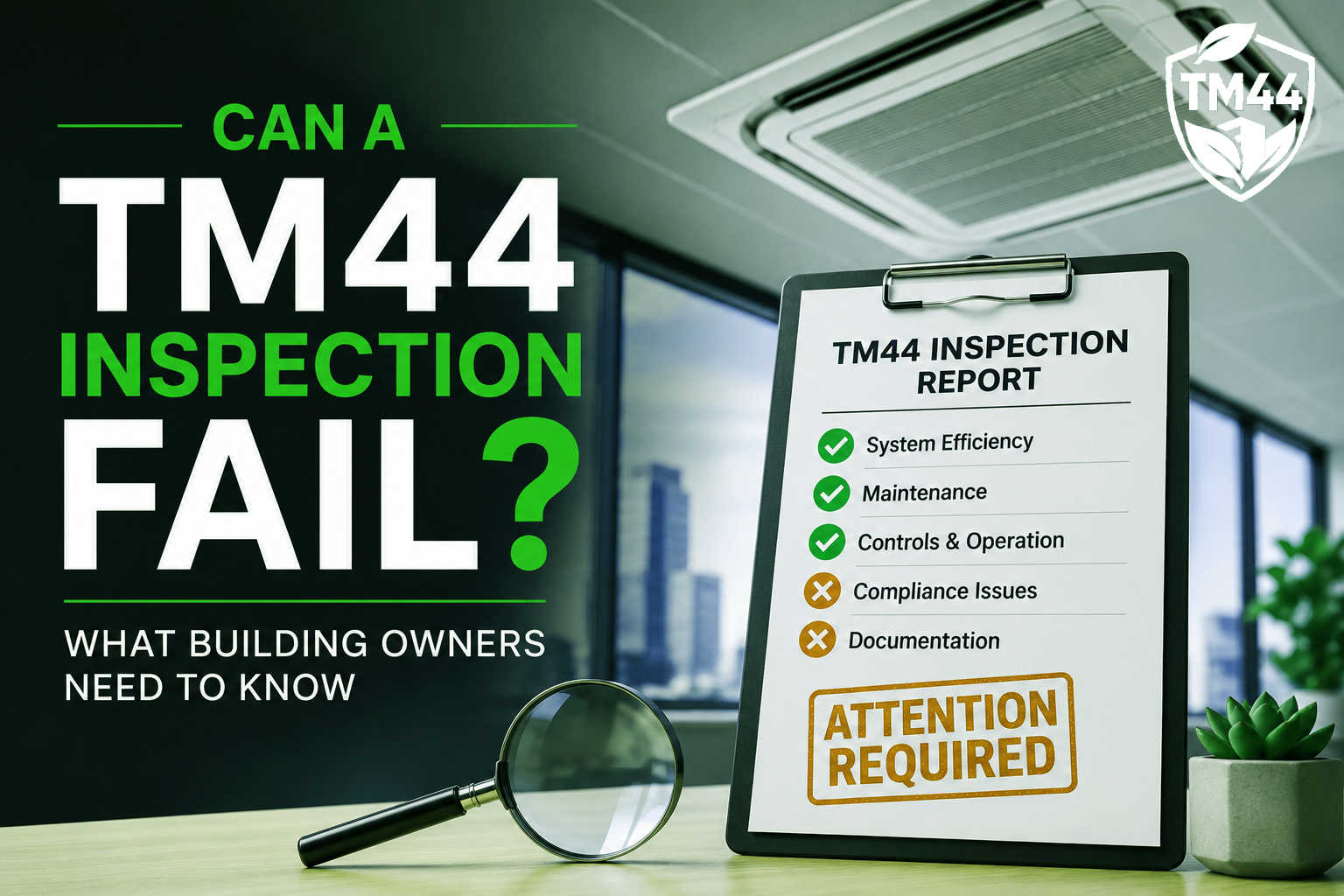
A TM44 inspection is not normally a simple pass or fail test. It is an air conditioning energy assessment designed to review the efficiency, condition, controls, maintenance and documentation of a qualifying commercial air conditioning system.
However, that does not mean there are no bad outcomes.
A building may still receive a TM44 report even if the air conditioning system is inefficient, poorly maintained, incorrectly controlled or missing key information. The real risk for a building owner, landlord, managing agent or facilities manager is not usually “failing” the inspection in the traditional sense. The bigger risk is having no valid TM44 report, an expired report, poor evidence, incomplete asset information or serious efficiency issues that are clearly identified in the report.
This guide explains what actually happens during a TM44 inspection, whether a TM44 assessment can fail, what a poor result looks like, and how building owners can reduce compliance and operational risk before an assessor attends site.
If you already know your building needs an assessment, you can book a TM44 inspection here.
Quick Answer: Can a TM44 Inspection Fail?
In most cases, a TM44 inspection does not “fail” in the same way as a gas safety check or electrical test. A TM44 inspection produces an air conditioning inspection report. That report records the condition, efficiency and operation of the air conditioning system and provides recommendations for improvement.
A poor TM44 outcome may include:
- Inefficient air conditioning equipment
- Poor maintenance records
- Missing asset lists
- Incorrect control settings
- Oversized or undersized systems
- Outdated or high-energy equipment
- Lack of access to plant areas
- Incomplete documentation
- Expired previous TM44 report
- No evidence that the report has been lodged correctly
The key point is this: the legal compliance issue is usually whether the qualifying system has been inspected by an accredited energy assessor within the required inspection cycle, not whether every recommendation in the report has been completed immediately.
For a wider explanation of the legal requirement, read our guide on what a TM44 inspection is.
Why People Ask Whether a TM44 Inspection Can Fail
Many building owners ask this question because they are used to other compliance checks where the outcome feels more binary.
For example, an EICR can be satisfactory or unsatisfactory. Gas safety checks can identify defects that require urgent action. Fire safety assessments can highlight serious risk items that need corrective works. Because of that, many commercial property owners assume a TM44 inspection works in the same way.
TM44 is different.
A TM44 inspection is primarily an energy efficiency and compliance assessment for air conditioning systems. It is designed to help the person responsible for the system understand whether the air conditioning equipment is operating efficiently, whether it is being maintained properly, whether controls are being used effectively and whether improvements could reduce energy consumption and carbon emissions.
That means the result is usually a detailed report, not a one-word pass or fail certificate.
However, a poor report can still create commercial pressure. It can expose inefficiency, show weak management, create problems during audits, raise questions during property transactions and reveal that a building has been wasting energy for years.
If your concern is whether your current report has expired, see our guide on what happens when a TM44 certificate has expired.
What Is a TM44 Inspection?
A TM44 inspection, also known as an air conditioning inspection or air conditioning energy assessment, is a statutory inspection for qualifying air conditioning systems in commercial buildings. In simple terms, it checks whether the system is being operated and maintained efficiently.
The requirement normally applies where the effective rated cooling output is over 12kW. This can include a single large system or multiple smaller air conditioning units in the same building where the combined output exceeds the threshold.
If you are unsure whether your building is caught by the threshold, read our guide on how to check the TM44 12kW threshold.
A TM44 inspection may apply to:
- Offices
- Retail units
- Hotels
- Restaurants and cafés
- Shopping centres
- Gyms and leisure centres
- Schools and colleges
- NHS and private healthcare buildings
- Warehouses with comfort cooling
- Data centres and server rooms
- Multi-site commercial portfolios
- Mixed-use buildings with commercial air conditioning
The inspection must be completed by an accredited air conditioning energy assessor. After the inspection, a report is produced and lodged where required. The report provides information about the system and gives recommendations to improve efficiency.
For building owners managing multiple properties, see our guide to TM44 for multi-site businesses.
What Does a TM44 Assessor Check?
A TM44 assessor is not simply looking at whether the air conditioning unit turns on. The assessment considers how the system is installed, controlled, maintained and used.
A typical TM44 inspection may review:
- The type and size of the air conditioning system
- The cooling capacity of the system
- Whether the system exceeds the 12kW threshold
- The location and number of indoor and outdoor units
- The condition of visible equipment
- Maintenance records and service history
- Control settings and operating schedules
- Thermostat locations and settings
- Whether the system is likely to be oversized or undersized
- Evidence of poor performance or energy waste
- The suitability of controls for the building use
- Opportunities to improve efficiency
- Practical recommendations for the person responsible
The assessor may also ask for documents such as asset lists, maintenance records, previous TM44 reports, system drawings, O&M manuals and access information. If those records are missing, the assessment can still often proceed, but the report may note that information was unavailable.
That is why we created a separate guide on what we need from you for a TM44 quote.
Can an Inefficient Air Conditioning System Still Receive a TM44 Report?
Yes. An inefficient air conditioning system can still receive a TM44 report.
This is one of the biggest misunderstandings. A TM44 inspection is not there only to approve perfect systems. It is there to inspect qualifying systems and identify how efficiently they are performing. If a system is old, badly controlled or consuming more energy than necessary, the report should highlight this.
A poor system may still have a valid TM44 report once it has been inspected and lodged correctly. The report may then contain recommendations such as:
- Review control settings
- Improve maintenance procedures
- Clean or replace filters
- Repair damaged insulation
- Check refrigerant condition
- Upgrade old controls
- Review zoning
- Replace inefficient equipment
- Improve time schedules
- Investigate excessive energy use
The important point is that the report does not normally force immediate upgrade works by itself. But ignoring the recommendations can be commercially risky, especially if the system is wasting energy, affecting comfort or creating avoidable running costs.
For more detail, read our guide on TM44 certificates for inefficient air conditioning systems.
What Does a Bad TM44 Inspection Outcome Look Like?
A bad TM44 outcome is not always labelled as “failed”. Instead, it usually appears through the findings and recommendations in the report.
A poor outcome may include comments such as:
- The system appears poorly maintained
- Maintenance records were not available
- Asset information was incomplete
- Controls were not set appropriately
- Cooling was operating outside business hours
- The system appears oversized for the cooling load
- The system appears inefficient for current use
- No previous TM44 inspection evidence was provided
- Plant access was restricted
- Several recommendations were raised for improvement
This kind of report can still be valid, but it may show that the building has avoidable energy waste or weak compliance management.
That matters because TM44 is not only about avoiding enforcement. It is also about understanding whether your air conditioning system is costing more than it should.
If your business is trying to reduce energy waste, see our guide on how TM44 inspection companies reduce energy waste and operating costs.
Example Scenario 1: The Office With No Asset List
A facilities manager contacts TM44.uk because their office building has several wall-mounted split units and a few cassette units across three floors. They believe the system might be over 12kW but do not have a full asset list.
During the quote stage, the assessor asks for basic information, including unit locations, model references and maintenance records. The client only has partial information. A site visit is booked anyway.
On site, the assessor identifies enough air conditioning equipment to confirm that the building is likely within the TM44 requirement. The inspection proceeds, but the report notes that complete asset records were not available.
Did the TM44 inspection fail?
Not necessarily. The inspection can still result in a report. But the poor documentation becomes a finding. The building owner now has a clear recommendation to create and maintain an accurate asset register.
The lesson: missing records do not always stop a TM44 inspection, but they weaken your compliance file.
For this exact issue, see our guide on what happens when you have no asset list for a TM44 inspection.
Example Scenario 2: The Retail Unit With AC Running Overnight
A retail unit has multiple air conditioning systems serving the shop floor, stockroom and staff areas. The building has a valid maintenance contract, but the energy bills are unusually high.
During the TM44 inspection, the assessor reviews the control settings and finds that parts of the system are cooling outside trading hours. The equipment is working, but the control strategy is poor.
Did the TM44 inspection fail?
No. But the report highlights a clear energy waste issue. The recommendation may be to review time schedules, adjust temperature setpoints and improve zoning.
This is where TM44 can become valuable. It does not simply confirm legal compliance. It can reveal small operational problems that cost money every month.
If you think your building has AC efficiency issues, read our article on common TM44 AC efficiency problems.
Example Scenario 3: The Landlord Who Assumed the Tenant Was Responsible
A commercial landlord owns a mixed-use building with a ground-floor shop and offices above. The tenant controls some of the air conditioning systems, while the landlord controls plant serving common areas.
Nobody has arranged a TM44 inspection because each party assumes the other is responsible.
When a managing agent reviews the compliance file, they discover there is no valid TM44 report. The building is now exposed to compliance risk and a new inspection needs to be arranged.
Did the TM44 inspection fail?
The problem is not that the inspection failed. The problem is that no inspection was arranged in the first place.
This is one of the most common TM44 risks. The person who controls the operation of the air conditioning system is usually the key party, but responsibility can become complicated in leased, multi-let or managed buildings.
For more detail, see our TM44 responsibility guide and our article on TM44 legal responsibility for landlords, tenants and managing agents.
Do You Have to Fix Everything in a TM44 Report?
In most cases, the TM44 report provides recommendations rather than an automatic legal order to complete every improvement immediately.
That said, the recommendations should not be ignored.
A TM44 report may identify items that are low-cost and easy to fix, such as incorrect time schedules or poor thermostat settings. It may also identify longer-term improvement opportunities, such as upgrading inefficient equipment or reviewing system design.
Even where recommendations are not mandatory in the same way as some safety remedial works, they can still matter for:
- Energy bills
- Tenant comfort
- ESG reporting
- Asset management
- Maintenance planning
- Corporate sustainability targets
- Property transactions
- Insurance and risk discussions
- Future compliance audits
For a deeper explanation of how to interpret recommendations, read our guide on TM44 report recommendations explained.
What Is the Biggest TM44 Compliance Risk?
The biggest TM44 risk is not usually a poor recommendation. It is having no valid report when your building needs one.
A business can have well-maintained air conditioning equipment and still be non-compliant if it has not arranged the required inspection. A maintenance contract does not automatically replace a TM44 inspection. Servicing and statutory energy assessment are different things.
This is a critical point for facilities managers and landlords. Many assume their air conditioning maintenance provider has “covered everything”. In reality, routine servicing, F-Gas obligations and TM44 inspections serve different purposes.
If this applies to your building, read our guide on PPM contract vs TM44 compliance.
The second biggest risk is an expired TM44 report. TM44 inspections must be renewed within the required cycle. If the report is old, the building may no longer have an up-to-date compliance position.
See our guide on TM44 renewal cost in 2026 if you are planning renewal.
TM44 Inspection Result vs TM44 Certificate
Many people use the words “TM44 certificate” and “TM44 report” interchangeably. In practice, the important document is the inspection report produced by the accredited assessor and lodged correctly where required.
A TM44 certificate is often used as a shorthand phrase by building owners and managing agents. But the report is what contains the useful information: findings, recommendations, system details and efficiency advice.
This matters because a building owner should not only ask, “Do I have a certificate?” They should also ask:
- Is the report still valid?
- Was it completed by an accredited assessor?
- Was it lodged correctly?
- Does it cover the relevant systems?
- Are there recommendations we should act on?
- Do we have the report available if requested?
- Has the building changed since the last inspection?
For more detail, read our full guide to the TM44 certificate and government lodgement process.
What Problems Can a TM44 Report Highlight?
A TM44 inspection can identify several categories of issues. These may not create a “fail” result, but they can still be important.
1. Maintenance Issues
The assessor may find signs that the system is not being maintained adequately. This could include dirty filters, blocked grilles, damaged components or a lack of maintenance records.
2. Control Issues
Poor controls are one of the most common causes of energy waste. Systems may run when the building is empty, operate at unsuitable temperatures or fight against heating systems.
3. Documentation Issues
Missing asset lists, unavailable manuals, incomplete service records and no previous TM44 report can make the compliance position weaker.
4. Sizing Issues
The report may suggest that the system appears oversized or undersized compared with the cooling load. Oversized systems can be inefficient. Undersized systems may struggle to maintain comfort.
5. Efficiency Issues
Older systems may consume more energy than necessary. A report may recommend upgrades, better maintenance, improved controls or further review.
6. Operational Issues
The way a building is used can change over time. A system originally designed for one layout may no longer suit the current occupancy, opening hours or internal heat loads.
For more examples, read our guide to TM44 hidden failures that still cause fines.
Can You Be Fined After a Poor TM44 Inspection?
The fine risk is mainly linked to non-compliance, such as failing to have a required inspection or failing to produce the report when requested. A poor report by itself is not usually the same as having no report.
However, poor documentation and weak compliance management can still make enforcement situations more difficult. If a local authority, buyer, solicitor, tenant or managing agent asks for the TM44 evidence and you cannot produce it, the issue becomes more serious.
This is why every building owner should keep a clear TM44 compliance file.
That file should include:
- Current TM44 report
- Previous TM44 report if available
- Evidence of lodgement
- Air conditioning asset list
- Maintenance records
- F-Gas records where relevant
- Access information
- O&M manuals if available
- Contact details for the responsible person
- Notes of any recommendations reviewed or acted on
For a full breakdown, see our guide on TM44 compliance file documents businesses should keep.
How Building Owners Can Avoid a Bad TM44 Outcome
The best way to avoid a poor TM44 outcome is to prepare before the inspection.
Here is a practical checklist.
1. Confirm Whether the 12kW Rule Applies
Do not assume each unit must be over 12kW individually. Several smaller units can add up. If one person controls the system and the combined output exceeds the threshold, the building may need a TM44 inspection.
Read our guide on the hidden TM44 air conditioning systems and the 12kW rule.
2. Find the Latest TM44 Report
Check whether the building has had a previous inspection. If yes, confirm the date and whether it is still valid.
3. Prepare an Asset List
List all indoor and outdoor units where possible. Include make, model, location and cooling output if available.
4. Gather Maintenance Records
Ask your maintenance contractor for service records. Even basic records are better than nothing.
5. Check Access Arrangements
Make sure the assessor can access plant rooms, roof areas, risers, ceiling voids or other relevant locations safely.
6. Review Operating Hours
If the system is running outside occupancy hours, check whether this is intentional. Poor schedules can lead to avoidable energy waste.
7. Identify the Responsible Person
Clarify whether the building owner, tenant, managing agent or facilities manager controls the system.
8. Book Early
Do not wait for a warning letter, sale, lease event or audit request. TM44 compliance is easier and cheaper to manage in advance.
If you need help, you can request a TM44 quote here.
Why This Topic Matters for Property Transactions
TM44 is increasingly relevant during commercial property transactions. Buyers, tenants, solicitors, managing agents and lenders may ask for energy and compliance documents before a deal completes.
If a building has air conditioning but no valid TM44 report, it can raise questions such as:
- Who controls the system?
- Is the building compliant?
- Has the system been inspected within the required period?
- Are there hidden energy efficiency problems?
- Will the buyer inherit compliance risk?
- Will the tenant need to arrange an inspection after completion?
- Could missing documentation delay the transaction?
A poor TM44 position may not always stop a transaction, but it can create additional questions and friction. For commercial landlords, it is better to have the report ready before a buyer or solicitor asks.
For transaction-related guidance, read our article on TM44 inspection before selling or leasing commercial property and TM44 commercial property deal risk.
Why Facilities Managers Should Not Treat TM44 as a Box-Ticking Exercise
A basic compliance mindset asks: “Do we have the report?”
A better facilities management mindset asks: “What is the report telling us?”
That second question is where TM44 becomes more valuable.
A well-used TM44 report can support:
- Energy reduction planning
- Maintenance strategy
- Budget forecasting
- AC replacement planning
- Carbon reduction targets
- Comfort improvements
- Better tenant communication
- Audit readiness
If the report identifies poor controls, outdated equipment or unnecessary cooling hours, there may be practical savings available. The report can help facilities teams justify improvement works to senior management because the recommendations come from an accredited assessment.
For facilities teams, we recommend reading TM44 for facilities managers and avoiding compliance risks with a TM44 survey.
TM44 Inspection Failure Myths
Myth 1: “If the system works, it will pass.”
Not necessarily. A system can cool the building and still be inefficient, poorly controlled or badly documented.
Myth 2: “My maintenance contract means I do not need TM44.”
Incorrect. Maintenance and TM44 inspections are separate. A maintenance contract may help, but it does not automatically replace a statutory TM44 inspection.
Myth 3: “Only large office buildings need TM44.”
Incorrect. Smaller commercial premises can also qualify if the combined air conditioning output exceeds the threshold.
Myth 4: “If recommendations are not mandatory, the report does not matter.”
Incorrect. Recommendations can still affect energy costs, asset management, tenant comfort and commercial risk.
Myth 5: “A TM44 report is only useful for avoiding fines.”
Incorrect. A good report can also help reduce operating costs and improve system performance.
For more general compliance information, visit our TM44 compliance guide for businesses.
Should You Be Worried If Your TM44 Report Contains Recommendations?
No, not automatically.
Recommendations are normal. A TM44 report with recommendations does not mean the assessor has failed your building. It means the inspection has identified ways to improve efficiency, maintenance or operation.
In many cases, recommendations are practical and sensible. For example:
- Adjust time schedules
- Review setpoints
- Improve maintenance evidence
- Update asset records
- Consider control upgrades
- Review plant replacement at end of life
The problem is not receiving recommendations. The problem is ignoring obvious issues for years, especially where the system is wasting energy or affecting comfort.
A proactive building owner should review the report, prioritise low-cost improvements and record any action taken.
When Should You Book a New TM44 Inspection?
You should consider booking a TM44 inspection if:
- Your building has air conditioning over the threshold
- You do not have a current TM44 report
- Your existing report has expired
- You have installed new air conditioning
- The building has changed use
- A tenant, buyer or solicitor has requested compliance documents
- You have received a warning letter
- You are preparing a compliance audit
- You manage a multi-site portfolio and need to standardise records
- You are unsure whether the 12kW rule applies
If you need a fast inspection, see our Emergency TM44 24/48 hour service.
Final Answer: Can a TM44 Inspection Fail?
A TM44 inspection does not usually fail in a simple pass or fail format. It produces a report that assesses the air conditioning system and highlights recommendations.
However, a poor TM44 inspection outcome can still expose serious problems. These may include inefficient equipment, weak maintenance records, missing documentation, poor controls, excessive energy use or an expired compliance position.
For building owners, the best approach is simple:
- Confirm whether your system is over 12kW
- Check whether you have a valid TM44 report
- Prepare asset and maintenance records
- Make site access easy for the assessor
- Review recommendations after the report
- Keep a proper TM44 compliance file
- Book renewal before the report expires
If you are unsure whether your building is compliant, TM44.uk can help you check the requirement, arrange an inspection and provide a clear route to compliance.
Get a TM44 inspection quote today.
FAQs
Can a TM44 inspection fail?
A TM44 inspection does not normally fail in a simple pass or fail way. It produces a report that reviews the air conditioning system’s efficiency, controls, maintenance and documentation. A poor report can still highlight serious issues that building owners should review.
What happens if problems are found during a TM44 inspection?
The problems are usually recorded in the TM44 report as findings or recommendations. These may relate to maintenance, controls, efficiency, documentation or system sizing. The building owner or responsible person should review the recommendations and decide what action is practical.
Can an inefficient air conditioning system still get a TM44 report?
Yes. A TM44 report can still be produced for an inefficient system. The report may identify that the system is wasting energy, poorly controlled or due for improvement. The key compliance point is that the qualifying system has been inspected by an accredited assessor.
Do I have to complete every TM44 recommendation?
In most cases, TM44 recommendations are advisory rather than automatic mandatory works. However, they should not be ignored. Acting on recommendations can reduce energy costs, improve comfort and strengthen the building’s compliance file.
What is the biggest TM44 compliance risk?
The biggest risk is usually not having a valid TM44 report when one is required. Other risks include expired reports, missing asset lists, poor maintenance evidence and assuming that a maintenance contract replaces a TM44 inspection.
Does a maintenance contract replace a TM44 inspection?
No. A maintenance contract does not automatically replace a TM44 inspection. Maintenance, F-Gas checks and TM44 inspections serve different purposes. A building may be maintained regularly but still need a separate statutory TM44 assessment.
Who is responsible for arranging a TM44 inspection?
Responsibility usually sits with the person who controls the operation of the air conditioning system. This may be the building owner, landlord, tenant, managing agent or facilities manager, depending on the lease and building setup.
Should I book a TM44 inspection before selling or leasing a commercial property?
Yes, if the building has qualifying air conditioning and no current report. Having a valid TM44 report ready can reduce transaction delays and provide better compliance evidence for buyers, tenants, solicitors and managing agents.
TM44 Checker v9 Pro
Check TM44 compliance status in seconds
Search the official GOV data routes and public register fallback. If a record is missing or unclear, request a manual compliance review from TM44.uk.
Official data routesGOV fallbackCommercial buildings only
Case Studies & Success Stories Energy Efficiency & Cost Savings Guides & How-To Articles Industry News & Updates TM44 Compliance & Regulations
Related Posts
August 28, 2026