October 13, 2026
The TM44 Evidence Standard: What Actually Proves Your Building Is Compliant?
July 28, 2026

Written by
TM44TeamAlfa
Commercial buildings often have large compliance folders, maintenance records, service invoices, contractor emails and technical documents. Yet when a question is raised about TM44 compliance, the presence of paperwork does not necessarily mean the building is compliant.
This is where confusion begins.
A facilities manager may have an annual maintenance certificate. A landlord may have an F-Gas record. A managing agent may have an old air-conditioning report saved on a shared drive. A tenant may have emails confirming that the system was serviced. All of these documents may be useful, but they do not carry the same evidential weight.
The central question is not simply whether documents exist.
The real question is:
What evidence actually proves that the building has met its TM44 air-conditioning inspection obligations?
For commercial buildings with qualifying air-conditioning systems, the answer depends on the status, accuracy and validity of the inspection report, the building details recorded, the assessor who completed the inspection and whether the report was properly lodged.
Understanding that evidence hierarchy is essential for landlords, tenants, managing agents, facilities managers, property investors and anyone responsible for commercial building compliance.
Why TM44 compliance is often misunderstood
TM44 inspections concern the energy performance and operation of qualifying air-conditioning systems in non-domestic buildings.
Where the combined effective rated output of the relevant air-conditioning systems exceeds 12 kW, an inspection is generally required at least every five years. You can read more about the wider legal framework in our guide to TM44 inspection requirements in the UK.
The inspection is not the same as an annual service. It is not the same as refrigerant leak testing. It is not replaced by an EPC, a maintenance contract or a contractor’s site report.
This distinction matters because commercial property teams often combine several different compliance duties under one broad heading such as “air-conditioning paperwork”.
That may include:
F-Gas records
maintenance schedules
service invoices
equipment warranties
commissioning documents
asset registers
breakdown reports
repair quotations
BMS trend data
an EPC
an old TM44 report
Each record can be useful. Some may support the inspection process. Others may help establish system capacity, maintenance condition or operational history.
However, only certain evidence proves that a valid TM44 inspection has actually been completed.
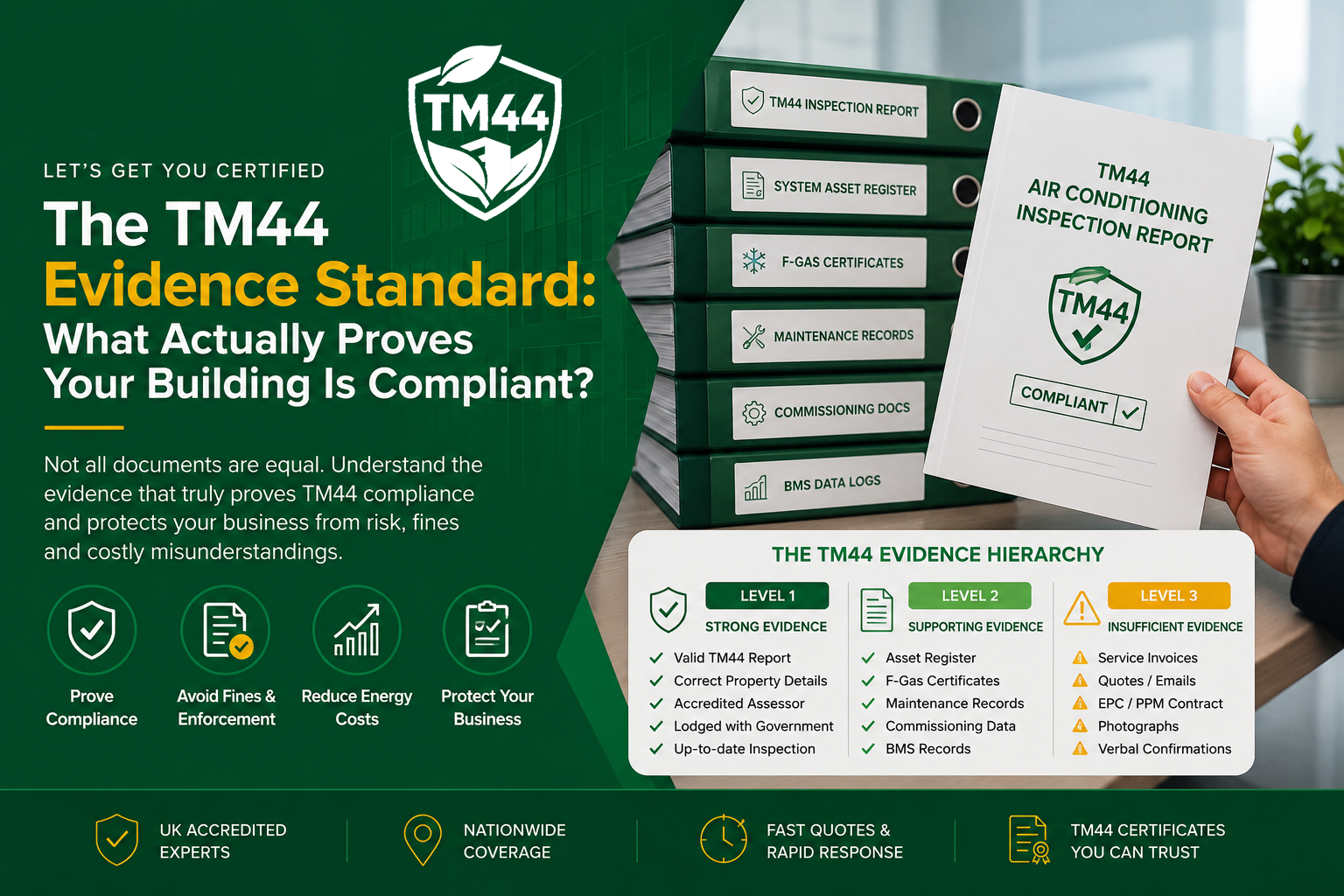
The TM44 evidence hierarchy
A practical way to understand TM44 compliance is to divide the available evidence into three levels.
Level 1: primary compliance evidence
This is the evidence that directly demonstrates that the building has undergone the required air-conditioning inspection.
The strongest evidence normally includes:
a current TM44 air-conditioning inspection report;
the correct building address and relevant property details;
the inspection date;
identification of the accredited air-conditioning energy assessor;
information about the systems assessed;
evidence that the report was properly lodged;
a report that remains within its valid inspection cycle.
This is the core compliance position.
A report that is current, accurate and properly lodged provides a much stronger basis than an invoice, maintenance certificate or contractor email.
For a detailed explanation of the inspection document itself, see our guide to the TM44 report.
Level 2: supporting technical evidence
Supporting evidence helps demonstrate that the air-conditioning systems have been identified, maintained and understood correctly.
This can include:
air-conditioning asset registers;
equipment schedules;
manufacturer specifications;
maintenance records;
F-Gas documentation;
commissioning certificates;
previous inspection reports;
building management system data;
cooling-capacity calculations;
plant replacement records;
annotated floor plans;
photographs of internal and external equipment.
These documents can be important during the inspection. They may help the assessor confirm the number, type, age, location and rated output of the systems.
They can also reduce uncertainty and help produce a more accurate report.
But supporting evidence is not the same as proof that the statutory inspection has been completed.
Level 3: documents that do not prove compliance on their own
Many records are regularly mistaken for TM44 evidence.
These include:
service invoices;
maintenance quotations;
PPM contracts;
engineer attendance sheets;
photographs of air-conditioning equipment;
verbal confirmation from a contractor;
emails stating that the building is compliant;
an EPC;
a quotation for a future TM44 inspection;
evidence that units are rarely used;
evidence that a system has been switched off;
an incomplete or draft inspection report.
These may support a broader compliance file, but they do not independently demonstrate that the required TM44 inspection has taken place.
What a valid TM44 report should establish
A TM44 report should not be treated as a generic certificate with no technical content.
A proper inspection is intended to assess the energy performance and operational condition of the air-conditioning systems. It may consider the efficiency of the installed equipment, maintenance arrangements, system controls, operating conditions and opportunities for improvement.
The report should be linked to the correct building and should provide enough information to identify the systems that were considered.
It should not leave the responsible person guessing whether the inspection relates to:
the whole building;
one tenant’s area;
a single system;
part of a multi-let property;
a previous configuration of the building;
equipment that has since been replaced.
This is especially important in commercial buildings that change over time.
A property may undergo refurbishment. Tenants may install additional split systems. A landlord may replace central plant. Internal layouts may change. New cooling equipment may be added to server rooms, meeting rooms, kitchens or specialist areas.
A report can only provide reliable evidence where it relates to the actual building and system configuration.
Where major changes have occurred, relying automatically on an older report may create a false sense of security.
Why correct property details matter
One of the first checks should be whether the report identifies the correct property.
This sounds obvious, but address problems are common.
A report may refer to:
the wrong unit number;
the landlord’s postal address rather than the inspected site;
an outdated company name;
part of a larger complex;
a previous building name;
an incomplete postcode;
a multi-let property without identifying the inspected area.
Minor administrative differences do not always invalidate the underlying inspection, but material uncertainty should not be ignored.
If the report cannot be confidently connected to the correct building and systems, its evidential value is weakened.
The responsible person should be able to explain clearly:
which property was inspected;
which systems were included;
when the inspection occurred;
who carried it out;
whether the report was lodged;
when the next inspection is due.
If those questions cannot be answered, further review may be necessary.
Why assessor accreditation matters
TM44 inspections must be carried out by an appropriately accredited air-conditioning energy assessor.
A general air-conditioning engineer may be highly experienced in installation, servicing and repair, but that does not automatically mean they are authorised to complete and lodge a TM44 inspection report.
The distinction is important.
An engineer can service the system.
A maintenance contractor can replace components.
An F-Gas-qualified technician can carry out relevant refrigerant work.
But the TM44 inspection must be completed by someone holding the appropriate qualification and accreditation for the type and complexity of the system being assessed.
Our guide on who can carry out a TM44 inspection explains this distinction in more detail.
Where evidence is being reviewed, the assessor’s identity and accreditation should form part of the compliance check.
Why government lodgement matters
A physical or digital report is only part of the evidence.
The report should also be properly lodged through the required process.
Lodgement provides an official record of the assessment and is an important part of demonstrating that the inspection was completed correctly.
A draft PDF stored in an email inbox is not equivalent to a properly completed and lodged report.
Similarly, a contractor may have prepared technical notes or an inspection summary without completing the formal process.
That is why property owners and managers should not stop their review as soon as they find a document labelled “TM44”.
They should confirm whether it is the final report and whether the required lodgement was completed.
You can read more about this in our guide to the TM44 lodgement process in the UK and our dedicated page on TM44 certificate government lodgement.
Does an air-conditioning maintenance certificate prove TM44 compliance?
No.
Maintenance records can demonstrate that a system has been serviced, inspected for operational faults or maintained under a planned programme.
They may show that filters were cleaned, refrigerant pressures checked, components tested or repairs completed.
This is valuable information.
However, maintenance does not replace the separate requirement for a TM44 air-conditioning inspection.
The two activities have different purposes.
Maintenance primarily concerns the operation, reliability and condition of the equipment.
TM44 concerns the energy assessment and inspection obligations applying to qualifying systems.
A building can have an excellent maintenance programme and still lack a valid TM44 report.
Equally, a building can have a valid TM44 report but poor ongoing maintenance.
Good property management requires both.
This distinction is examined further in our article on PPM contracts versus TM44 compliance.
Does an F-Gas certificate prove TM44 compliance?
No.
F-Gas obligations and TM44 obligations overlap in the sense that both relate to air-conditioning systems, but they are separate compliance regimes.
F-Gas documentation may relate to:
refrigerant quantities;
leak testing;
refrigerant handling;
repairs;
recovery;
technician qualifications;
equipment records.
TM44 focuses on the energy inspection of qualifying air-conditioning systems.
A current F-Gas record does not prove that the TM44 inspection has been completed.
Likewise, a TM44 report does not automatically demonstrate that all F-Gas duties have been met.
Both records may sit within the same technical compliance file, but one does not replace the other.
For more information, see our F-Gas leak testing and compliance checks service and our guide comparing TM44 inspections with F-Gas inspections.
Does an EPC prove TM44 compliance?
No.
An Energy Performance Certificate provides information about the energy performance of the building.
It does not replace the requirement for a separate air-conditioning inspection where the relevant systems exceed the applicable threshold.
This is another common source of confusion during property transactions.
A landlord may have a valid EPC and assume that all energy-related compliance matters have been addressed.
However, EPC and TM44 obligations are separate.
A commercial property may therefore have:
a valid EPC but no valid TM44 report;
a valid TM44 report but an expired EPC;
both documents current;
neither document current.
Each requirement needs to be checked independently.
More information is available on our commercial Energy Performance Certificate service.
What role does the asset register play?
An accurate air-conditioning asset register is one of the most useful supporting documents.
It can help identify:
the number of systems;
indoor and outdoor units;
manufacturer and model;
cooling output;
location;
installation date;
operational status;
tenant ownership;
maintenance history.
It can also help determine whether the combined effective rated output exceeds 12 kW.
However, an asset register must be treated carefully.
Registers are often incomplete or outdated.
They may omit:
tenant-installed systems;
server-room cooling;
rooftop equipment;
units installed during refurbishment;
redundant equipment that remains connected;
systems serving shared areas;
systems controlled by the landlord but located within tenant space.
An asset register is therefore evidence of the system configuration, not final proof of TM44 compliance.
Where no reliable register exists, the inspection may still proceed, but more site investigation may be required.
Our article on the air-conditioning asset register for a TM44 inspection explains how this information should be prepared.
What if the report exists but cannot be found?
A lost report creates an evidence problem.
The inspection may have been completed, but if the responsible person cannot produce the report or confirm its status, the building’s compliance position becomes harder to demonstrate.
This commonly occurs when:
a property changes managing agent;
the facilities manager leaves;
an old landlord sells the building;
the report is held by a contractor;
documents are stored in a former employee’s email account;
the inspection was arranged by a tenant;
the original file was never saved centrally.
The first step should be to search the property compliance records carefully.
Check:
shared drives;
compliance platforms;
previous managing agents;
landlords;
tenants;
maintenance contractors;
energy consultants;
original invoices;
purchase or lease due-diligence files.
It may also be possible to review the available register information or confirm whether a valid report can be located.
Our TM44 register checker can help begin that process.
Where no reliable evidence can be recovered, arranging a fresh inspection may be safer than assuming the building remains compliant.
What if the report is expired?
TM44 inspections are generally required at intervals not exceeding five years.
An expired report provides historical evidence that the building was inspected at an earlier point, but it does not establish a current compliance position.
Once the inspection cycle has passed, a new inspection is normally required.
The old report may still be useful because it can help the new assessor understand:
the previous system configuration;
earlier recommendations;
plant condition;
known control issues;
previous cooling-capacity calculations;
systems that may have been replaced.
But the old report should not be presented as current evidence.
For further guidance, see our article explaining what happens when a TM44 certificate has expired.
What happens after refurbishment or system replacement?
Refurbishment can fundamentally change the evidence position.
A valid report may have been based on systems that no longer exist.
The building may now contain:
additional split systems;
new VRF or VRV equipment;
replacement chillers;
upgraded fan coil units;
altered controls;
new tenant cooling;
systems serving newly created spaces;
heat pumps operating in cooling mode.
If the building has changed significantly, the old inspection evidence may no longer describe the current systems accurately.
The responsible person should review whether the changes affect:
total cooling capacity;
system boundaries;
ownership;
areas served;
plant type;
controls;
maintenance arrangements;
inspection scope.
This issue is explored in our guide to TM44 risk after commercial refurbishment.
The challenge of multi-let buildings
Multi-let buildings frequently create the most complicated evidence problems.
The landlord may control central cooling.
Individual tenants may install additional systems.
Shared areas may be served separately.
Some units may be vacant.
The managing agent may hold documents for the landlord’s equipment but have no records for tenant systems.
Responsibility may depend on who controls the relevant system and who has the legal obligation to obtain the inspection.
The compliance review should identify:
landlord-controlled systems;
tenant-controlled systems;
shared systems;
systems serving only one demised area;
equipment installed after the last inspection;
whether the combined output has been assessed correctly;
whether one report or multiple reports are required.
The name printed on a maintenance contract does not automatically determine legal responsibility.
The practical issue is who controls the system and who is responsible for ensuring the relevant inspection is completed.
Our detailed article on TM44 legal responsibility between landlords, tenants and managing agents provides further guidance.
Evidence requirements during a commercial property transaction
TM44 evidence should form part of commercial property due diligence.
When buying, selling, leasing or refinancing a building, relevant parties may ask:
Is the report current?
Does it cover the whole building?
Has it been lodged?
Does it reflect the present system configuration?
Are there outstanding recommendations?
Have major systems been replaced?
Are tenant-installed units included?
Who will be responsible after completion?
When is the next inspection due?
A seller should not assume that providing a maintenance folder is enough.
A buyer should not assume that a valid EPC confirms air-conditioning compliance.
A tenant should not rely solely on a landlord’s verbal assurance.
A managing agent should not accept an unidentified PDF without checking the property, date and scope.
These checks help prevent compliance liabilities from passing unnoticed between parties.
For broader transaction guidance, see our article on TM44 inspections before selling or leasing commercial property.
What managing agents should retain
Managing agents should maintain a clear TM44 compliance file for every relevant property.
That file should contain:
the current lodged report;
the inspection date;
the next due date;
the assessor’s details;
the asset register;
evidence of major system changes;
maintenance and F-Gas records;
relevant floor plans;
landlord and tenant responsibility notes;
correspondence relating to missing or additional systems;
a record of recommendations and actions.
The due date should also be entered into the property compliance calendar well in advance.
Waiting until the report expires can create unnecessary risk, particularly for large or complex sites where documentation, access and assessor availability may require more preparation.
For organisations responsible for multiple buildings, our TM44 portfolio management service supports centralised inspection planning, reporting and renewal control.
Why an evidence review should happen before an enforcement issue
A compliance file is easiest to correct before anyone formally requests it.
Once a business receives an enforcement letter or document request, the time available to establish the position may be limited.
At that stage, discovering that the report is expired, unlodged, linked to the wrong address or based on an earlier system configuration can become a serious operational problem.
A proactive evidence review allows time to:
locate existing reports;
check validity;
confirm lodgement;
update asset information;
resolve responsibility questions;
inspect new systems;
arrange access;
obtain a quotation;
schedule the inspection.
Our guide to TM44 enforcement, fines and penalties explains why businesses should address uncertainty before an enforcement process begins.
A practical TM44 evidence review
A robust review should answer five fundamental questions.
1. Does the building require a TM44 inspection?
Review the combined effective rated cooling output and identify all relevant systems.
The threshold is based on combined capacity, not simply the output of the largest single unit.
Our TM44 kW checker can help with an initial assessment.
2. Is there a current report?
Locate the latest report and confirm the inspection date.
Do not rely on a filename alone.
Open the report and check the contents.
3. Does the report relate to the current building and systems?
Compare it against the present property layout, asset register and equipment.
Consider changes since the inspection.
4. Was the report completed and lodged correctly?
Confirm that the document is final and that the required lodgement took place.
5. Can the evidence be produced quickly?
The report should be stored centrally and accessible to the responsible person.
Compliance that cannot be demonstrated creates unnecessary uncertainty.
How TM44.uk can help
TM44.uk provides nationwide air-conditioning inspection and compliance support for commercial buildings across the UK.
We work with:
landlords;
tenants;
managing agents;
facilities managers;
property investors;
corporate occupiers;
public-sector organisations;
multi-site businesses.
Our service can support you where:
no report can be found;
the existing report has expired;
the building has changed;
the asset information is incomplete;
responsibility is unclear;
additional systems have been installed;
you have received a compliance enquiry;
you require a new inspection and lodged report.
We can review the available information, identify what is missing and provide a clear quotation for the required inspection.
Our accredited assessors carry out inspections for offices, retail premises, hotels, warehouses, healthcare buildings, education sites, industrial properties and complex multi-site portfolios.
You can review our complete TM44 air-conditioning inspection service or request a TM44 inspection quote.
Final position: evidence must be valid, current and connected to the building
The strongest TM44 compliance file is not the thickest file.
It is the one that clearly demonstrates:
the building’s relevant systems have been identified;
the legal threshold has been assessed correctly;
an accredited assessor completed the inspection;
the report relates to the correct property and systems;
the report was lodged properly;
the inspection remains current;
supporting records are retained;
future renewal is being managed.
Maintenance records, F-Gas certificates, asset registers, service invoices and EPCs all have a place within a well-managed compliance file.
But they do not replace the primary evidence of a current, properly completed and lodged TM44 air-conditioning inspection report.
Where the evidence is incomplete, expired or uncertain, the safest approach is to review the position promptly rather than rely on assumption.
For nationwide support, contact TM44.uk or request a TM44 inspection quotation.
TM44 Compliance Evidence: Frequently Asked Questions
Clear answers explaining which documents genuinely demonstrate TM44 compliance, which records only provide supporting evidence, and when a new air-conditioning inspection may be required.
A current, accurate and properly lodged TM44 air-conditioning inspection report completed by an accredited assessor.
Asset registers, maintenance records, F-Gas documentation, commissioning records and building management system data.
Service invoices, contractor emails, PPM agreements, quotations, EPCs and verbal statements do not independently prove compliance.
What document provides the strongest proof of TM44 compliance?
The strongest evidence is a current TM44 air-conditioning inspection report completed by an appropriately accredited assessor, linked to the correct property and systems, and properly lodged through the required process.
The report should identify the inspection date, the assessor, the building, the systems considered and the findings of the assessment. Learn more about the contents of a TM44 inspection report .
Does an air-conditioning maintenance certificate prove TM44 compliance?
No. Maintenance records can demonstrate that equipment has been serviced, checked or repaired, but maintenance and TM44 inspections have different purposes.
A maintenance visit does not replace the statutory energy inspection of qualifying air-conditioning systems. A building may therefore have a valid maintenance contract but no valid TM44 report.
Does an F-Gas certificate count as proof of TM44 compliance?
No. F-Gas documentation concerns refrigerant management, leak testing, technician competence and related equipment records. TM44 concerns the energy inspection of qualifying air-conditioning systems.
Both sets of documents may form part of the same building compliance file, but one does not replace the other. Read more about F-Gas leak testing and compliance checks .
Does a commercial EPC confirm that a building is TM44 compliant?
No. An Energy Performance Certificate assesses the energy performance of the building. It does not replace a separate TM44 air-conditioning inspection where the relevant cooling systems exceed the applicable threshold.
A building can have a valid EPC but an expired or missing TM44 report. Each compliance requirement must be reviewed separately.
Why is government lodgement important for a TM44 report?
Lodgement creates the formal record of the completed assessment. A draft report, survey note or PDF stored in an email inbox is not equivalent to a completed and properly lodged inspection report.
Property owners and managers should confirm that the document they hold is the final version and that lodgement was completed. Our TM44 lodgement process guide explains the process in more detail.
What if the building has a TM44 report but the address is incorrect?
Minor administrative differences may sometimes be explainable, but the report must be clearly connected to the correct building and inspected systems.
Errors involving unit numbers, building names, postcodes or the scope of a multi-let property can weaken the evidential value of the report. The property details should be reviewed before the document is relied upon.
Can an asset register prove that a building is below the 12 kW threshold?
An accurate asset register can help calculate the combined effective rated cooling output, but it must be complete and current.
Missing tenant systems, server-room cooling, redundant units or equipment added during refurbishment can change the compliance position. The TM44 kW checker can support an initial capacity review.
What should we do if the previous TM44 report cannot be found?
Check shared drives, previous managing agents, landlords, tenants, maintenance contractors, energy consultants and transaction files. Search for invoices, assessor details and report references that may help trace the assessment.
You can also begin with the TM44 register checker . If no reliable evidence can be recovered, a fresh inspection may be the safest way to establish the current position.
Is an expired TM44 report still useful?
An expired report is useful as historical and technical information, but it does not demonstrate a current compliance position.
It may help a new assessor understand the previous system configuration, earlier recommendations and plant condition. However, a new inspection will normally be required once the five-year inspection period has passed.
Does a previous report remain valid after refurbishment or system replacement?
Not necessarily. New split systems, replacement chillers, altered controls, additional tenant equipment or changes to building use may mean that the previous report no longer describes the current installation accurately.
Significant changes should trigger a review of the building’s cooling capacity, system boundaries and inspection scope. Read more about TM44 compliance risk after commercial refurbishment .
What documents should a complete TM44 compliance file contain?
A strong compliance file should contain the current lodged report, inspection and renewal dates, assessor details, the air-conditioning asset register, maintenance records, F-Gas documentation, relevant plans and evidence of major system changes.
For multi-let or multi-site properties, it should also record responsibility between landlords, tenants and managing agents. Our TM44 portfolio management service can support centralised compliance control across multiple sites.
Unsure whether your existing documents genuinely prove compliance?
Request a TM44 Quote
Send us the property address, your existing TM44 report, available asset information and any supporting records. We can review the likely inspection requirements and provide a clear nationwide quotation.
Case Studies & Success Stories Energy Efficiency & Cost Savings Guides & How-To Articles Industry News & Updates TM44 Compliance & Regulations
Related Posts
October 8, 2026