July 22, 2026
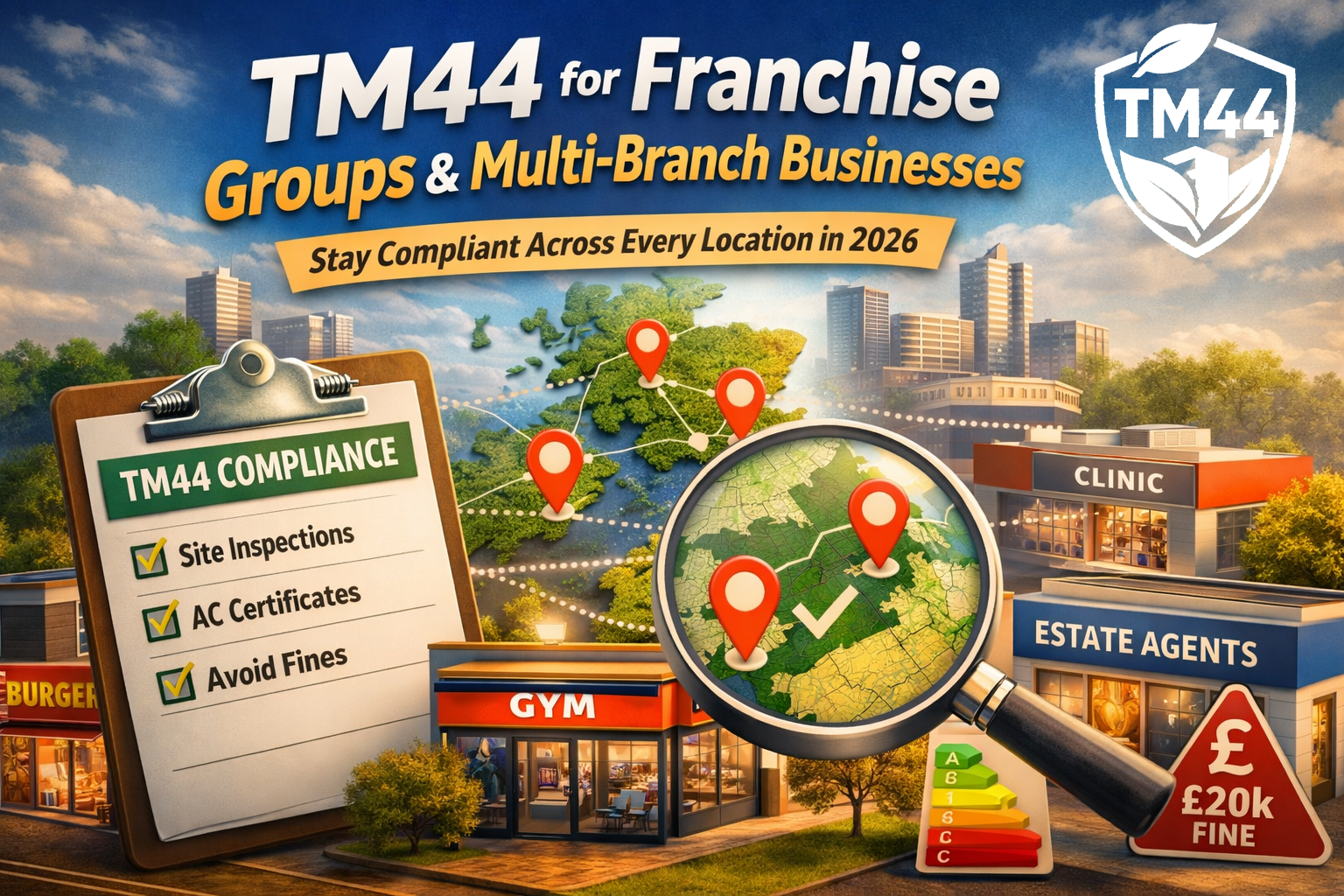
TM44 for Franchise Groups and Multi-Branch Businesses: How to Stay Compliant Across Every Location in 2026
April 7, 2026

Written by
TM44TeamAlfa
Table of Contents
If you run a franchise group, a chain of commercial premises, or a business with multiple branches across the UK, TM44 compliance can get messy fast.
One site may have a neat asset register, a clear maintenance history, and a facilities manager who knows exactly what is installed. Another site might have old split units, missing paperwork, a landlord who thinks the tenant is responsible, and a local manager who has no clue whether the building has ever had a TM44 inspection.
That is where multi-site businesses get caught out.
TM44 is not usually missed because a company is trying to be careless. It gets missed because responsibility is fragmented, data is scattered, and nobody has a single view of the whole portfolio.
For franchise groups and multi-branch operators, that creates a real commercial problem. A single missed site can lead to enforcement risk, internal compliance gaps, delayed transactions, confused contractors, and unnecessary stress. When multiplied across ten, twenty, or fifty locations, it becomes a systems issue, not a one-off admin mistake.
This guide explains how TM44 works for franchise groups and multi-branch businesses, why this area causes so much confusion, where businesses go wrong, and how to build a practical compliance process that works in the real world.
If you are not even sure whether a site needs a TM44 inspection, check our TM44 Checker first:
https://tm44.uk/tm44-checker/
That is the fastest way to start.
Why TM44 becomes more complicated when you have more than one site
A single-site business can usually deal with TM44 in a fairly straightforward way. You check the cooling output, confirm whether the system falls within scope, book the inspection, get the report, and keep it on file.
A multi-branch business is different.
Now you are dealing with:
- different landlords and lease structures
- different ages and types of air conditioning systems
- different maintenance contractors
- different internal managers
- different levels of documentation
- different opening hours and access restrictions
- different regions and cities
- different people assuming someone else has sorted it
This is exactly why portfolio compliance is such a strong commercial issue. The market gap is huge because compliance historically has been low, and large numbers of eligible buildings have simply not kept up with inspections. That creates a real opportunity for businesses that want to get ahead of the problem instead of reacting late.
For franchise groups, the main issue is not usually whether TM44 exists. The issue is operational control.
What TM44 means in simple terms for a franchise or chain business
A TM44 inspection is an air conditioning energy inspection for qualifying non-domestic buildings with systems above the legal threshold. It is designed to assess the energy efficiency of the installed air conditioning systems and provide recommendations on improvement, maintenance, and operation. The inspection cycle is generally every five years for qualifying systems.
In practical terms, that means if your branch, clinic, office, gym, retail unit, restaurant, or commercial site has air conditioning over the threshold, it may need a valid TM44 inspection report.
Now multiply that across your estate.
If you manage:
- ten gyms
- twelve clinics
- twenty retail branches
- eight estate agency offices
- thirty fast-food outlets
- a mixed portfolio of offices and customer-facing branches
you need more than a basic understanding. You need a repeatable process.
The biggest mistake franchise groups make
The biggest mistake is assuming every branch is essentially the same.
They are not.
You might have two sites with identical branding and completely different compliance positions.
One branch may be in a modern retail unit with landlord-managed HVAC.
Another may be in an older converted space with tenant-controlled split systems.
Another may have had systems upgraded after a refit.
Another may have had multiple smaller units added over time, pushing the building over the threshold without anyone noticing.
This is why multi-site compliance should never be based on assumptions.
A head office saying “all our sites are small, so we probably don’t need TM44” is how problems begin.
The right approach is branch-by-branch review.
That does not mean making everything complicated. It means putting structure around the decision.
Which types of franchise and chain businesses are most likely to need TM44?
This is where things get commercially interesting.
Some of the strongest TM44 opportunities sit in sectors with multiple locations and regular customer footfall. These businesses often rely heavily on cooling, comfort, and internal air-conditioned environments.
High-risk sectors include:
Retail chains
Shops, showrooms, convenience chains, branded stores, and retail parks often have cooling systems that push them into scope, especially when multiple internal units or combined systems are involved.
Gyms and fitness studios
These are one of the clearest examples. Comfort cooling matters, occupancy levels are high, and systems often run hard for long hours.
Clinics and private healthcare groups
Dental groups, therapy clinics, private medical practices, diagnostic centres, aesthetic clinics, and health brands often use air conditioning consistently and depend on reliable indoor conditions.
Estate agencies and serviced offices
Individually, some offices may look modest. But once multiple units, separate cassettes, or split systems are counted together, the threshold issue becomes more relevant.
Hospitality and food-led brands
Restaurants, coffee chains, hotel groups, and quick-service outlets can have a mixed mix of front-of-house cooling, back-of-house services, and landlord-tenant responsibility confusion.
Franchise office groups
Large office-based networks, training centres, education providers, and agency groups often forget about TM44 because they do not see themselves as “air conditioning heavy” businesses. That assumption can be wrong.
Who is responsible when the business is a franchise?
This is where the real confusion starts.
A franchise model adds an extra layer because there may be:
- a franchisor brand
- a franchisee operator
- a landlord
- a managing agent
- a facilities company
- a mechanical contractor
- a local site manager
Everyone may be involved, but nobody may be clearly owning TM44.
In real life, responsibility depends on the legal setup and the building arrangement, not just the brand structure.
A franchisor may control branding standards and fit-out guidance but not building compliance.
A franchisee may operate the site but lease terms may place responsibility elsewhere.
A landlord may retain control of central plant while the tenant controls local systems.
A managing agent may coordinate works but not hold the legal duty.
That is why one of the smartest things a franchise group can do is stop treating TM44 as an informal maintenance issue and start treating it as a compliance responsibility map.
For each branch, ask:
- Who controls the system?
- Who benefits from the space?
- Who holds the lease obligations?
- Who arranges maintenance?
- Who keeps the documents?
- Does anyone know whether a valid TM44 report already exists?
If nobody can answer those questions cleanly, the business has a process problem.
Why multi-branch businesses get caught late
Multi-site businesses often get caught in one of five moments:
1. During an internal compliance review
Someone at head office starts checking certificates and realises air conditioning compliance has never been centrally tracked.
2. During a transaction
A site is being sold, leased, refinanced, renewed, handed over, or reviewed and missing compliance documents suddenly become a problem.
3. After a warning or enforcement concern
A business becomes aware of TM44 only after someone raises the issue formally.
4. During maintenance works
An engineer or consultant points out that the building likely needs a valid inspection report.
5. During expansion
A growing franchise adds more sites, realises some older branches have inconsistent documentation, and suddenly needs a portfolio-wide solution.
The issue is rarely the inspection itself. The issue is that the business waits until the compliance gap becomes visible under pressure.
Case study example 1: Regional gym group with twelve sites
A regional gym operator has twelve branches across London, Birmingham, and Manchester.
Head office assumes all sites are maintained because each branch has an HVAC contractor. But maintenance is not the same as TM44 compliance.
When the operations team starts reviewing documents, they find:
- 3 sites have valid reports
- 4 sites have no accessible records
- 2 sites have had AC upgrades since the last known inspection
- 3 site managers do not know what TM44 is
On paper, the brand looks well run. In reality, the compliance position is fragmented.
What should happen next?
A proper portfolio review would:
- identify which branches are in scope
- confirm which reports are valid
- create a branch-by-branch status tracker
- prioritise overdue or unclear sites
- coordinate inspections by region
- centralise all reports in one system
The result is not just compliance. It is control.
Case study example 2: Franchise clinic group with mixed lease terms
A healthcare franchise has nine clinics. Five are leasehold. Two are in serviced medical buildings. Two are owner-occupied.
The problem is not the inspection. The problem is responsibility.
At some sites, the landlord controls the central system.
At others, the clinic has its own split systems.
At one site, additional units were installed during a refurbishment.
At another, a previous tenant left equipment that nobody has properly documented.
The group cannot apply one blanket answer to all sites.
This is where businesses waste time by asking the wrong question:
“Do we need TM44 across the group?”
The better question is:
“Which of our sites need TM44, who is responsible at each one, and what evidence do we already hold?”
That shift in thinking saves time, money, and back-and-forth.
Case study example 3: Retail chain preparing for expansion
A growing retail chain has eighteen branches and is about to open four more.
The leadership team wants to build proper compliance systems before the estate gets bigger. Smart move.
Instead of waiting for problems, they create a TM44 workflow:
- every new site goes through a TM44 check during onboarding
- cooling plant is logged before fit-out sign-off
- lease responsibility is reviewed at acquisition stage
- all reports are stored centrally
- expiry dates are tracked in one place
- annual reviews flag sites that need follow-up
That is how serious operators stay ahead.
The best time to build a portfolio compliance process is before the portfolio becomes chaotic.
The business cost of getting this wrong
A lot of people still treat TM44 like background paperwork. That is the wrong mindset.
For multi-site businesses, getting it wrong creates five types of cost.
Compliance risk
If a qualifying site should have a valid inspection and does not, the business carries avoidable exposure.
Delay cost
Missing paperwork can create delays during property decisions, landlord conversations, audits, and internal approvals.
Operational cost
Teams lose time chasing documents, arguing responsibility, and trying to reconstruct old site histories.
Energy cost
TM44 is not only about legal compliance. It is also about identifying inefficiency, poor controls, maintenance issues, and wasted energy. That matters when you operate across multiple branches. The cumulative waste across a network can be serious.
Reputation cost
Sophisticated landlords, agents, buyers, and corporate partners expect organised businesses to know their compliance position. If you cannot produce a clear answer, it reflects badly on internal controls.
How to manage TM44 properly across multiple branches
Here is the practical framework.
Step 1: Build a live site list
Create one master list of all locations.
Include:
- full address
- branch type
- landlord or ownership status
- whether AC is present
- known system type
- whether documents are available
- current TM44 status
This sounds basic, but loads of businesses skip it.
Step 2: Check if each site is likely in scope
Do not guess. Review each branch properly.
Where there is uncertainty, use our TM44 Checker:
https://tm44.uk/tm44-checker/
It is a simple starting point and helps cut through the confusion quickly.
Step 3: Confirm responsibility
For each branch, identify who is responsible for the system and the compliance process.
If responsibility is unclear, flag it early rather than letting it drift.
Step 4: Centralise documents
All valid TM44 reports, related notes, site records, and follow-up recommendations should be held centrally, not buried in local email inboxes.
Step 5: Prioritise overdue or unknown sites
Do not try to solve everything in a messy rush. Group sites by risk:
- valid
- unclear
- likely overdue
- confirmed overdue
- new acquisition / pending review
Step 6: Roll out by region or business type
For larger portfolios, it often makes sense to batch inspections by geography or sector type.
Step 7: Create renewal visibility
A five-year cycle sounds long until you forget when the last report was done. Track expiry dates before they become urgent.
Why a specialist TM44 provider matters more for franchise and portfolio work
This is where businesses often make the wrong procurement choice.
They focus only on getting “a certificate” for the lowest price.
That can work for a simple one-off site, but it is not the best move for a portfolio or franchise group.
For multi-branch businesses, you want a provider who understands:
- site variation
- portfolio planning
- landlord and tenant confusion
- phased delivery
- regional coverage
- central reporting
- commercial decision-making
You do not just need an assessor. You need a process partner.
That is exactly why we built TM44.uk around practical compliance support for real businesses, not just generic theory.
Relevant services you can explore include:
- TM44 Portfolio Management
https://tm44.uk/tm44-portfolio-management/ - TM44 Air Conditioning Inspections
https://tm44.uk/tm44-air-conditioning-inspections/ - TM44 Certificate & Government Lodgement
https://tm44.uk/tm44-certificate-government-lodgement/ - TM44 Consultant
https://tm44.uk/tm44-consultant/ - Emergency TM44 24–48 Hour Service
https://tm44.uk/emergency-tm44-24-48-hour-service/
If your branches are spread across multiple locations and you need a structured approach, that is exactly the sort of work we help with.
Internal warning signs that your group may already have a TM44 problem
Be honest. If several of these are true, your business probably needs a review.
- No central list of sites with AC systems
- Nobody knows which branches are above the threshold
- Reports are stored locally instead of centrally
- Different branches use different contractors without oversight
- Lease responsibility has never been reviewed site by site
- Branch managers assume head office handles it
- Head office assumes landlords handle it
- Reports cannot be produced quickly when requested
- Expansion has outpaced compliance systems
- Older branches have patchy paperwork
- Refurbishments added cooling but nobody reviewed TM44 implications
These are not rare issues. They are normal in growing groups. The problem is leaving them unresolved for too long.
How this topic helps your wider compliance strategy
One reason this blog topic is powerful is that it sits at the centre of several wider compliance and property decisions.
A serious multi-site business should think about TM44 alongside:
- maintenance standards
- F-Gas checks
- EPC strategy
- energy performance improvement planning
- landlord obligations
- expansion due diligence
- operational risk control
That is why this page naturally connects with your wider TM44 resources.
Useful next-step pages include:
- TM44 Inspection Requirements UK
https://tm44.uk/tm44-inspection-requirements-uk/ - TM44 Regulations UK
https://tm44.uk/tm44-regulations-uk/ - TM44 Legal Requirements for Commercial Buildings
https://tm44.uk/tm44-legal-requirements-commercial-buildings/ - TM44 Inspection Cost UK
https://tm44.uk/tm44-inspection-cost-uk/ - TM44 Enforcement, Fines & Penalties UK
https://tm44.uk/tm44-enforcement-fines-penalties-uk/ - F-Gas Leak Testing & Compliance Checks
https://tm44.uk/f-gas-leak-testing-compliance-checks/ - Energy Efficiency Upgrade Report (Post-TM44)
https://tm44.uk/energy-efficiency-upgrade-report-post-tm44/ - Get a Quote
https://tm44.uk/get-quote/
That internal linking structure is strong because it helps both users and search engines understand that this article is part of a serious compliance cluster, not a random standalone post.
Why this matters in 2026
In 2026, the businesses that win are not the ones scrambling at the last minute. They are the ones building systems.
That is true in sales.
It is true in operations.
It is true in compliance.
Franchise groups and multi-branch businesses do not fail on TM44 because they are small or careless. They fail because complexity grows faster than internal structure.
A few branches becomes a regional footprint.
A regional footprint becomes a national network.
Soon there are different landlords, different contractors, different fit-outs, different site teams, and nobody has a clean picture anymore.
That is why now is the right time to fix it.
If you operate across multiple locations, stop asking:
“Do we think we’re probably covered?”
Start asking:
“Which sites need review, what is our current status, and what is the most efficient way to bring the whole portfolio under control?”
That is the question serious operators ask.
Final word
TM44 for franchise groups and multi-branch businesses is not just another compliance task. It is a portfolio management issue.
Handled badly, it creates confusion, delay, and avoidable exposure.
Handled properly, it gives you control, visibility, and a cleaner operational model across your sites.
If you are unsure whether a site or branch may need a TM44 inspection, start with our TM44 Checker:
https://tm44.uk/tm44-checker/
If you already know you need help managing multiple locations, portfolio compliance, or site-by-site TM44 support, explore our services or request a quote:
- Our Services
https://tm44.uk/our-services/ - TM44 Portfolio Management
https://tm44.uk/tm44-portfolio-management/ - Get Quote
https://tm44.uk/get-quote/
The smart move is not waiting until a problem lands on your desk.
The smart move is getting ahead of it now.
TM44 Checker v9 Pro
Check TM44 compliance status in seconds
Search the official GOV data routes and public register fallback. If a record is missing or unclear, request a manual compliance review from TM44.uk.
Official data routesGOV fallbackCommercial buildings only
Case Studies & Success Stories Energy Efficiency & Cost Savings Guides & How-To Articles Industry News & Updates TM44 Compliance & Regulations
Related Posts
July 16, 2026