July 22, 2026
TM44 for Banks, Building Societies and Financial Offices: AC Compliance for UK Financial Premises
June 12, 2026

Written by
TM44TeamAlfa
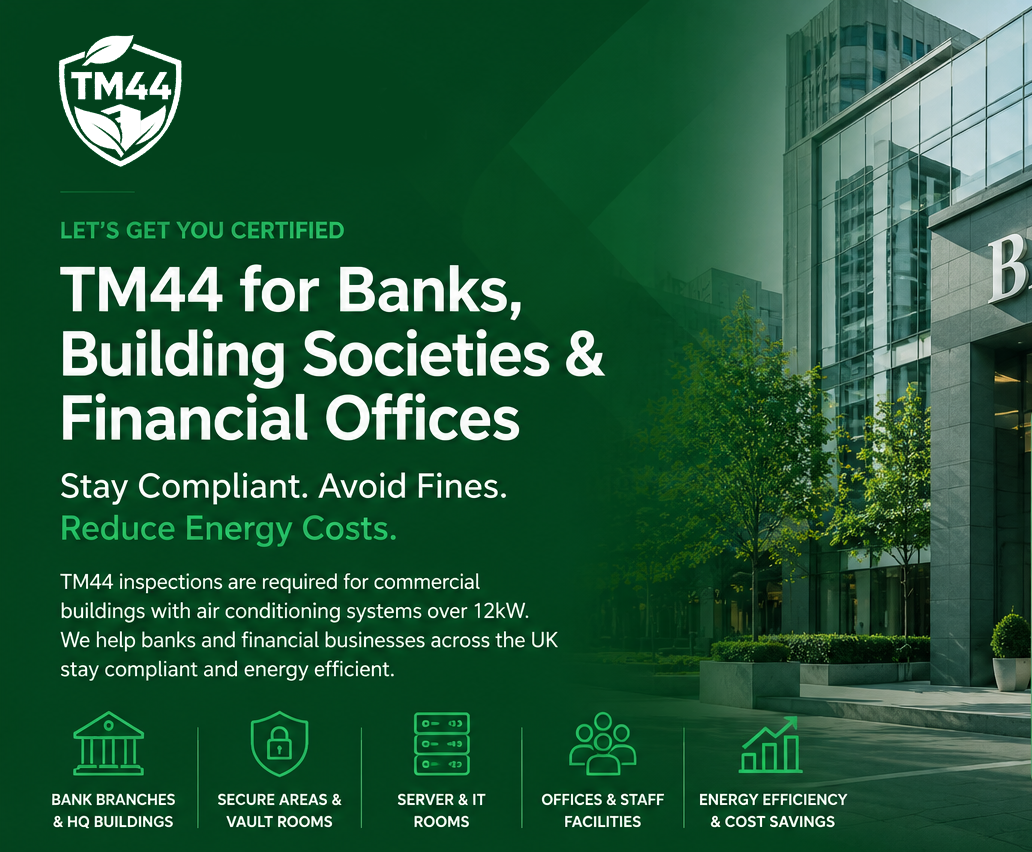
Banks, building societies and financial offices are not always the first buildings people think of when discussing air conditioning compliance. Most people associate TM44 with large offices, shopping centres, hotels, universities or public buildings. However, many financial premises rely heavily on cooling systems every day, especially where customer areas, staff offices, server rooms, secure rooms and meeting spaces need stable temperatures.
This is why TM44 air conditioning inspections matter for banks and financial-sector premises. If the total effective rated cooling output of the air conditioning system is over 12kW, the building may require a valid TM44 inspection. That inspection must usually be repeated at least every 5 years, and the report should be carried out by an accredited air conditioning energy assessor.
For banks, building societies, finance offices, insurance firms, mortgage brokers and wealth management companies, TM44 is more than a technical requirement. It affects compliance records, energy efficiency, operating costs, portfolio risk and property management. A missed inspection can create problems during internal audits, lease renewals, property sales, insurance reviews, landlord checks or facilities management handovers.
At TM44.uk, we help financial businesses, commercial landlords, managing agents and facilities teams arrange accredited TM44 inspections across the UK. Whether you manage a single bank branch, a regional office, a city-centre financial headquarters or a multi-site property portfolio, we can help you understand your responsibilities and get the correct inspection booked.
Why banks and financial offices often need TM44 inspections
A bank branch may look simple from the outside, but the cooling setup can be more complex than expected. A typical high-street branch may have air conditioning serving the customer area, staff office, consultation rooms, cash handling space and small IT room. A larger branch may also have cooling for meeting rooms, waiting areas, back-office spaces and secure areas.
Financial offices can be even more demanding. Many have open-plan office floors, boardrooms, interview rooms, client meeting areas, compliance departments, document storage areas, server rooms and communications rooms. Some of these areas only need cooling during normal working hours. Others, such as IT and comms spaces, may need cooling 24/7.
This is where TM44 becomes important. The requirement is not based only on whether the building has one large air conditioning system. Multiple smaller systems can also count if their combined effective output exceeds the threshold. That means a building with several split units, cassette units, VRF systems or server-room units may fall within scope even if no single unit looks especially large.
If you are unsure whether your premises fall within the rules, it is worth reviewing the TM44 inspection requirements before assuming the building is exempt. Many compliance gaps happen because the site manager, landlord or maintenance contractor assumes the system is too small when the combined capacity has never been properly checked.
Why TM44 compliance is often missed in financial premises
Banks and financial companies are usually very strong on regulation, audit trails, data security and corporate compliance. However, building energy compliance can still fall between departments.
The branch manager may only deal with comfort complaints. The facilities contractor may service the AC units but not handle TM44. The landlord may manage the base-build HVAC system, while the tenant controls extra cooling added later. The compliance team may focus on financial regulation, customer protection, cybersecurity and operational risk, while property compliance sits elsewhere.
This creates a common problem: everyone assumes someone else has dealt with TM44.
The most common reasons TM44 is missed in banks and financial offices include:
• Regular AC servicing is mistaken for a TM44 inspection
• F-Gas records are mistaken for a TM44 certificate
• Tenant-installed cooling is not included in landlord compliance records
• Server-room cooling is overlooked because it is not part of the main comfort cooling system
• Older branch units have no central asset register
• Replacement units are fitted without updating compliance documents
• Multi-site estates have inconsistent records across different branches
• Expired TM44 reports are not picked up until an audit or lease event
• Facilities teams focus on reactive maintenance rather than statutory inspection cycles
• The 12kW threshold is misunderstood
A valid TM44 certificate gives the responsible person clearer evidence that the air conditioning system has been assessed in line with the relevant inspection requirements. Without that evidence, the organisation may struggle to prove its compliance position when asked.
TM44 is not the same as AC maintenance or F-Gas checks
This is one of the biggest misunderstandings in the financial sector. Having a maintenance contractor does not automatically mean the building has a valid TM44 inspection. A maintenance visit normally focuses on keeping equipment working. It may include cleaning filters, checking operation, checking faults, replacing parts or reviewing basic system performance.
F-Gas checks are also different. F-Gas compliance focuses on refrigerant obligations, leak checks and environmental control of fluorinated gases. It is important, but it is not a substitute for TM44.
A TM44 inspection is an energy assessment of the air conditioning system. It looks at efficiency, controls, sizing, operating patterns, maintenance condition and practical improvement recommendations. The final TM44 report should give the building owner, tenant or facilities manager useful information about how the cooling system is performing and where improvements may be possible.
For banks and financial offices, it may make sense to review TM44 and refrigerant obligations together. If your premises also need refrigerant-related support, TM44.uk can connect the compliance conversation with F-Gas leak testing and compliance checks so your air conditioning records are more complete.
Where cooling systems are commonly found in banks and financial offices
Financial premises often have several cooling zones. These zones may have been installed at different times by different contractors, especially in older branches or leased offices.
Common areas include:
• Customer banking halls
• Private consultation rooms
• Mortgage adviser offices
• Staff offices
• Boardrooms and meeting rooms
• Cash handling rooms
• Secure back-office spaces
• Server rooms and IT cupboards
• Communications rooms
• Reception areas
• Trading rooms
• Compliance and administration floors
• Archive and document storage areas
• Staff breakout areas
• Training rooms
This matters because a TM44 inspection should consider the building’s air conditioning system properly, not just the most visible units. Server-room cooling, supplementary split systems and tenant-added units can all affect the compliance picture.
In some cases, financial premises may have cooling that is oversized, poorly controlled or operating for longer than needed. A TM44 inspection does not just help with compliance. It can also highlight where energy is being wasted.
The 5-year rule and why banks should track renewal dates
TM44 inspections are not one-off documents that last forever. Qualifying air conditioning systems normally need inspection at least every 5 years. If your report has expired, the building may need a new assessment.
This is particularly important for banks, building societies and financial companies with multiple sites. A single office may be easy to track. A 40-branch network is much harder. If each branch has different equipment, different lease terms, different maintenance contractors and different report dates, it becomes easy for one or more sites to fall behind.
That is why a portfolio tracker is important. For multi-site operators, TM44 portfolio management can help organise inspection dates, site details, asset information and renewal planning across multiple locations.
For financial businesses, this can reduce last-minute compliance pressure and make it easier to plan inspections around branch operations, staff availability and customer footfall.
Case study example 1: High-street bank branch with small split systems
A high-street bank branch operates from a two-storey commercial property. The ground floor contains the customer banking hall, waiting area and two consultation rooms. The first floor contains staff offices, a meeting room, kitchenette and comms cupboard.
The branch has:
• Two split systems serving the customer area
• One cassette unit serving the staff office
• One small unit serving the meeting room
• One dedicated cooling unit serving the comms cupboard
Individually, the units do not look substantial. The branch manager assumes the site is too small to need TM44. The maintenance contractor visits twice a year, so the property team assumes compliance is covered.
During a property review, the combined cooling capacity is checked and appears to exceed the 12kW threshold. There is no valid TM44 report on file.
The TM44 inspection identifies the installed systems, reviews the available maintenance information and checks the operating arrangements. The assessor notes that the customer area cooling is being left on after closing time and that the comms cupboard cooling is set lower than necessary. The report recommends reviewing timer settings, checking control arrangements and improving the AC asset record.
The result is a clearer compliance position and practical energy-saving opportunities. The branch now has better documentation and a renewal date to track.
Case study example 2: Building society with mixed landlord and tenant systems
A building society leases a ground-floor unit in a mixed-use commercial building. The landlord provides the main system serving part of the unit, but the tenant has added extra split units to cool consultation rooms and a small IT area.
The lease is being renewed, and the landlord asks for updated building compliance information. The building society can provide service records for the tenant units but cannot confirm whether those units were included in the landlord’s TM44 inspection.
This creates a responsibility gap. The landlord has a report for the base-build system, but the tenant’s supplementary units may not be included. The tenant assumed the landlord had covered everything. The landlord assumed tenant-added cooling was the tenant’s responsibility.
A fresh inspection or compliance review helps clarify the installed equipment and who is responsible for each part of the cooling system. This is especially useful before lease renewals, fit-out changes or branch refurbishments.
If your organisation is in this position, TM44.uk can review the available information and advise what is needed before booking the inspection. You can get a TM44 quote by sending the site address, asset list if available and any existing report details.
Case study example 3: Financial headquarters with server rooms and meeting floors
A financial services company occupies several floors in a large office building. The main office floors have comfort cooling. The boardroom suite has separate controls. The IT room has dedicated cooling operating continuously. Additional cooling has been installed in a secure document processing area.
The company has a maintenance contract and strong internal compliance controls, but its TM44 report expired 7 months ago. Nobody noticed because the renewal reminder was sent to a former facilities manager.
During an internal ESG and property compliance review, the expired report is discovered. The company needs an updated inspection quickly because the building is due for a wider lease and energy performance review.
In this situation, speed matters. TM44.uk can help with standard bookings and, where availability allows, emergency TM44 inspections for urgent compliance situations. The inspection can help the business restore its evidence trail, update the building’s AC compliance position and identify energy-saving actions.
Energy waste in financial premises
Energy waste in banks and financial offices is often hidden. Cooling systems may continue running after staff leave. Server rooms may be cooled far more than necessary. Meeting rooms may have comfort cooling active even when rooms are empty. In older branches, controls may be unclear or poorly labelled.
Common energy waste issues include:
• AC running outside business hours
• Poorly set timers
• Cooling and heating working against each other
• Server rooms set unnecessarily cold
• Filters or coils not maintained properly
• Old systems with poor seasonal efficiency
• Staff using local controls inconsistently
• Multiple units serving the same area without coordination
• Doors opening frequently in customer areas
• Poor zoning between public and staff spaces
The purpose of TM44 is not to force expensive upgrades immediately. The report provides recommendations. These may include no-cost or low-cost operational improvements, such as adjusting timers, improving controls, reviewing setpoints or strengthening maintenance records.
For financial premises with multiple branches, even small energy reductions across many sites can become meaningful. One branch saving a small amount each month may not look dramatic. Fifty branches reducing avoidable cooling waste can create a stronger operational benefit.
What information should banks prepare before booking?
A TM44 inspection is easier and more efficient when the right information is available. Before booking, try to gather:
• Full site address
• Company or branch name
• Contact person for access
• AC asset list if available
• Indoor and outdoor unit model numbers
• Cooling capacities if known
• Previous TM44 report if available
• Maintenance records
• F-Gas records if applicable
• Basic operating hours
• Access notes for roof areas, plant rooms or secure areas
• Any landlord or tenant responsibility details
Do not worry if you do not have everything. Many businesses do not have a complete AC asset list. TM44.uk can still guide you on what is needed and help arrange the inspection.
For pricing, the final cost usually depends on the number of systems, building size, complexity, access requirements, location and reporting scope. You can review general guidance on TM44 inspection cost before requesting a tailored quotation.
TM44 certificate government lodgement
A proper TM44 inspection should not just result in an informal document. The report needs to be handled correctly, and the appropriate certificate and lodgement process matters.
For financial organisations, this is important because compliance evidence must be reliable. Internal auditors, property managers, landlords, buyers, tenants or enforcement bodies may need proof that the inspection was completed properly.
TM44.uk supports the inspection process through to TM44 certificate government lodgement, helping ensure the required documentation is dealt with correctly.
This is especially important for businesses with strict governance standards. A report sitting in an inbox is not the same as having a properly completed compliance record.
How TM44.uk supports banks and financial businesses
TM44.uk provides UK-wide support for businesses that need clear, practical and professional air conditioning compliance help. We work with commercial premises of different sizes, from smaller sites with a few AC units to larger buildings and multi-site portfolios.
For banks, building societies and financial offices, we can help with:
• TM44 air conditioning inspections
• TM44 certificate support
• Government lodgement guidance
• Multi-site branch portfolio coordination
• Urgent compliance bookings where available
• Review of available asset information
• Guidance on what documents are needed
• Support for landlords, tenants and managing agents
• Coordination with related AC compliance needs
We understand that financial premises often need minimal disruption. Branches cannot always close for inspections. Secure areas may require supervised access. Server rooms and comms rooms may have access restrictions. Our process is designed to work around practical site requirements while keeping the compliance process clear.
Why financial organisations should not wait
TM44 compliance is easy to delay because air conditioning systems often work quietly in the background. If the building feels comfortable, no one thinks there is a problem. But comfort does not prove compliance.
Waiting until a lease renewal, enforcement letter, property sale or internal audit is risky. It can create unnecessary urgency and may leave the business with limited appointment options.
A better approach is to check now:
• Does the building have air conditioning?
• Is the combined cooling output likely to exceed 12kW?
• Is there a valid TM44 report?
• When does the report expire?
• Are all tenant and landlord systems included?
• Are server rooms and supplementary units accounted for?
• Is the certificate properly lodged?
• Is there a renewal tracker for future compliance?
If the answer is unclear, the building should be reviewed.
Book a TM44 inspection for your bank or financial office
Banks, building societies and financial offices often have more air conditioning compliance risk than they realise. Branch networks, secure areas, server rooms, office floors and customer spaces can all contribute to the 12kW threshold. Regular maintenance is useful, but it does not replace a proper TM44 inspection.
A valid TM44 inspection helps your organisation stay compliant, understand system performance, reduce unnecessary energy waste and maintain better property records.
If you manage a bank branch, building society, finance office, financial headquarters or multi-site portfolio, TM44.uk can help. Send us your site address, available AC asset list and any existing report details, and we will advise the next step.
To start, get a TM44 quote and our team will help you move from uncertainty to a clear compliance position.
TM44 FAQ
TM44 FAQs for Banks, Building Societies and Financial Offices
Clear answers for financial premises, branch networks, office buildings, server rooms and secure areas that may need a TM44 air conditioning inspection.
Do banks and building societies need a TM44 inspection?
Banks and building societies may need a TM44 inspection if the total effective rated output of the air conditioning system is over 12kW. This can include customer areas, staff offices, meeting rooms, secure spaces and IT or comms rooms. The requirement depends on the installed cooling capacity, not the business type alone.
Does the 12kW TM44 rule apply to several small AC units?
Yes. The 12kW threshold can apply where multiple smaller air conditioning units serve the same building and their combined effective output exceeds the threshold. This is common in bank branches and financial offices where split systems have been added gradually across different rooms.
Is regular AC servicing the same as a TM44 inspection?
No. AC servicing helps keep equipment operational, but a TM44 inspection is a separate energy assessment carried out by an accredited assessor. A service sheet, maintenance visit or repair invoice is not the same as a valid TM44 certificate.
Can server-room cooling make a financial office fall under TM44?
Yes. Dedicated cooling for server rooms, comms rooms and IT cupboards can contribute to the total cooling capacity. Financial offices often have systems that run outside normal business hours, so these areas should be included when reviewing whether a TM44 air conditioning inspection is required.
How often do financial premises need a TM44 inspection?
Qualifying air conditioning systems usually need a TM44 inspection at least every 5 years. Banks and financial organisations with several branches should track expiry dates centrally, because different sites may have different inspection dates and different system arrangements.
Who is responsible for TM44 in a leased bank branch?
Responsibility can depend on the lease, the installed systems and whether the landlord or tenant controls the air conditioning. Tenant-added cooling can sometimes be missed if the landlord only manages the base-build system. If responsibility is unclear, the site should be reviewed before assuming it is covered.
Do financial offices need TM44 if the landlord already has a report?
Not always. A landlord report may cover the main building system, but it may not include tenant-installed split units, server-room cooling or supplementary systems. Financial tenants should check whether their specific cooling systems are included in the existing TM44 report.
What information is needed to quote a TM44 inspection for a bank or financial office?
Useful information includes the site address, building type, AC asset list, model numbers, cooling capacities if known, previous TM44 report, maintenance records, access details and any landlord or tenant responsibility notes. If you do not have a full asset list, TM44.uk can still advise what is needed for a quote.
Can TM44.uk help with multiple branches or a financial property portfolio?
Yes. TM44.uk can support single-site inspections and multi-site branch portfolios. Our TM44 portfolio management service helps financial organisations organise inspection requirements, renewal dates and compliance planning across multiple locations.
How can I book a TM44 inspection for a bank, building society or financial office?
You can request a quote by sending the site address, available AC information and any existing report details. TM44.uk can then advise the next step and help arrange an accredited inspection. Start by using the get a TM44 quote page.
Need TM44 compliance for a bank or financial office?
Send us your site details, AC asset list if available, and any existing report information.
Get a TM44 Quote
Case Studies & Success Stories Energy Efficiency & Cost Savings Guides & How-To Articles Industry News & Updates TM44 Compliance & Regulations
Related Posts
July 16, 2026